

Can We Restore Civility?
Co-Founder, Polarization Research Lab
Can We Restore Civility?
Why is society so divided? Can it be fixed? Sean Westwood uses data and behavioral science to explore what it will take to rebuild trust.
00.07
At its core, understanding human behavior gives you leverage over outcomes, individual and collective. Whoever understands why people act, choose, fear, or trust, gains the ability to shape environments, messages, and actions. This makes behavioral awareness one of the most consequential forms of knowledge in any society. The Polarization Research Lab, yes, there is such a thing. Is a collaboration between Dartmouth College, Stanford University, and the University of Pennsylvania. It's a research group and a research hub dedicated to applying science to the study of polarization and democracy. I would say we have a little bit of that in our country these days. Their research focuses on understanding partisan biases, where they originate, how they manifest, and what their limits are. What makes the PRL vital is its nonpartisan rigor. Welcome to our stage
01.01
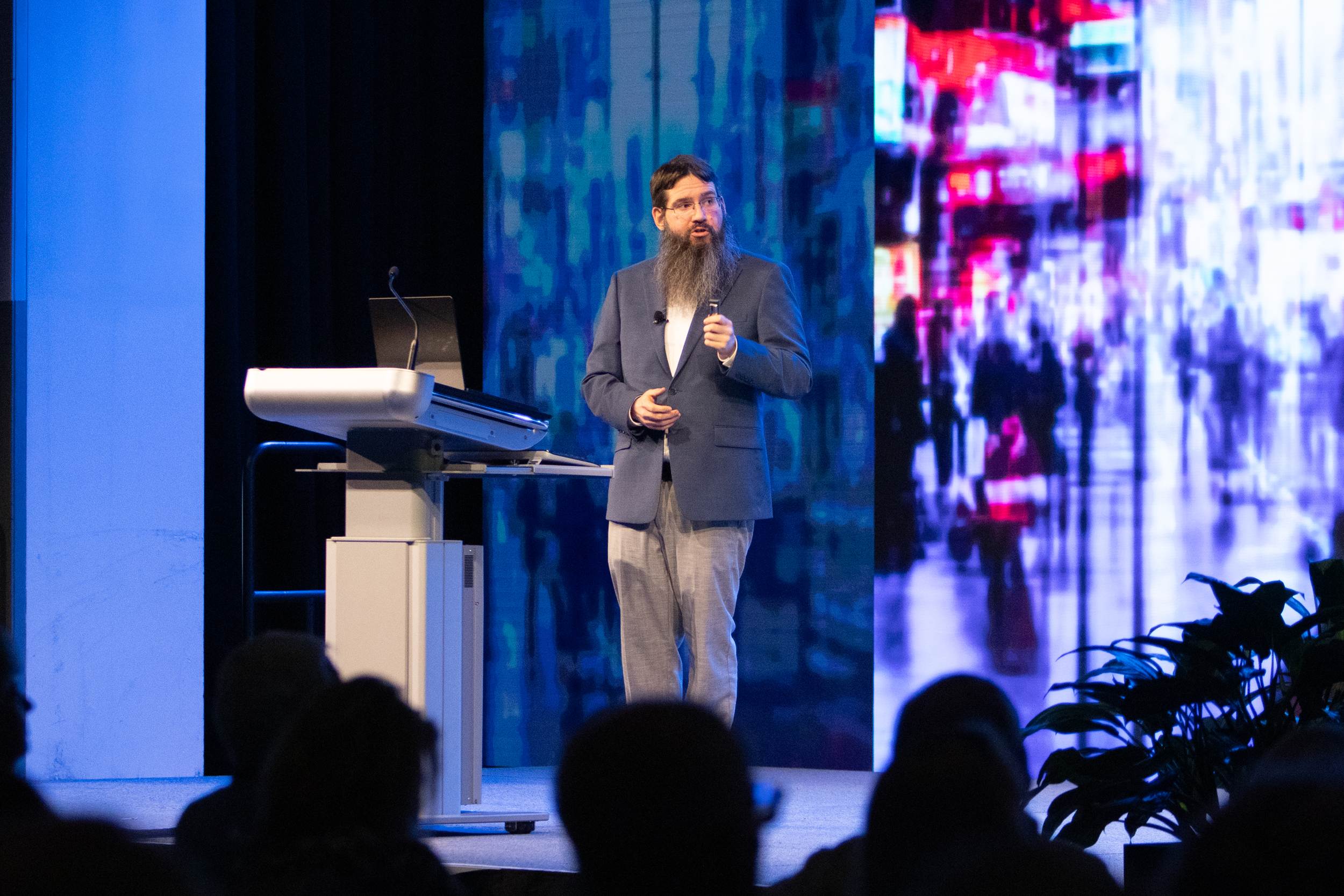
Shawn Westwood, professor in the department of government at Dartmouth and director of the polarization research lab. Sean, welcome. Hi everyone. So, we've had our dose of biotechnology of the humanities. I'm here to talk about the social sciences. I'm an incredibly lucky man. I'm a professor at Dartmouth College and I'm a fellow at the Hoover Institution at Stanford University. I study democratic norms, support for partisan violence, and effective polarization, which is just the extent to which we tend to dislike members of the other party and elevate for rational and sometimes irrational reasons members of our own party. Today, I want to talk about the the miracle that is American democracy. This starts with a hefty dose of pessimism. In 2017, I told the New York Times, I don't think things are going to get better in the short term. I don't think they're going to get better in the
02.00
long term. I think this is the new normal. And without question, American politics is in a really difficult place. But it's tempting to join the doom loop coming particularly from my part of the academy and conclude that the trajectory isn't it was irreversible, that decline is simply where we're headed. However, I have genuine optimism and I want to show you where it comes from. The current information environment does little to build confidence in democracy. As we saw in a talk earlier today, these are some headlines that I just picked randomly from the news. A crisis coming. The twin threats to American democracy. Why democracy is in retreat. The republic is under siege. This is how democracy dies. There's perhaps no better way to demobilize the public than to tell them that democracy no longer exists. We must identify flaws. That's our job as citizens as members of a constructive society. But we cannot abandon critical thought for clicks. These headlines are so persistent they
03.01
become ambient. They're background noise that produces a steady cumulative conviction that things are falling apart. The question that we have to ask though is is this conviction calibrated correctly? The problems are real. That's not deniable. But the scale, the severity, and the sense of inevitability might be wrong. And I think it is. Before I show you the data, though, I I want to talk about a little bit of history. I want to show you that no matter what you think is wrong with America today, the system has survived far worse. And I want to connect our history with data to show you where we really are. So in 1798, just seven years after the Bill of Rights were codified, Congress passed the Alien and Sedition Acts. These are four laws in total. The Alien Acts gave the president unilateral power to deport non-citizens, anyone he deemed dangerous. No trial, no hearing, just unilateral action. The Sedition Act made it a federal crime to publish false,
04.01
scandalous, or malicious statements about the government or the president. And of course, the law allowed the government to define those standards. In in practice, that meant any criticism of the government was outlawed. Newspaper editors were arrested. Benjamin Franklin's grandson was fined and imprisoned for criticism of President Adams. A congressman was jailed for writing a letter critical of the administration. And at least 25 people were prosecuted. Every single one a member of the opposing party. This was not a French effort. It passed Congress. It was signed by the president and it was enforced by the federal courts. The first amendment was seven years old and it was already under direct assault. But this corrected when Jefferson won in 1800. The acts expired. Democracy recovered not because it was perfect, not because it was flawless, but because the mechanisms of accountability, imperfect as they were, functioned. This is the pattern in American democracy. We've always been in crisis.
05.02
The question is how long it takes to correct. We'll return to to more of that history in a moment. But first, how do we know where things actually stand today? This is where my lab comes into play. My interests began at Stanford. As a graduate student, uh I noticed that there was a profound change in political dialogue. Disagreements among my peers were shifting from policy to identity. So, it wasn't I disagree with you because your opinion on taxation is wrong. It's you're a bad person because you're a Republican. Indicting people because of their party, not their ideas. Partisanship in the modern era has become a tribal identity and us versus them. And even for Americans with absolutely no understanding of policy debates, we find that partisanship manifests as a meaningful way of signaling who is good, who is bad, who is like us, who is not like us. At Dartmouth, I built a lab just to measure how bad, how dire things in politics have become. To do this, I
06.01
survey a thousand Americans each week, over 156,000 in total across six countries. And I match this with public opinion data on what our elected officials actually say and do. And this is what I've learned. And it does give optimism, or at least I hope it does. So, I want to start by pointing out an absurd statistic that has been floating around for the last 8 to 10 years. Up to one in four Americans supports political violence. Anyone heard a statistic something like this? It's been floating around in the New York Times, The Atlantic, CNN, MSNBC, you name it. It drove the narrative for years. But if that number were accurate, we would be in serious trouble. But not only is it wrong, but it doesn't correspond to observe reality, right? There's no political war on our streets. We're not in civil conflict. So what does the data actually tell us? If you take a more measured approach, if you take a more robust social scientific approach, you find that the actual number of people who support political violence is about
07.01
2%. It's quite a difference, right? And most importantly, this is an indicator of who says they would support someone else committing political violence. This is not an indicator of who would actually do it themselves. But more to the point, this 2% is not a uniquely political phenomena. My work turns my work shows that this turns out to be just the share of Americans who are violent and aggressive. This is the same portion of the population who will tell you that they would support a fight in a bar or a fight on the street. Political violence is an outlet for people predisposed to violence. It's not a cause of extra violence. Politics is not creating new violent actors. Nevertheless, 2% is not zero and it maps onto a very large proportion of a country of hundreds of millions. But 2% is still a fringe whereas 25% is a movement. They describe very different countries and very different political responses. I think the important thing
08.00
to keep in mind when we think about political violence is that in the 1970s there were literally dozens of bombings. There were race riots. There were political assassinations. things we just don't see today. But let me put this number in even u more fine context. So if we look at data showing us political violence from January 6, 2021, there have been 34 incidents. That is 34 times someone has faced violence because of their political affiliation or because of their political beliefs. But let's like let's look at who these individuals are. These violent people are not trying to start a revolution. 70% of the perpetrators are not registered to vote, right? These are not hardcore partisans. Only a third made any statement explaining their actions. Most had no manifesto. These are not organized or coherent terrorists. More importantly, they're not uh spread across the country. They're geographically
09.00
confined. These are lonely, mentally ill people, many acting out from behind a keyboard in their parents' basement. In comparison, though, in the same time period, the FBI recorded almost 20,000 racial hate crimes and over 6,000 religious hate crimes. Political violence, at least as we observe it, is not a destabilizing force. Anti-semitism is, racism is. But again, let's compare this to what the system has come through. In 1861, as you all know, American democracy actually failed. The country split. Lincoln suspended habius corpus, the constitutional right that prevents the government from holding you without justification or trial. The military was allowed to arrest and detain civilians indefinitely with no judge, no hearing, no legal recourse. But in the long term, the Constitution didn't just survive. It expanded. The Civil War led us to the 13th, 14th, and 15th Amendments. Abolition, equal protection, voting rights came directly out of this failure. So what does self-correction look like today? This
10.02
plot shows what many miss among the general public, support for democratic norms remains very strong. Super majorities of Americans of both parties endorse the norms that preserve democracy. If we zoom in, you can certainly find points where support for democratic norms moves a little bit up or a little bit down, but we regress to a stable mean every time. The advantage of the kind of highfrequency polling I do is that we can distinguish real signal from the noise. And here the signal is stability. It's not perfection, but it's durable equilibrium. The natural question then is, is this conflict, is this crisis we see unique to the United States? Or is it endemic to competitive democracies? Many of you have run global organizations or run global organizations. You work overseas. You pay attention to the news. And there is a prevailing narrative that America is exceptionally broken. Our exceptionalism is our failure. But the comparative data tell a very very different story. There are certainly pressures against democracy across the globe. Uh stay in
11.01
Germany, Le Pen and France, Orban and Hungary. But how do we compare? So on the left is the number of democratic norm violations Americans support. Things like saying elections don't need to be free, that courts can be ignored, that losers don't need to concede. The US is nearly zero. we outperform our peers. Americans endorse fewer norm violations than almost every other democracy we track. On the right is the number of political uh acts of violence that the public will support. Again, the US is at the bottom. We support fewer acts of violence. So, it is the case that partisan hatred is stronger in the United States than it is in many other countries. But the things that actually determine whether a democracy survives, commitment to norms, rejections of violence as a political tool, on those things, we're among the strongest. So that is a dissonance, right? America feels more broken than it is because of polarization, which is very visible. And the loudest signal that we're seeing in the news might not be representative of
12.00
the most important fact about our commitment to democracy. So the current moment is difficult, but democracy has been tested under far worse situations. So stepping back to 1932, we saw a global economic collapse. 25% unemployment, banks failing across the country. Across the Atlantic, democracy was collapsing. Germany was taken by Hitler. Italy was under Mussolini. Spain was headed to civil war. The United States, under the same pressures, held a free election. The incumbent President Hoover lost. Roosevelt won. And and power transferred peacefully. That was not inevitable. It was a choice by our institutions, by our leaders, and by our citizens to commit to democracy even when the outcome was uncertain. One year later, a group of Wall Street executives concluded that democracy in electing Roosevelt had made a mistake. They recruited Major General Smemedley Butler, the most decorated Marine to that point in American history to lead a supposed army of 500,000 veterans in a
13.01
march on the White House. The objective to overthrow Roosevelt and install a fascist style government. They had tens of millions of dollars and had studied Mussolini's playbook playbook in preparation. Butler refused and he testified before Congress. The failure here is that nobody went to prison. But the coup itself did not happen. One person with integrity broke the conspiracy. The lesson here is that when powerful people lose faith in the system, they become susceptible to a dangerous idea. that rules should only apply when you're winning. Those threats came from outside the legislature. The worry today is that the rot is within Congress itself. So we measured that to understand how our elected officials magnify conflict. We've classified 7 and a half million congressional statements. So their tweets, their press releases, their floor speeches, their newsletters using AI to identify when politicians are doing the normatively important work of disagreeing on policy. So positivity isn't the goal, it's constructive
14.01
negativity or when they're using divisive language to make personal attacks just to get attention on cable news and social media. So this is showing you the distribution of personal attack rates for our current Congress. The vast majority of legislators never make a personal attack. They never cross that rhetorical line. They do committee work. They negotiate. They compromise. This is work that is so fundamentally boring. You never hear from them until they're calling you asking for a campaign contribution. But there is a small right tale of members, right? There are individuals who have built a brand around aggression and disrespect and they're the ones who dominate cable news. They're the ones who dominate social media. They shape the perception of what Congress is. But in reality, they're the exception. That matters because when you convince and conclude when you convince the people to conclude that everyone in Washington is a provocator they disengage and when serious people disengage the pro provocators win by default.
15.01
If you think this was unprecedented though uh you know a loud minority distorting the perception of the whole it isn't. The rhetoric that we've seen the rhetoric we've seen has been much much worse. So, I want to take you back in time. In 1800, a prominent newspaper framed the presidential election as a choice between God and a religious president or Jefferson and no God. They predicted Jefferson's election would lead to murder, robbery, rape, adultery, and that incest will openly be taught and practiced. In response, Adams in an official campaign document called uh was called a hideous hemaphroditical character which has neither the force and firmness of a man nor the gentleness and sensibility of a woman. In 1828, the debate was just as fraught. A newspaper called Jackson's mother a common prostitute in all caps. In response, Adams was called a pimp.
16.01
In both cases, the public survived. In fact, what's remarkable is that Adams and Jefferson reconciled and they corresponded for 14 years until they died on the same day, July 4th, 1826, the 50th anniversary of the Declaration. So, our political rhetoric has always been vicious. It's always been divisive. But what has changed is our memory of it. We romanticize a past of civility that just never existed. One more example of the system facing pressure period surrounding World War II. Roosevelt, again, one of the most beloved presidents in American history, a man who won 46 of 48 states, decided that he was going to pack the Supreme Court, add justices until they ruled in his favor in support of his social programs. Congress refused, his own party refused, institutions held, and then he imprisoned 120,000 Americans in camps because their Japanese ancestry. The threat to democracy here did not come from a fringe. It came from the
17.00
center, from a president with overwhelming public support. And the system still corrected. So where does this leave us? The problems are real. Polarization is real. A small minority endorse violence. Some legislators are genuinely corrosive. And we have a president who is honestly very divisive. But the problems that we experience today are smaller, more concentrated, and more tractable than the narrative suggests. 2% is not 25%. A flat trend line is not a death spiral. In 2017, I said that things would not get better. Data and history have changed my mind. The question is what to do with that. You are America's leaders. I have three requests of you. First, be skeptical of the doom narrative. Not because the problems we face aren't real. They certainly are. But because doom produces bad decisions. Second, consider who you engage with. When you take meetings with provocators, you're taking meetings with people who are prominent because of their divisiveness, and you're reinforcing the incentive structure that
18.01
produces them. Thirdly, model disagreement in your workplace. Keep politics out of the workplace. You employ people who voted for different candidates and who disagree about the direction of the country, but there is no reason that their opinions should taint innovation or success. So 250 years, contested elections, bitter divisions, sedition acts, civil war, degression, world wars, court packing, internment camps, assassinations, and impeachments. Laws passed to restrict civil rights and presidents acting unilaterally to take them uh to take them on. And yet here we are still arguing, still voting, still holding together. This is the product of a system designed to bend without breaking and to successive generations who decided the system was worth defending. And I want to be transparent. I work at a university and universities are a part of the problem that we face. Higher education has one essential job to prepare young people for the world they're going to inhabit. And we have to
19.01
be honest, we've not done the best job of doing that. We have allowed ideology to crowd out intellectual rigor. We let ideological conformity pass for consensus. The public has noticed this, that our faculty are out of step and that we're not aligned with most America of America and that our prices have surged beyond reach, beyond affordability, and in many instances beyond reason. As a consequence, the public and their trust in American universities has collapsed. And that's our own fault. But I want to say that at Dartmouth, we're correcting course. We're returning to merit as the basis for admissions and for hiring. We're equipping students to engage across lines of difference. Not to avoid disagreement, that's an easy out, but to conduct it constructively and with genuine intellectual curiosity. We're committed to building genuine viewpoint diversity, not as a talking point, but as institutional practice. If universities can rebuild trust and restore our place in society, we become part of the self-correction that has
20.01
kept democracy running for 250 years. If we can't, we become part of the problem. We contribute to doom. But I'm really bullish on America for all her faults. I'm the most pessimistic person in the world. If I won the lotto, I'd complain about the taxes I had to pay. But I'm still optimistic about America, and I encourage you to be as well. Thank you. Wait for just a second. It's It's really nice to meet the most pessimistic person in the world. I'll I'll take that honor with pride. You'll take that honor. So you you said that one of the things Dartmouth is doing is trying to restore viewpoint diversity. Yes. Would you say that that was a real problem at uh Dartmouth? There was not viewpoint diversity and how did it manifest itself? So I don't want to pick on Dartmouth. I think that it's endemic in all institutions of higher education, especially the Ivy Leagues. And I think what happened is that we came to a point where we were hiring not because of ideas, but because of ideology, because of how you would vote in the voting
21.00
booth rather than what you would say in the classroom. The thing that's changed, I think, is that the public has noticed that. They've noticed that we're selling a bill of ill goods, and we're a little late to noticing the problem, but we're trying to fix it. Were the faculty hiring Were the faculty hiring people who were like them or who were likeminded because that made them comfortable, not uncomfortable. Yeah, absolutely. It is the case that we have a monoculture. In a lot of departments, there is one political party. If a line I like is that if you were to put AOC in a lot of college departments, she would be a moderate, right? Academia has academia has endorsed a single ideological viewpoint. That's not true in every department. It's not true in government departments or econ departments, but it is true in some of the humanities. But the humanities are important to save. And the way that we do that is we say, "We're going to continue moving forward. We're going to keep your discipline in place, but we want you to hire based on creativity, based on originality, based on ideas. Sean, thank you so much. Appreciate it.
22.01
Sean Westwood.
About the Speakers
Watch more videos on this Topic

Imagine Solutions and the 501(c)(3) Searching for Solutions Institute were founded in 2008 with the mission to bring leading-edge speakers and thinkers to engaged audiences of change-makers, addressing matters of societal importance related to science, medicine and healthcare, business, social entrepreneurship, nonprofit, social sciences, the arts, conservation and the environment, exploration and discovery, and more, and the vision of generating real conversations and the space for impact, influence, and connection.