

Breaking the Bad News Bubble
Founder, Fix The News
Breaking the Bad News Bubble
Is the world really getting worse? Angus Hervey challenges the narrative with data-driven stories of global progress offering a clearer, more hopeful view of the future.
00.07
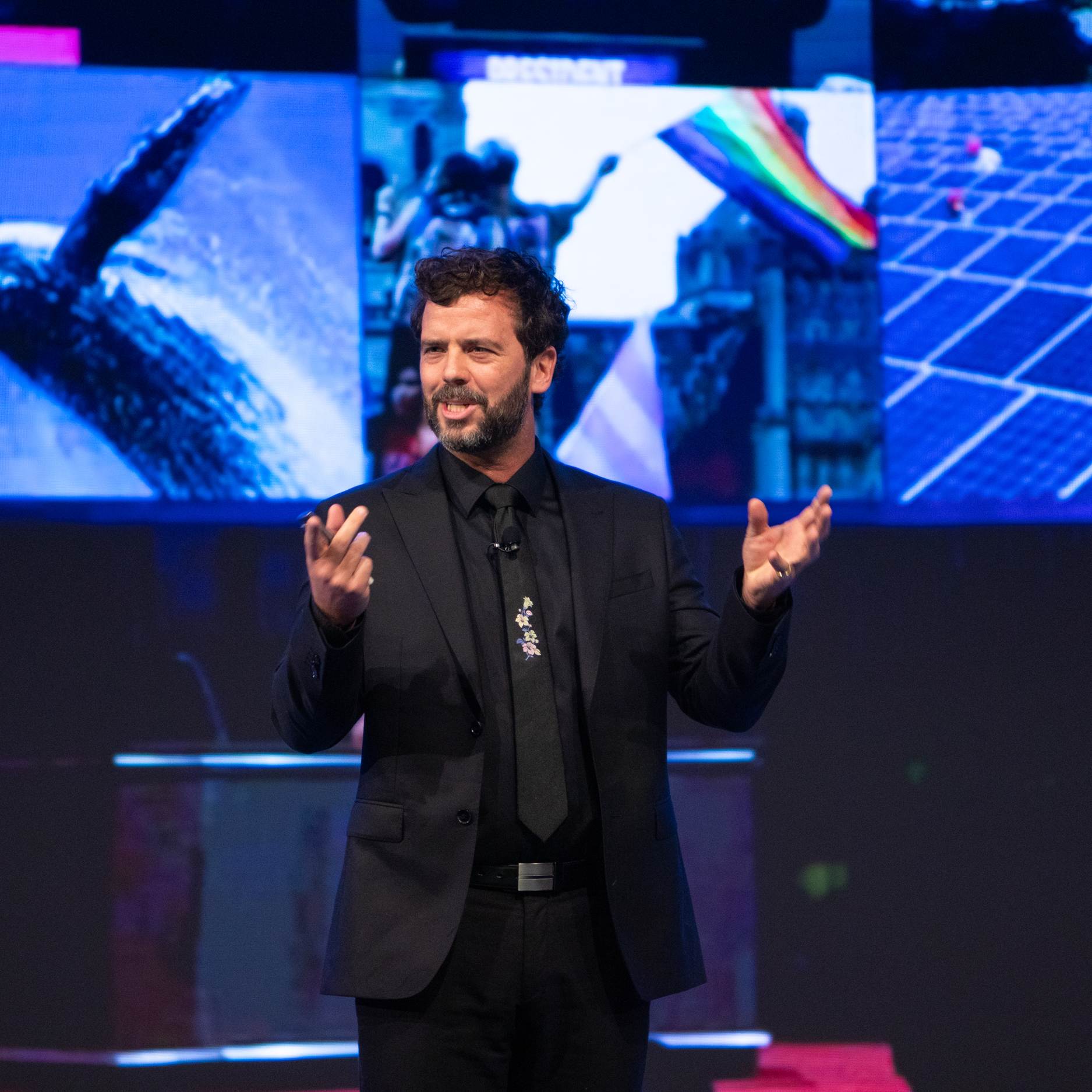
Angus Herby is a trained political economist with a PhD from the London School of Economics. But today he practices a kind of journalism with a twist. He's the founder of Fix the News, a digital platform showcasing what's widely called solutions journalism. And what is that? Well, it's the antidote to the frequent doom and gloom negativity one so often finds in today's conventional journalism. It's hard to avoid it. Fix the News aims to meet the massive demand Hervey sees for rigorous evidence-based reporting on human achievement. Everything from public health breakthroughs to climate and energy solutions. Here to tell us more about journalism that informs about solutions and not just about problems is Angus Hervey. Please welcome Angus.
01.10
This is a bacterium. It's called chlamydia tracomatus. It's really small. You could fit 500,000 of these things on the tip of a sewing needle. And it's super infectious. In one form, it causes chlamyia, which is the most common sexually transmitted infection on Earth. This is a bacteria that goes after our mucosal membranes, the kind of the wet exposed tissue in the human body, genitals, throat, eyes. But in another form, it causes a disease you haven't heard about called traoma. And traoma is a lesson in how much damage time can do. Young children get it first. Their eyes get itchy and red and they rub, passing it between them through fingers and flies. It's a
02.00
disease of poverty. In places without running water, it passes quickly and easily. This goes on for years, infection after infection, each one leaving a little more scar tissue on the eyelid until eventually the eyelid contracts and the eyelashes bend inwards. At first, just one or two. You can pluck them out with tweezers, but they grow black back thicker within weeks. Each time you shut your eyes, the lashes scrape against your cornea. The pain is horrific. Blinking becomes agony. You can't close your eyes because it hurts too much. Sleeping becomes impossible. It's described as like having glass shards inside your eyeballs. So, people get desperate. They tie string around their eyelashes to keep them away or they burn them off with hot ash. Some people cut notches in their eyelids with blades to fold the skin back. Eventually, over years, the cornea
03.00
becomes so damaged that it clouds over and you go blind. But the lashes keep scraping even after the world goes dark. Tacoma is ancient. We found traces of it in skulls going back to the Ice Age. The Ebis Papyrus, which is three and a half thousand years old, contains a suggested treatment which is take out your eyelashes and then apply lizards blood. St. Francis of Aisi had traoma. He was blind from it when he died in the 13th century. In the 1800s, it was rampant in North America and Europe. Charles Dickens based one of his novels of a school where the boys went blind from it. At Ellis Island in New York, immigration inspectors would check for it with a button hook. They'd flip up your eyelid. If you had draoma, you were deported instantly. But by the 20th century, the disease had vanished from the west. A side effect not of medicine, but of prosperity. running water, sewage systems, indoor plumbing. It retreated to the
04.01
world's poorest places where it remains today the most common infectious cause of blindness on the planet. a plague that has been with us since the pyramids or or at least it was because in 2025 Egypt eliminated traoma after 4,000 years and it wasn't alone. Seven countries have eliminated traoma in the last 12 months. The most recent was Libya which eliminated it two weeks ago. A generation ago, one and a half billion people, a quarter of humanity was at risk of exposure. Today, that number has come down by 94% down to 97 million. That is one of the best things I have ever heard of. One of the most inspiring things happening on planet Earth today. And yet, not a single major news
05.01
organization has written or published or reported anything about Traoma in the last two years. I'm a solutions journalist. I make a living by finding and sharing stories of progress. While most people look at their news feeds, my job is to watch the telemetry. Let me explain what I mean by that. When something goes wrong on a space mission, the world watches the visual broadcast. Uh they see the feed from the cameras. They see the explosion, the twisted metal, the cloud of debris. But at mission control, they're not watching what's on the main screen. They're watching the numbers. Fuel reserves, uh, trajectory gif, uh, oxygen levels, the systems that determine the underlying health of the mission, and whether that crisis is survivable. World news is a little bit like that.
06.00
Unless you have been hiding under a rock, you will know that right now the visual feed looks terrible. You only have to pick up your phone to figure out that there is a very big cloud of debris. Ukraine, Sudan, another war in the Middle East that none of us want. Uh populism, corruption, chaos, protests, uh the end of the international rules-based order. As Mark Carney said at Davos this year, we're not going back. We are in the midst of a rupture, not a transition. Today, I don't want to dismiss any of that. Instead, what I would like to do is share with you a few of the things that I'm seeing in the telemetry, a few of those stories like Draoma that are taking place off camera. Let's uh start with what I think is one of the strongest signals, the Gallup World Poll. This is the largest survey in the world. Every year Gallup goes to 142 countries and in each of those countries they ask a thousand people how
07.00
life is going and in the most recent edition 33% of people said that they were thriving. That is the highest proportion ever recorded. The number of people the proportion of people saying that they are suffering fell to 7%. That is the lowest level ever recorded. Now you might expect numbers like this to feature prominently in coverage about the state of the world. They don't. In the same survey, a record four and five people said that they were satisfied with their personal freedoms and three and four people said that their countries were good places for children to learn and to grow. Economic optimism has rebounded to its highest level since just before the financial crisis. For most people in most places, life is getting slowly but steadily better. Part of the reason is that the global economy has proven remarkably resilient. Last year, the IMF said that growth was 3.3% essentially unchanged from the year before. Global trade grew to $35
08.00
trillion. That's up 7%. The collapse that everyone has been predicting just hasn't materialized. And the death of globalization uh rumors about that appear to be uh a little bit premature. Most importantly, the World Bank said that four in five countries reduced poverty in 2025. That is the highest proportion in over a decade. That's why most people say life is getting better. To take just example, Mexico for the first time in its history is now a middle-ass country. More people are now categorized as middle class than as living in poverty. In fact, Mexico has pulled an astonishing 12 million people out of poverty since 2018. But when was the last time you heard a story about Mexico that didn't involve drugs, immigration, or cartels? Since 2019, India has expanded rural tap water access from 17% of the population
09.03
to 81%. What that means in practical terms is that over half a billion people, that is more than the combined population of the United States and North America, have received access to clean running water in the last six years. It's the largest and fastest sanitation drive in human history. But I promise you won't find anything about it in the international section of the New York Times. And I can tell you that because I keep on looking. Another reason that people say life is getting better is because they're just getting less sick. Humanity's toll of illness and early death is almost 13% lower than it was in 2010. And that includes a period where we had a once in a century global pandemic. This is according to the latest global burden of disease report published last year. Death rates from tuberculosis, the world's deadliest infectious disease, have fallen by around 40% in that time. Deaths from lower respiratory infections are down by around a quarter. Diarrheal diseases kill roughly half as many
10.01
children as they did in 2010. Deaths from HIV AIDS have dropped by around 40%. In fact, a record 17 countries eliminated a disease in 2025, which is the most ever in a single year. And the Lancet announced that for the first time in our species history, the dominant global health threat is no longer an infectious disease. It's lifestyle illness, diabetes, heart disease, cancer, diseases of living longer, eating more, moving less. That is a civilizational milestone. We just crossed it and nobody noticed. And there is hope there, too. Global cancer death rates adjusted for age have fallen by more than 20% in the last three decades, even as populations have grown and aged. In the United States, seven in 10 people now survive their cancer for 5 years or more. In the 1970s, children who are diagnosed with leukemia had a 10% survival rate. Today, that is over 85%.
11.01
And speaking of children, more than 500 million kids around the world, students now receive free school meals. That's about a third of the world's school children. It's up from 400 million in 2020. It means that in the last 5 years, an extra 100 million children are now getting fed at school. And we know that when kids get fed, they learn better. Their families worry less. In the last 12 months, Bolivia ban child, Bolivia, uh, Bhutan, Bikina, Fasa, Portugal, and Colombia all raised the legal age of marriage to 18. Q8 outlawed honor killings. Kazakhstan banned, uh, bride kidnapping. Uh, Norway, France, and Italy all made sex without consent uh, a a action that would count as rape. And Zimbabwe abolished the death penalty, which are all human rights victories you probably
12.00
didn't see in your newsfeed. Here is another one. Last year, the United States recorded its lowest murder rate in history. New York City recorded its lowest number of shootings ever. As the city's new mayor, Zoran Mandani, put it, "Each of those percentage points adds up to a dining room tables that don't have an empty seat. Lives freed from the dark cloud of grief. children that grow up with a parent at home. In fact, the United States is also not alone. Murder rates have come down on every single continent in this century. Even in places like South and Central America, in Brazil, the murder rate is down by 25% since 2020. In Mexico, under President Shinabum, murders have come down by 37%. Global homicide rate is now at a record low, falling by 25% since 2000. And according to Gallup, 73% of people worldwide say they feel safe walking alone at night, which is the highest proportion ever recorded. In a strange twist of fate, we are
13.01
living through the safest time in human history. Yet somehow, we have convinced ourselves that it's the most dangerous. Look, I hope I don't sound like some kind of bloodless bureaucrat here. I'm old enough and ugly enough to know that you can't fact check someone out of a feeling. And I know that for hundreds of millions of people, the world feels like a terrible place right now. If you are a parent who just lost a child in an air strike in Iran or a young girl in Afghanistan, or you're a single mom in Delaware struggling to pay the rent or a cobalt miner in the DRC, the world does not feel like a good place. The telemetry is meaningless. But I also think that we're giving a little too much attention and airtime to the collapse merchants. We keep on hearing these days that fascism is imminent, that the kids are doomed, that democracy is dying, and that climate change will be the end of civilization as we know it. But the
14.00
thing is that the people saying that stuff are saying it from positions of extraordinary privilege and relative comfort. They're being lazy. Cynicism is a shortcut to sounding smart. It sounds sophisticated. Doom is just kind of it's sexy. You know, it's dramatically satisfying in ways that incremental progress just never will be. It's much easier to predict the end of the world than it is to wrestle with the truth, which is that some things are genuinely scary, some things are going surprisingly well, and most of it's just really complicated. That truth though is increasingly difficult to see because something structural has changed in the way we produce journalism and in how we produce and consume news. We live for better or for worse in a digital economy with an everexpanding universe of products and companies that are selling them. But there are only so many of us and we only have so many hours in the day. There is
15.02
limited attention. In the language of economics, attention is a scarce or finite resource. And what that means is that our attention, my attention, your attention, our collective attention is increasingly valuable. There is a reason that we say we pay attention. There's a cost involved. And what the news companies know is that the best way to make you pay attention, a technique as old and as tested and tried and true as storytelling itself, is to tell you a tale of death, disaster, or division. The data bears this out. In a massive study of 23 million headlines from 47 of the world's biggest news outlets, researchers found that negativity has dramatically increased in the 21st century. Headlines denoting fear have almost doubled and headlines denoting anger have tripled in that time span. You can see here that things really kind of accelerate after 2010, which is of
16.02
course the advent of the era of social media. There is something about social media that seems to turbocharge these trends. And what we know today is that social media is now where most people get their news. It doesn't arrive through a newspaper or a television. It arrives on their phone. And what the platforms that run these social media uh and what the companies that run these social media platforms know is that you are almost twice as likely to click on a story or to share one or or to linger on it that is negative rather than a story that is neutral or positive. The incentives reward negativity. And what we also know is that the most extreme sources share the most negative content. And so everyone is kind of trapped in this race to the bottom. Forget the left versus the right filter bubbles. The worst filter bubble in the world today is the bad news bubble. And we're all stuck in it. We have created
17.03
the most powerful information system ever known. And it's a misery machine. What that means is that if you want to understand what's happening in the world, you can't rely on the headlines. You have to be able to understand or follow the trend lines too. And I think nowhere is that more true than when it comes to climate change. Now we have been told that climate change is a global story. But climate is not a global story. If you go back to the Paris in 2016 and you strip China out of the equation, then what you can see is that global carbon emissions have essentially flatlined in that time. The arises from developing countries have been more or less offset by declines from the rich countries. But during that same time, China has added the equivalent of five Germanies to the global carbon emissions ledger. And there is nothing that any country could have said or done in that
18.01
time period that would have made an iota of difference. Now though, something has shifted. China's emissions have been flat or falling for 21 months. Not because of an economic slowdown, but because the structure of its energy system is transforming. Last year, clean energy drove more than a third of China's GDP growth. They are now installing so much wind and solar and batteries that not only is it meeting all new power demand, it's eating into fossil fuel demand. Solar output grew 43% in a single year. Clean power uh met that they installed more solar in a single month than Germany installed in its entire history. Coal generation is falling in China. China's not doing this out of climate morality or because they suddenly developed a conscience. They're doing it because they know that wind, solar, and batteries are the most effective tool for economic growth and energy security in human history. And China is not alone. India, the third largest carbon emitter
19.03
in the world. Power sector emissions came down last year as well. In Pakistan, over a third of electricity is now generated by solar. That's up from zero six years ago. In Africa, solar imports rose 60%. And here in the United States, despite a federal government that is actively hostile to clean energy, 96% of net new electricity generation installed last year was clean wind, solar, and batteries. This year, according to the EIA, once you take retirements into account, 100% of new energy capacity added to the grid will be wind, solar, and batteries. A decade ago, the politics was in favor of an energy transition, but the economics wasn't. Today, the politics are stuck, but the economics have never been better, and the economics are going to win. My favorite New York Times journalist is David Wallace Wells and in his most recent column, he pointed out that this
20.02
year the world will likely spend more on green energy than it devotes to military spending. When the Paris Agreement was signed a decade ago, projections showed us heading to four degrees of warming, which is a hell hole. Today, those projections have come down to 2.7 degrees C. It's still way too high. But every tenth of a degree that we shave off that means fewer floods, fewer famines, fewer people forced from their homes. It's not a reason to relax. It's a reason to keep going. We've already brought it down by more than a degree. We can close it even further. And the people who do that will be the technologists and inventors and engineers and investors who believe in the future, not the cynics who keep telling us that we're all doomed. This is the same pattern. You can see it playing out when it comes to the natural world as well. A lot of the stories that should be front page news are invisible. The Sega antelope has been roaming the central Asian step since the ice age. In the early 2000s, its population crashed
21.00
to less than 30,000. Today, there's over 4 million thanks to the intervention of conservationists. The Arabian orics, previously extinct in the wild, has been restored through breeding programs and is now thriving in the Middle East. Green sea turtles were recently taken off the endangered list. Tiger numbers in India have doubled in the last 15 years. Last year, French Polynesia created a marine protected area the size of Europe. And this year, a global treaty entered into force allowing countries to create large marine protected areas in the twothirds of the world's ocean that lie beyond national jurisdictions. Oh, and deforestation in Brazil just hit its lowest level in a decade. Brazil's environmental minister, Marina Silva, says that if current trends continue, this year will see the lowest level of deforestation in the Amazon since records began. This is just the tip of the iceberg. By the way, last year, our organization, Fix the News, shared almost a thousand
22.01
stories about conservation victories like this. New protected areas, species returning, animal cruelty declining, huge swades of land being restored and rewed. I used to find the silence around those stories really frustrating. I used to find it infuriating. But these days, I think I find it clarifying. You see, I first started tracking these kinds of stories because I wanted to prove that the world was getting better. But I was naive. You can't prove something like that. The world's just too big and too complicated for simple binaries. Then I thought, okay, I'm going to expose the people behind this. you know, the ones who are responsible for making us all miserable. The the the ones pushing all the bad news. What I learned though is that no one's actually in charge. It's another problem with growing older and uglier. There's no villain. There's no evil genius in a boardroom deciding what does or doesn't get reported. The system isn't run by anyone. It's the
23.02
result of billions of individual choices made over decades by editors chasing clicks, coders optimizing for engagement, audiences rewarding outrage. It is not malicious, it's emergent. And so these days, I do this work simply to pay tribute to the millions of people who make it happen. The health workers in Egypt who eliminated traoma by distributing antibiotics and teaching kids how to wash their faces. The activists who spent years fighting to overturn child marriage in Bolivia. The forest monitors in the Amazon who prevented the fires from getting out of control. The technicians in China who installed 230 million solar panels in a single month. The scientists who ran malaria trial malaria vaccine trials in Africa for years. the police officers and community workers and violence interrupters in New York who did the hard yards block by block year after year. Egypt didn't eliminate traoma
24.01
because of some natural law of progress. The United States didn't cut murder rates to all-time lows because of historical inevitability. The Amazon isn't recovering because of luck. People did all of that. And you know what? They will keep on doing it regardless of what happens now in the Middle East. Regardless of what's trending on Tik Tok or who wins the midterms this year or what gets decided the next big UN climate summit, progress is not a moral arc. It doesn't just happen. It's a choice made by millions of people who will never get any credit, who will never see their names appear in the news. But it's all there. It's all in the telemetry. And once you learn how to see that, I promise the world will never look the same way again.
25.02
Quick question before you go. One of your slides, I believe, said that that something like 37% of people get their news uh principal source is Tik Tok. Was that was that right? Depends on the generation. Depends on the generation. But for this audience, how would you advise this audience to find identify a news source they can actually trust? In other words, that is accurate. Look, I think I think one of the problems with polarization, one of the many problems with polarization is obviously that trust has become a scarce resource as well. to my mind the big legacy media organizations for all their faults they make a really big effort for fact-checking um you know they're pretty rigorous I've I've been behind the scenes for some of those organizations you know the New York Times the Washington Post the the LA Times for all their faults they still are dedicated to
26.00
rigorous fact-checking obviously their opinion columnists you may or may not agree with them and obviously their decisions on what to cover and what not to cover make a difference as well what about the BBC BBC same thing. You know, I think there is a lot of noise these days around bias and, you know, who is or isn't leaving out information, but those big legacy media organizations really are still dedicated to trying to uncover some version of the truth. But on social media, they don't have the same incentives. Thank you, sir. Thanks for Angus RV.
About the Speakers
Watch more videos on this Topic




Imagine Solutions and the 501(c)(3) Searching for Solutions Institute were founded in 2008 with the mission to bring leading-edge speakers and thinkers to engaged audiences of change-makers, addressing matters of societal importance related to science, medicine and healthcare, business, social entrepreneurship, nonprofit, social sciences, the arts, conservation and the environment, exploration and discovery, and more, and the vision of generating real conversations and the space for impact, influence, and connection.