
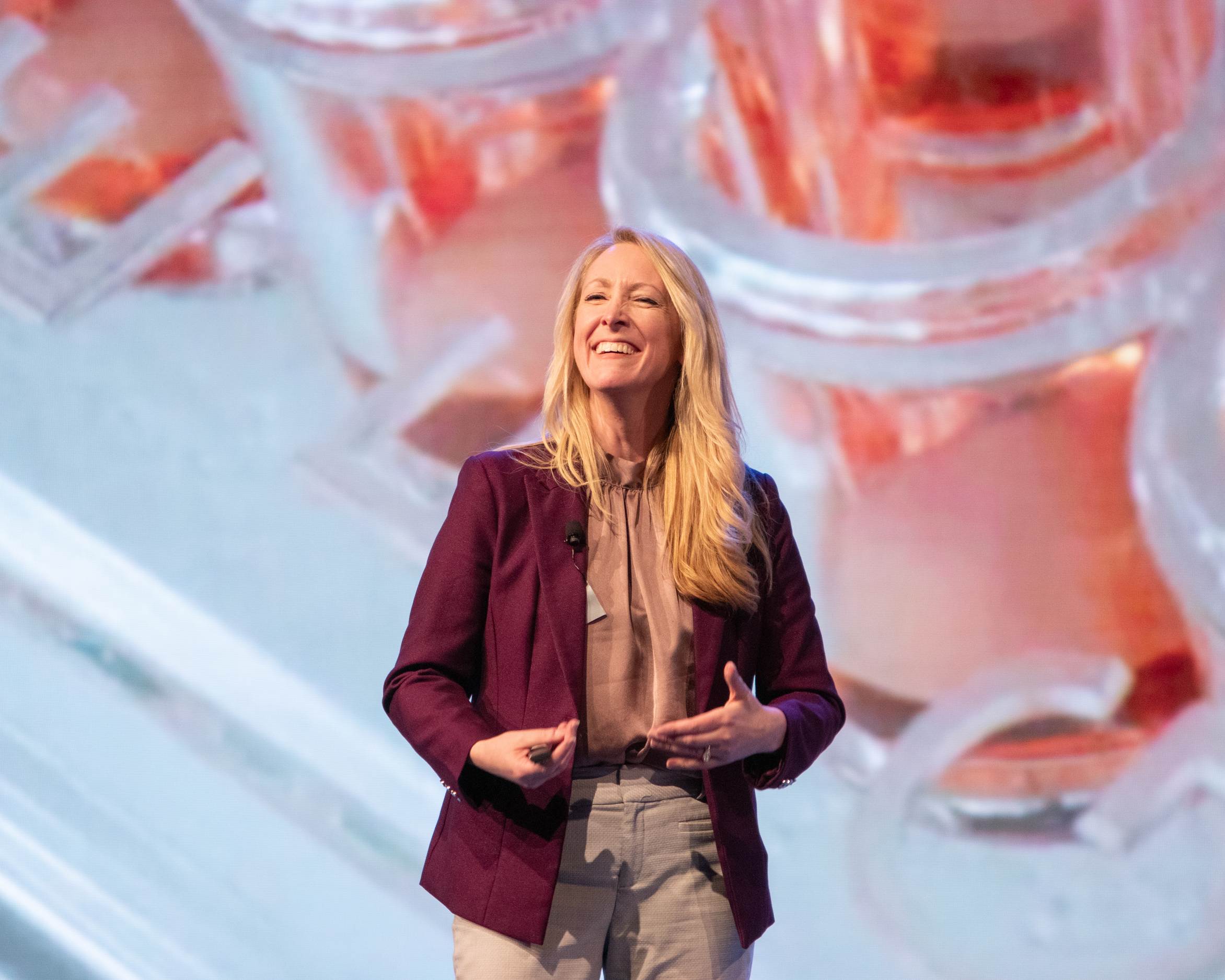

Bringing Regenerative Medicine to Scale
Chief Operating Officer, ARMI
Bringing Regenerative Medicine to Scale
What if we could grow cells, tissues or even organs on demand? Jennifer McDonald explores how regenerative medicine is moving from possibility to reality.
00.07
Back to medicine now. The Advanced Regenerative Manufacturing Institute or ARMI represents a genuinely transformative approach to medicine. In simple terms, Army and its COO Jennifer McDonald are pioneering ways to manufacture regenerative therapies at scale. It's one thing to create breakthroughs in a lab. It's quite another to take that miraculous science and adapt it to standardize manufacturing processes and reliably produce next generation therapeutics from human cells. That day is closer than you think. And imagine what it means. 60% of Americans live with chronic illnesses and more than 100,000 await a transplant at any given time. 17 people die daily for lack of a transplantable organ in the US alone. Here to tell us about an industry that
01.01
could eliminate organ weight lists, revolutionize trauma care, and save lives is Jennifer McDonald, COO at the Advanced Regenerative Manufacturing Institute, also known as Army. Jennifer, welcome. Good to have you with us. Good afternoon everyone. What a joy to be with you in such inspired conversation today across such a wide range of topics and I'm actually delighted that the discussion today has centered on both science and the humanities. The thoughtfulness in that curation strikes me in a particular way. As you'll see in just a moment, I have the privilege today of connecting with you on a topic that is deeply personal to all of us. You might wonder how I can
02.00
know that in a room filled with hundreds, that something is truly common among us and deeply personal to each of us. But in fact, the topic today is part of our shared human experience. It's part of our history. It shapes our individual lives and our choices. It shapes families over generations. It shapes our communities. And in truth, it influences the trajectory of whole civilizations. Even as we gather today, it is shaping our future. And of course, that topic is our health. I have the delight of being part of an organization that focuses on transforming the future of human health. I'm a family doctor and an Army veteran by background, and I chose with purpose an innovation
03.01
space that would boldly take on the future. As you know, the theme of the conference today is honoring our past and creating our future. That is something I find personal fulfillment in and invite you into a story that we are writing together for the future of human health. The institute I lead, the Advanced Regenerative Manufacturing Institute or Army with an I. And yes, for those of you paying close attention, I went from the army with a Y to army with an I. Indeed, our institute focuses on convening and connecting the technology innovation industrial base in the United States and around the globe to bring together in a precompetitive sense before things are brought to market collaborators that can advance human health. We aim to activate
04.01
ideas and drive them all the way forward to impact. We are in a moment on the globe where competition for leadership in this space is extraordinary. In fact, it's at a fever pitch. Why? Because biotechnology we heard earlier today stands at 1.6 trillion globally. We're on our way to the tens of trillions. And biotechnology informs military superiority. It informs the trajectory of economies and it informs our daily lives and the leaders we seek to drive our futures forward. This is the industrial revolution of our time and the competition is fierce. But we as an institute believe that just as
05.01
the competition is fierce, so can be the collaboration, so can be our inspiration to work together to develop a common future where our health is at the center. The current state in this nation I find as a family DAP to be quite extraordinary. We are in a current state where six in 10 Americans live with at least one chronic illness. Four in 10 live with at least two. That's across all age groups. The human impact in our daily lives is staggering. So is the economic consequence. In the US, we expend nearly 20% of our GDP on healthcare. And that number is climbing. And there's a particular piece that stands out to me as someone who has devoted my life to thinking about the entirety of the human lifespan. And that
06.00
is the opportunity cost. This touches each of our lives. At a statistic of six and 10, this is part of each of our daily lives. We either live with a chronic illness or more than one or we love someone that lives with a chronic illness or more than one. This is personal to us. It's deeply personal and the opportunity cost is significant. What I mean by that is if you think about the hundreds in the room today and the number of us that managed a chronic illness before we went to sleep last night or woke up this morning to do the same or worried about a loved one who is managing that same illness wondering if today they are going to pursue with the same resilience they were able to yesterday if their health will old if we can overcome yet again those challenges
07.02
we do day after day. But imagine if we could spend that energy, if we could spend that emotion on something other than managing chronic illness. Imagine if we could cultivate health with that energy. There are other leaders thinking about these same topics and thinking about the impact to our nation, to our communities, even to the globe. What you see on the screen is a nationally chartered by Congress, bipartisan commission focused on the future of biotechnology and its impacts to all of us. The National Security Commission on Emerging Biotechnology, they released a final report last year that estimated that the next three years, and since it was a year ago, really, we have two, the next two years, will influence leadership in biotechnology around the globe for the next 30. Think about the last time, the
08.02
last industry that had that kind of impact. Biotechnology is beginning to touch each of our lives and we can choose for that to be an extraordinarily positive impact. Simultaneously, other industries are surging forward in their rates of advancement. Multiple disciplines of engineering certainly we hear on a daily basis about the advancements in AI and machine learning. multiple aspects of computation, information processing and data, quantum even now. And at the same time, biochemistry, even as we've heard from this stage today, is racing forward. Things we thought were out two decades on the horizon are happening now. We are able to engineer proteins. We are able to engineer cells and tissues, even whole organs, and advance health and medicine in a way
09.01
that's unprecedented. And the confluence of those disciplines advancing at the same time means we as a species have an opportunity in front of us that's unprecedented. And so in the theme of honoring our past and creating our future, I give a little bit of honor to what has been our tradition in health and medicine and biotechnology. The breakthroughs we know today started in essentially the manner you see on the screen. Scientists at lab scale with pipet in hand innovating thinking about the big questions of science and humanity thinking about how we might go forward in a different way than where we have been and those breakthroughs have led us to extraordinary progress in the center here Dr. Dr. Yamanaka
10.04
invented a method to create induced pluropotent stem cells. Simple donation from me for example and my adult cells with my full consent can be reverted to induced or engineered pluropotent meaning they can become essentially any tissue in my body stem cells induced pleuropotent stem cells. And that breakthrough was in the early 2000s. He won the Nobel Prize in 2012. We're 20 plus years on and now those breakthroughs need a way to scale. They need a way for those therapeutics to reach all of us and to change the future. The good news is in this nation, we've done this before. We know this story from other industries. Thomas Edison gets a great deal of credit for the light bulb and should extraordinary breakthrough. But
11.02
what is lesser known is that Lewis Latimer, a patent draftsman working with Edison and who also worked with Alexander Granbell, created a carbon filament that allowed light bulbs to be mass-roducible. That act is what actually brought light into homes, into businesses. It transformed the globe. In this day and age, we hardly think twice, flipping a light switch. We can turn something on with the sound of our voice. Oftentimes, it's automated. This was an action that took an idea all the way to impact. We know the story of the Model T. On the bottom left, the Higgins boat. 20,000 of these manufactured in New Orleans, Louisiana. Just in time for D-Day changed the course of history, changed
12.00
the course of the globe. And at the core of it, an idea was brought to impact. An idea through manufacturing was brought to scale. And the story of Silicon Valley, especially with semiconductors, is one that is particularly resident resonant in biotech in this day and age. When we as a nation chose to offshore the manufacturing of semiconductors, with it went the innovation, the intellectual property, the market share, the jobs. And as we all know, we have spent more than a decade aiming to get that back. In biotech, we would like to stay in active leadership, in active collaboration for the future of human health. And our institute, we believe there's a core concept to this. We call it scalable, modular, automated, and closed manufacturing. If we think around the room about how many of us could make the exact same
13.02
batch of chocolate chip cookies twice, if I gave you the same ingredients, the same flour, the same sugar, the same exact, maybe you like dark chocolate, maybe you like milk chocolate, same chocolate chips, could you make the same batch twice? And if your answer is well maybe those are inert predictable measurable ingredients. Now think about induced puropotent stem cells becoming renal tissue becoming heart muscle becoming pancreatic cells for the treatment of diabetes. These cells are living things. They're extraordinary sensors with thousands of transactions every second. How could we make that the same way twice? How can we get to a state where cell therapies and ultimately tissues and organs are made in a predictable, reliable, safe, scalable way?
14.02
And the answer is in the manufacturing. The answer is in making sure that the process technologies underlying that manufacturing are scalable. So that if we're making a cell therapy for the treatment of type 1 diabetes that we know we can make the same thing with the same level of quality and the same level of rigor and safety at one liter or five liters or 10 or 100 or 500. That's how we scale. And if you're an innovator looking at that leap and you can trust the underlying manufacturing technology, that means you have a stronger chance of your product making it all the way through clinical trials. If you're an investor, that means you can trust the process and you can more likely invest in that innovator to bring their therapy forward. And if you're one of us waiting for that therapy to come forward, it means that this will be acted upon with greater speed. That right there is the mission of our nonprofit public private partnership to
15.02
advance that speed and bring more therapies safely to patients faster. This is 2018. our original scalable modular automated and closed manufacturing platform for the production of a cell-based product end to end. This is automated. This was developed by true to this conference theme, scientists on one side of the room, humanities folks in the middle, and engineers on the other side of the room beginning to have a conversation with one another. And the scientists who were spending most of their time in a lab began to say,"Well, yes, I I take that cryovile of cells and I I put it in my genes pocket, that little one that nobody really knows what it's for, and I wait till my hip feels cold, and then I move it into the culture media and expand those cells, and then I start the process." And the engineers said, "That's great. How about
16.02
we do this with precision? How about we thaw that vial the same exact way every time and we engineer you a module so you can use that little that little tiny hip pocket for something else. We're going to engineer you. We're going to design a manufacturing platform that will do the process you've been doing manually and by hand a little bit different every time. This will do it the same way every time so that you get the same product. If you're a researcher, that means you can trust what you're starting with and you can compare your research across labs, speeding innovation. If you're on the commercial side, that again means you can trust what is coming off of that manufacturing line and bring that to patients faster. This concept is transforming the place I work even as it is transforming the future of this industry. I happen to work at a site that used to be the largest industrial
17.00
complex in the world in Manchester, New Hampshire. There's a millard there that used to make 60 miles of textiles an hour. All handmade on looms. My office is actually in the machine shop. And now this is turning into biotech. Now this looks like the picture on the right. It is also opening up new frontiers. This concept of scalable, modular, automated and closed manufacturing is opening up new possibilities. We work very actively with multiple parts of the federal government. In a military context, this means that we are within reach of the prospect of being able to manufacture blood products closest to where an injury occurs. That's also true for critical access hospitals, for rural hospitals. This means that we can have what we need closer to the place and the moment where it is needed.
18.01
And this is also opening up new frontiers as humanity thinks about further exploration of space and how we might venture to Mars or even beyond. If we can manufacture safely what we need to get ourselves there, much much more is possible. For the innovators in this space, it's not just the technology. It's not just the manufacturing that counts. Of course, it's the ability to move that idea to commercial impact, to human impact. And so as an institute we have put together the wraparound resources, the regulatory strategy, the quality strategy, the commercialization strategy, the connection with investors that matters to these innovators bringing their product forward such that it might impact more human lives. And the good news is this is working. What you see on the on the screen is
19.00
just a snapshot of what has occurred in the last year. And you'll notice that there are breakthroughs occurring in everything from liver disease to orthopedics to neurologic conditions, heart disease, kidney disease, diabetes, multiple types of endocrine conditions, autoimmune conditions. These are not 10 years away prospects. These solutions are in clinical trials right now, right as we speak. And we as an institute are working with those innovators to make sure that we are moving forward with all possible speed. This is also drawing importantly the investment that's needed for that continued change. Biotechnology innovation is an expensive endeavor and we know that these innovators need support as they move those therapies forward. the ability as an institute to derisk that progression and enable investors to
20.02
contribute to an impactful solution that they know will both bring a return and matters to the future has in eight years drawn over three billion toward our member innovators. This is working and it is speeding us forward. And I will leave you with where we're going. This is not the current state of biotechnology yet. This is the current state of electric vehicle manufacturing. Fully automated. This is where we're headed. And I often get the question, but where are the people in the process? Won't this won't this affect jobs? In fact, it will create jobs of a different type. The difference here is that in the current state of electric vehicle manufacturing, the humans are not making physically the car. They are monitoring the quality, monitoring the production
21.00
and managing the distribution so that all of us can access that technology. Think about that applied to the next generation of medicines made from human cells. That means that automation can bring us quality and consistency and rigor. It can decrease risk and cost both on the R&D side and in full fullcale production. And that we can create economic growth in doing so. The impact is extraordinary and I find myself inspired each day to be a part of this space. For those of you interested in getting involved, whether you are an innovator yourself, whether you're an investor, or whether you are someone with a loved one to whom this matters, we invite you to become involved with us. Again, we are a nonprofit seeking to see these solutions succeed. And so we will take partnership across the board to see that happen such that together
22.05
the future of cultivating human health can become as intuitive as flipping on a light switch. Thank you. [applause] Jennifer, if I might, could I just ask you a question? It's a bit of a stray question, but it be it's because it doesn't have to do with with regenerative medicine. uh it does have to do with healing medicine and it is a it is a word that I hear a lot about these days and it is peptides. Are you familiar with peptides? Certainly. A smile has come to your face. Will you explain what they are and what their healing properties are and why peptides are hot? Yes. To the extent they are, which I think they are. Yes, indeed they are. in a number of regards. They are they are hot as you said in a wellness space. They are small molecules that can affect the health of
23.02
a specific organ or system in the body and contribute to the long-term wellness of that organ or system. In fact, they are also ingredients in the way that cell-based therapies are manufactured. So they are bringing health if you will to the products that we aim to generate longterm long-term health and for both reasons at the top of they're part of the wellness move. Are they healing? Do they have healing properties? They essentially encourage health. They are a part of the puzzle that encourages an organ or a system to maintain. Should I feel safe taking them? I would look at depending on what they are what my condition is and so solution. Yes. Exactly. writ large they have value. Okay. And I would just advise looking into the specific type of condition being treated and the specific type of product applied. Well, thank you for going off off the farm there to answer my stray question, Jennifer. Thank you so much. Thank you. Appreciate it. Good luck.
About the Speakers
Watch more videos on this Topic

Imagine Solutions and the 501(c)(3) Searching for Solutions Institute were founded in 2008 with the mission to bring leading-edge speakers and thinkers to engaged audiences of change-makers, addressing matters of societal importance related to science, medicine and healthcare, business, social entrepreneurship, nonprofit, social sciences, the arts, conservation and the environment, exploration and discovery, and more, and the vision of generating real conversations and the space for impact, influence, and connection.