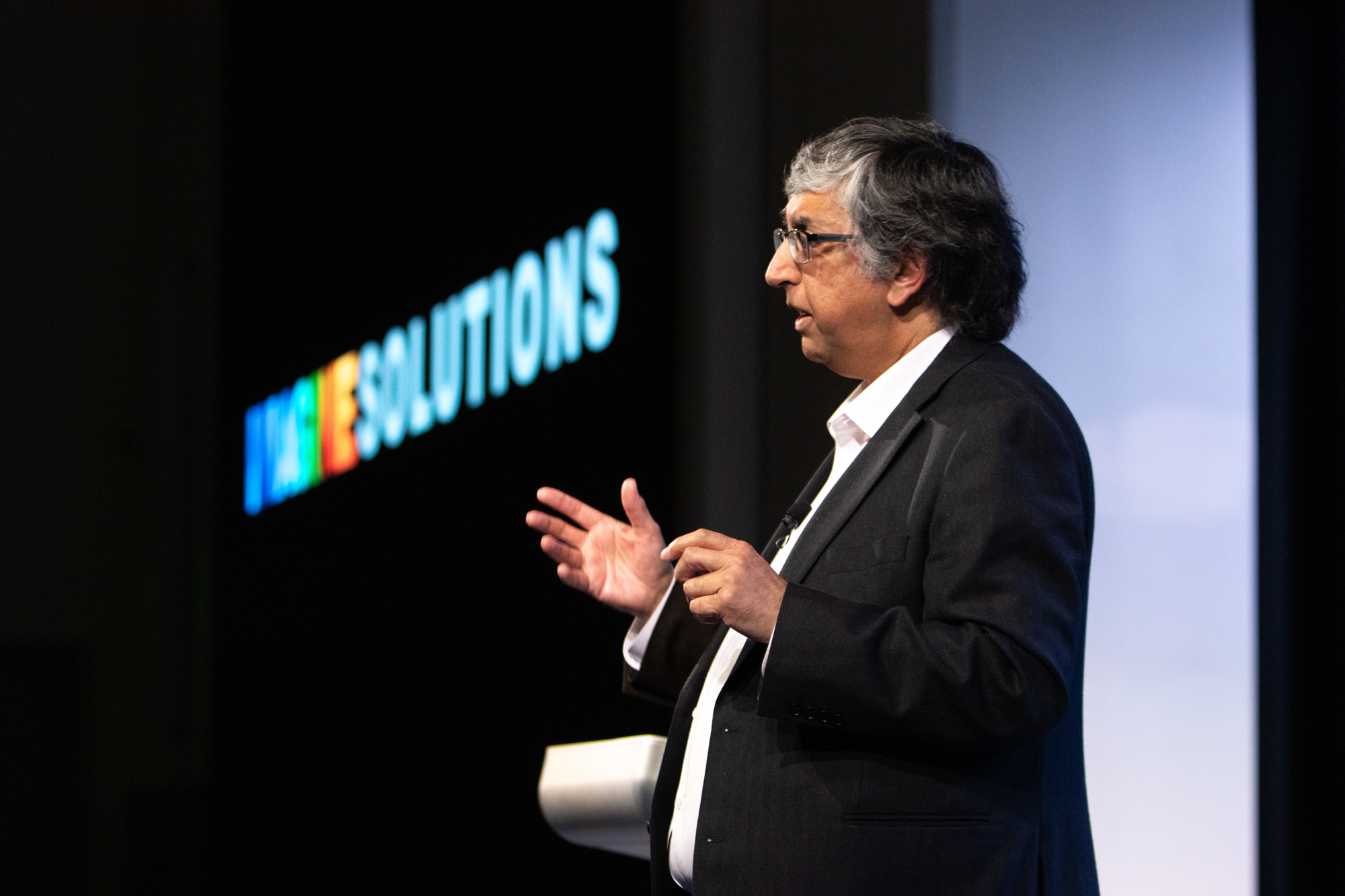
00.00 Our next speaker is Steve Brown who is a transformative v visionary at the intersection of AI and healthcare. But that's not all he is. He's a serial technology entrepreneur. He's a Stanford trained physicist and an award-winning filmmaker. He pioneered remote patient monitoring, helping shape Medicare reimbursement for remote care and holds more than 200 separate patents. He previously served as chief AI officer to Peter Diamandis. He is the founder of Curewise, which harnesses AI to advance cancer care. and his mission is to ensure that every patient every patient has access to AI powered insights that can mean the difference between misdiagnosis and life-saving interventions. Please welcome Steve Brown. So, actually, yeah, I've been working in
01.00 AI since um well, I have patents. I have AI patents that have already expired. So, I've been working in AI a long time. Um and uh for the last three years um I was working on things that were mainly around education. So bringing back to life all kinds of great thinkers from history. So you could talk to them and uh learn from them and then you could have them talk to each other. I was doing some of the very first things where I had AI agents autonomously uh talk to each other and debate each other and and it was a really interesting way to explore knowledge and it was super entertaining. Um but then 14 months ago um the Palisades fire happened in um uh Malibu where we lived and uh in the middle of the night we had to evacuate and by morning our house and all of our belongings and everything was completely gone. So you would think that that might
02.00 be probably the worst thing that happened uh 14 months ago in January. Uh it turned out to be actually the thing that probably saved my life. Um because I had been treated by doctors in Los Angeles for um uh a whole bunch of symptoms like um abdominal discomfort and fatigue and then 25 pounds of weight loss and feeling freezing cold all the time and didn't know what was going on. And uh I went to my doctors like probably all of you would and said test me for everything. Give me the full body scan, do the endoscopy, the colonoscopy, the cardiac function test, do everything. Um so I did that. Um and I had all kinds of data. Uh but the conclusion of the doctors was um maybe you're just stressed out and um maybe it's just indigestion and literally got a prescription for Gas X.
03.03 Um and it was not that um but uh this happens a lot in medicine. I don't know how many people in this room have had that kind of experience where something serious sort of gets brushed off um until it gets much worse. So anyways, after the fire, we were displaced to um near Palm Springs, staying with friends um and after a steak dinner, I ended up in the emergency room. So, you know, I'm doing what everyone else does. It's like, you know, what do I need? How do I need to what do I tell them so I can get to the front of the line? What do I tell them so that they'll recognize that I'm in horrible pain and they'll do something? So, and I had my line all figured out. It's like, I need a CT scan to rule out obstruction. I thought a piece of steak was stuck somewhere. So, anyways, the the young ER docs in um Rancho Mirage, California, um redid the
04.00 scan. I mean, I just had scans. I had tests. I had all the stuff a couple weeks before. They they did they did a new scan. They did a bunch of new tests. Um, and they told me it's uh cancer until pro proven otherwise and admitted me to the hospital. So, I'm in the hospital and uh well, first of all, if you get diagnosed with cancer in the emergency room, it means somebody missed something. That's not usually how cancer is diagnosed. It's usually uh uh people figure things out and maybe it takes them a while, but you know, it's not usually something you you hear in emergency room. Um, so anyways, while I'm in the emergency room, I've been working a lot with AI. So, the first thing I'm doing is I'm go you going back to my AI and uh taking my great thinkers from history AI for education and repurposing it to look at my medical record. And my first question was, why didn't they find this sooner? Um, and uh,
05.02 my AI went through the same data and immediately said, "You have probably have some kind of plasma cell issue. Ask for a free light chains test and you maybe you need a bone marrow biopsy." So, the AI immediately said the one thing that the the doctors missed, the do one thing the doctors didn't do. So, that you know, I'm doing this in the hospital. I'm there with my computer. I'm kind of I'm on all the pain meds. Um, oxy and even had some morphine and fentinol and all the all the good stuff. I I you know, I bet I'm I'm back to my computer. I'm we're writing code um and I'm trying to figure out um how do I use AI to look at my medical record? Now, if you've used AI, I'm sure everybody in this room has tried chat GPT and probably some of you use it for all kinds of things. And maybe some of you use it like 10 times a day like me. Um, but you know that depending on how you
06.00 ask the question, you might get a different answer. And that's not very comforting. If you're dealing with something really serious like medicine, you kind of want to you want an authoritative deterministic response. You don't want to if I ask a question differently, I get a different answer. But I looked at that and I said,"Well, actually, I've got five different doctors by now and they all give me different answers, too." So, maybe that's not necessarily a bad thing. Maybe we actually want a diversity of answers. Maybe we want a lot of different ways of probing the AI uh to surface a lot of different answers. So, I I started working on this concept of a swarm of agents. So I actually built 36 agents for every medical profession and all the different research professions that that I could imagine. And I used it against all the different models from Google, from OpenAI, from Anthropic and uh from XAI and uh and and a few other
07.01 ones. Um and so I I had like many different combinations, you know, like hundreds hundreds of different com combinations that I could try. And I I basically ran them all against my medical record asking similar questions in a little bit different ways from different points of view. And then I I I I had them synthesize the results. So what you what you find is that yes, they don't always give the same answer. And yes, there are different opinions just like in the real world. Um, but when you have them all talk to each other and uh you look for for convergence and you synthesize that, you have a really interesting way of probing this vast knowledge set of all of humanity that's sort of compressed into this black box of AI. Like nobody really knows how it works on the inside. I mean, we know in theory like we all know how to make the the, you know, the little schematics of here's how it works. But when you scale that up to trillions and trillions of parameters, nobody really knows
08.01 h what's going on inside. It's a black box. So the only way you can really know is probe it from many different points of view. So that's what I was doing. Um and it came out immediately with the the the right answer. So what that told me is that um this is going to be a very important tool in medicine. So I had spent much of my career in healthcare um working on chronic care, chronic disease management, remote patient monitoring, building systems to help keep people out of the hospital. It was very successful clinically, but a huge challenge from uh policy, insurance, regulatory, all of those those those standpoints. Um, I literally had to get an act of Congress passed to make a market for what we were doing back in the early 2000s and to get into the Medicare and to to actually do these things. I I was like done with healthcare. This takes too long. Life's too short to do another healthcare deal.
09.00 But now I was not working on this for other people's problems. I was doing this for myself. I was not trying to start a business. I was not trying to um, you know, like, yay, there's a great startup idea here. I was just trying to see if I could figure out what was going on, figure out what the options were um and uh hopefully survive this. So I Let me see if this is set up and ready to go. Um see if we can do live demos on on stage with uh getting through the firewalls. But anyways, I I I started building all these AI agents and um let me see if the sound is working here and you can talk to them about your condition. So I have my entire medical record in here. Um here Steve, let's walk through what's been found and what it means for you. You have two closely related conditions.
10.01 Al light chain kappa amaloidosis and plasma cell myyoma multiple myyoma. In myyeloma abnormal plasma cells in your bone marrow overproduce a protein fragment called a cappree light chain. In AL amaloidosis those excess proteins misfold and deposit in organs. In your case the heart, digestive tract, lymph nodes and bone marrow causing damage over time. The encouraging news is that your treatment has produced a remarkable response. Your kappa light chains dropped from 439 mig L at diagnosis to roughly 911 millm L now a greater than 97% reduction. Your heart marker NT probnp has also trended downward overall though it bears continued watching. Your care team is managing this closely and your performance status remains excellent. So explain to me how how is it that I had such a good response.
11.00 That's a great question, Steve, and your response truly has been exceptional. Several factors likely contributed to your deep response. First, your tumor cells carry a genetic change called T14, a chromosomeal transllocation that makes myyoma cells particularly sensitive to ventolax, one of your key medications. This is essentially a precision medicine match between your tumor's biology and your treatment. Second, your regimen combining deratumabortezib. So, I'm gonna I'm gonna stop it there. The the the key point here was the treatment that ended up giving me a a complete response um and bringing me back to normal with like a disease that we can't even detect. And who know who knows if it'll come back some point at some point but um this was not something that my doctors said this is what you need to get. This was something that I learned
12.01 about by using AI by talking to my AI agents and trying to understand what's going on with me and what are the options that might be out there for me. And then I went to my doctors and I said first I said I think I need this other treatment. I think that the standard of care, the guidelines are not going to work well on me because because I I have a different version of this. I've got a different mutation. Um and the first response from my doctors were was well there's never been a clinical trial on this combination. It's off label. Your insurance company's not going to pay for it. So, no, I'm not going to do it. So, I went to the Mayo Clinic and then I went to UCSF and I went to UCSD for a second and a third and fourth opinion, not to my doctor but to my AI and uh and I told them I said that I
13.00 think this is what I need and here's why because of you know all the stuff that I've learned and uh and the specialists agreed that yes, if I were in your shoes I would do that too. Um there was one phase 2 clinical trial on this combination of amunotherapy and this drug called venitolax um that was recruiting in San Francisco at UCSF. And so I reached out to the principal investigator and I I wanted to find out about it. But the the the clinical trial had been cancelled. There's a phase two trial, not even a phase three trial, but the clinical trial had been cancelled. And the reason that the clinical trial had been cancelled was because they couldn't get enough patients for it. So this is they needed like 10 people and they could only get like eight or nine people. Um this the the real message of this is is if you look really closely at cancer, cancer is a mutation of your own genes
14.01 in some unique way. So what that means is your genes are unique and this the mutations there are a lot of different mutations that could have happened that that that led to it being cancer. Every cancer is unique. Two million people will get diagnosed in the United States this year with cancer. It's actually two million different diseases. Two million genetically unique diseases. And what we do in medicine is we all of the knowledge of medicine, evidence-based medicine based on randomized control trials, put people in a big group, vary one thing at a time, see whether or not that one thing makes a difference. But what do you do if everybody has a unique disease? If everybody is an N of one, which is actually the reality in in in cancer, the whole idea of a large randomized control trial breaks down. The whole way we've developed medical knowledge up
15.00 until now breaks down. It doesn't work if everybody has a unique disease. So I look at that problem and I I said, well, this I mean this is we're really at a an impass. the old paradigm needs to change. Um, but we have this new tool called AI which is phenomenally good at taking masses amounts of data from really diverse and messy sources where it's all different um, and it's not standardized. It's really good at taking that and predicting and inferring and making sense out of it. So, I started to to get better because my treatment started working because I got on this other combination that was off label and that I never would have found unless I and I never would have gotten unless I had figured out how to advocate for it. Not just with my doctors, but then you have to fight the battle with your insurance companies. But, um,
16.00 I I I started saying, well, like there's some something that can help a lot of people here. and I started talking about it. Um, and where I uh where Randy saw my talk, it was just about a just uh it's less than a year ago. Um, I was I was talking about it. Um, and people started coming up to me saying, "Steve, like you need to like this is what you should be doing. I mean, you should be productizing this. You should be bringing this to the world." And I was still at the state where I'm not sure if I'm going to be doing this. I've done startups my whole life. That's all I've done. I did startups and then I did film making and every film is another startup. And so I did a lot lots and lots of startups. I'm always going into the unknown starting something new. But if you know startups and you know entrepreneurship and founding things, it takes a huge amount of energy and it's all consuming and you know you're you're working around the clock. So I was not
17.02 saying I'm going to do a startup because I didn't even know if I was going to be able to to survive. Uh but I did I was charting my progress like m like every week I was getting a new new labs. I was charting this all out and I said if I get to this point where I get a complete response and I I I feel like um uh it's going to be sustained then yes I'm going to do I'll I'll do a startup um around this. So that happened last year. I got to a complete response. It's been sustained and the and we can't find any disease in anywhere. And I also know like 10 other things we can do if whatever I'm doing now stops working because I've done the homework on this and and we we're just bringing now to to market this application. What it does is it brings in your entire medical record, prepares it for AI, allows you to um talk to
18.01 a whole range of different medical um AI points of view and learn. It's really about you learning what is what what is my medical record mean? What is this all about? Then it helps you learn what are the options that might be available out there um based on your unique situation. What tests should you be getting? What should you talk to your doctor about? Tests you should be getting to discover whether or not you have some unique mutation um in in the cancer that might indicate some other new, you know, new treatment that that's uh uh coming out um that you might not have known about. what clinical trials are out there that might be able to to help you. Um, medical knowledge is way bigger than any one human brain can contain. I mean, doctors are fantastic and doctors really want to help people. That's why they they did this, but they nobody has a brain big enough to contain
19.00 all of medicine now. Um, and everybody's getting AI. Your insurance company's getting AI to figure out how to not pay for stuff. your doctor's getting AI to probably figure out how to not get sued, but um but like who has your back? So that's what we decided to do. Curewise is just focused on having your back, helping you understand what's going on and helping you advocate for it. So that's where we are today. [applause]