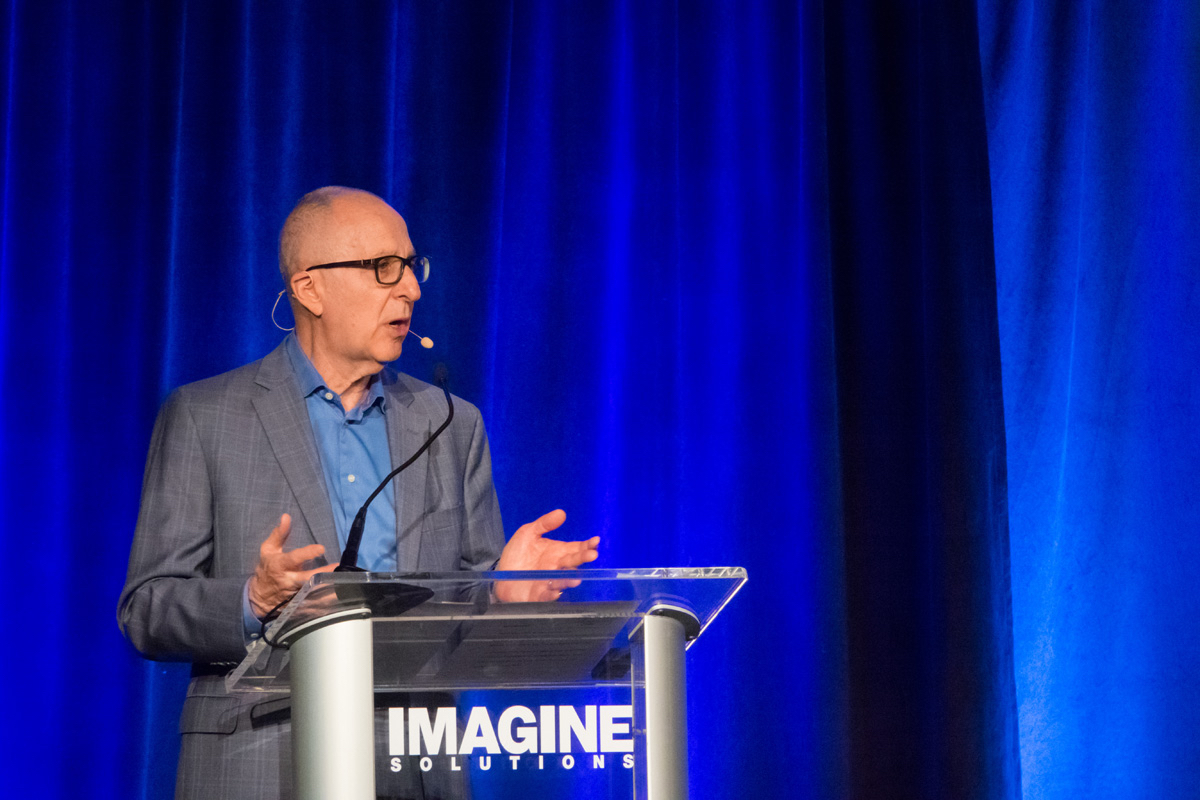
00.07 99 plus% of people do not of Americans do not know what the American Philosophical Society is. So let me educate you a little bit. The APS founded by Benjamin Franklin is the oldest learned society in the United States. Thomas Jefferson served as its president for 17 years. Six of our first 10 US presidents were members. It helped prepare Lewis and Clark for their expedition. Uh though much through much of its early life, the APS was the nation's de facto academy for science and its national library. It dates back to 1743, even older than the United States itself, and has been promoting useful knowledge ever since. Patrick Spiro is the CEO of the American Philosophical Society, a respected historian in his own right. He will bring alive quote the most important story in American history
01.02 and nobody knows it. Please welcome to our stage Patrick Spiro, the CEO of the American Philosophical Society. Patrick, well, what an invigorating day. Thank you, Randy, for inviting me uh to come here to Imagine Solutions. Um so, uh I want to um there's a 20-minut limit here. Uh I have a script, but I'm going to deviate from it. Call an Audible. Ry's probably nervous right now. Um [snorts] but uh uh so that stat 99.5% of Americans uh don't know of the American Philosophical Society. Let me tell you the story about how we came to that number. Uh so a few months ago in the fall uh I got a call from Randy Antic um who wanted to learn about the philosophical society. He had heard about it and he I told him about the APS and then he told me about imagine solutions and a few weeks later he said
02.00 you know what I want to come up to the philosophical society to see this place you just told me about because it sounds amazing but I'd never heard of it. So he visited me in Philadelphia and I uh gave him a full tour of the society, showed him what we had there in Philadelphia, but also what our work is beyond just Philadelphia, reaching out around the globe and he was completely blown away and he said, "I want you to come to Imagine Solutions to tell people about the philosophical society." Then a few weeks later, he got a call from Randy again and he said, "You know, I've been telling everybody I know about the APS and not a single person has ever heard of it. I I think 99% of Americans have never heard of it. And I said, "Randy, you're probably right." And that's how the 99.5% came about. So, I missed Tyler's question because I was going to ask that same question. I didn't get a chance to see how many hands uh were raised. So, before you saw the program for Imagine uh solutions, how many people here had heard of the Philosophical Society before? All right, Randy. It might be a little bit lower than 99.5, but probably in the
03.01 90%. Here's a harder question. So, for all of you that raised your hands, raise your hand if you can tell everybody here what the Philosophical Society does. All right, there we go. That's that's why I'm here today. Uh, so I want to tell you a little bit about the Philosophical Society. I want to tell you about what we've done, what we continue to do today, and some of the things we want to do in the future. So to set it up, um, as Tyler mentioned, we were founded in 1743 by Benjamin Franklin and a group of other civically minded individuals. Um, we were created because Franklin and others realized that there was a societal need for an institution like the Philosophical Society in the 1740s. If you want to situate yourself in the colonial period, this is a moment when Americans were beginning to lay the foundations for civil society. In Franklin's proposal to create the APS, which you can see up there, he described it as a moment in which the first drudgery of settling
04.01 these colonies is now well over. What he meant is that they're beginning to create institutions to support civil society. This is when the first universities were being created. This is when the first hospitals were being founded. This is when fire companies and insurance companies were being created. And so what he said is there's so much potential and promise in America and there are so many discoveries that are happening in people's communities that we need to create an institution that can be the clearing house for all the great ideas that America is developing. And you can see that there in this uh in the problem though he said is that we're too dispersed and we're not connected. We're too isolated and individualized and siloed to use the 21st century term. So there needed to be an institution to bring all these ideas ideas together and then share them with the rest of the world. And you can see that there in this quote in which he says uh great ideas remain uncommunicated and die with their discoverers and are lost to mankind. So he created the American
05.01 Philosophical Society with the idea that the more we know about our world both past and present that knowledge that greater understanding can create a better future. And so the American Philosophical Society full title held at Philadelphia for promoting useful knowledge which is our actual mission was created in 1743 and Franklin created a unique model. Um it's founded upon something called members which Franklin referred to as the virtuosi or ingenious men. And what his idea was is there are these great thinkers throughout America and they would elect these thinkers to be a part of the American Philosophical Society. But these members, it wasn't just an honor, it was a responsibility to be a member and they would send to Philadelphia where the APS was headquartered all the great discoveries and ideas that were happening in their communities. Not just the discoveries they were making, but everything else that was happening. and I would come to the philosophical society where they
06.00 would then publish the most promising uh new discoveries so that the rest of the world could benefit from this research. And so here you can see some of our founding members uh George Washington, Thomas Jefferson, John Adams, Thomas Payne, most of whom were elected not because of what they did in politics but how they contributed to the advancement of knowledge. Washington was a great agricultural reformer. Jefferson we know was the philosopher president. Some say Madison was a climate scientist in the APS today holds his his weather diary. Thomas Payne, it's not well known, but he was an engineer as well as a great pamphlete that we heard about this morning. And then our first woman that was elected was Princess Dashova from Russia who was a great patron of the sciences. And so this continues today where we elect members. We are the smallest of the learned societies in the United States, which is to say the most distinguished and elite. Um we elect we only have 850 living members, American
07.00 resident members. Only 25 people are elected every year. Five in the physical sciences, five in the uh biological sciences, five in the humanities, five in the social sciences, and five in civic leadership. And so people that uh don't even know that they're in the running to be a member, it's kind of like winning a Nobel laureate. All of a sudden, you receive a letter in the mail says, "Congratulations, you've been elected to the Philosophical Society." And here you can see the wide range of members that we've had over time from Darwin to Marie Curry to Al Albert Einstein. Over a hundred Nobel laureates have been elected to the philosophical society. But we're not just about science. We have leaders in juristprudence novelist. We really embrace the life of the mind kind of like what imagine solutions here does. The motto on our seal is new low discriminate. We don't discriminate. We believe all knowledge should be celebrated and can be useful. And in fact uh today we have uh two at least two uh APS members in the audience. Uh
08.01 one is Shawn Carroll uh who's been involved with Imagine Solutions. Uh Shawn has been a pioneering scientist looking at genes and then a a leader in science education at the Howard Hughes Medical Institute. Um and then the second one is me. Um okay, you're all laughing. [laughter] How am I supposed to interpret that? Truth is Shawn earned it. I was a quota case. Uh the society was worried about the age of members. They realized that I deviated so much from the mean that if they elected me a member, it would bring it down a little bit. Um so what did the society do uh over time? Um we really, you know, and I'm I'm a historian as Tyler noted, so I have to be honest to the past and tell you what the evidence really says. And the truth is uh the philosophical society we may have been founded in 1743 but it really was an idea that was ahead of its time. And so the APS only met in fits and starts uh for the first 20 years of its existence.
09.00 And it really didn't cohhere as an institution until the 1760s. And I don't think that's that's much of a mistake because we think back on that first talk we heard this morning when professor Mazer was talking about what we historians call the imperial crisis in the 1760s. This is a moment when colonists who had really thought of themselves as British subjects and probably thought of themselves as a Virginia or Pennian second didn't really think about themselves as Americans and maybe saw more competition with their other colonies than they did uh you know friendship or collegiality. All of a sudden in the 1760s they began to band together and historians have tracked out when people start to refer to themselves as Americans and it really starts in the 1750s and then spikes up in the 1760s and 1770s. So it's no mistake that as Americans are beginning to think more and lay the foundations for what would be an independent nation that the philosophical society really began to take root. And some of our first and major accomplishments are uh milestones
10.01 in American history and in the history of American science. So in 1769 there was a transit of Venus which is a very rare occurrence and it helps you determine how far the sun is from the earth. And this wasn't going to happen in a long time. And this being the height of the enlightenment scientists throughout the globe but especially in Europe uh were said this is our moment to figure out how far the sun is from the earth. And so, uh, James Cook was sent to Tahiti where he was observing the transit. Um, and then here in America, uh, David Writtenhouse, supported by the American Philosophical Society, created an observatory outside of Independence Hall where the Declaration and Constitution were both written and signed. Uh, and he was able to observe the transit of Venus perhaps more accurately than anybody else in the globe. It was such a remarkable occurrence that the royal astronomer in Great Britain complained that all of these salaried scientists in Europe couldn't be as good as the amateurs in colonial America. And that's the exact
11.02 quote. So you can get a sense on that rivalry, the tensions that were developing even in science between colonists and those in Great Britain. But it's important for American scientists because what written house showed not just to Great Britain but the entire world is that American science can compete on par with the best science in Europe. It was a major and important statement of American independence and potential. In the 1770s we also funded a major scientific uh experiment called the Silk Society. The APS and a group of other scientists wanted try to try and introduce silk into the American economy. Now this might seem like a little bit of a odd idea but there's a real reason behind it. It gives you a sense on why the society existed. We the members at the time realized that the British economy which was based on a merkantal system in which the Americans could not manufacture goods themselves. The idea was they would export raw materials where they'd be refined in Great Britain and then sold back to
12.00 Americans at a higher price. So you can get a sense of the subjugation that Americans were feeling. they desired more free trade. But what the APS said is, "Well, if we have to work within the system, maybe we can introduce new uh uh uh um products, commodities like silk into the American economy to work within this imperial system and try and alleviate this crisis." Now, of course, this experiment failed and so too did the British Empire fall. But it gives you a sense on the ways in which the APS has tried to use science to address important societal problems. After the American Revolution, the APS was really catalyzed uh by the independent nation and served as a bedrock uh an intellectual bedrock for the early nation. Our headquarters are located right next to Independence Hall. If you visited Independence Hall, you've probably walked by us and thought we were part of the the complex. We are actually a completely independent 501c3. And there's no mistake that that building was bi sitted seated right next
13.01 to Independence Hall. It's because the founders realized that knowledge and access to knowledge was going to help shore up the fragile foundations of this republic. The APS served as an intellectual home for Thomas Jefferson. Jefferson, as you probably know, was on the outs with the Washington administration and often the Adams administration. So, uh he often spent more time in the uh APS than he did in the halls of uh uh power. And in fact, uh, Jefferson was the society's president for 17 years, and he described being the APS president as the most flattering incident of his life. The APS was also home to the first successful natural history museum in the United States. Uh, calling back to the other uh, talk we had this morning about the Smithsonian. The Peels Museum opened in Philosophical Hall in 1794. Um, so we were the home to the first successful natural history museum in in the United States as well. Uh, we we've continued
14.01 to evolve. If you were to visit us, you probably would feel like we're a old antiquated institution. But the truth is the APS has continued to evolve as the needs of our society has changed and as the nature of knowledge itself has changed with technology and new information. So in the 19th century uh we supported the first successful mastadon excavation in uh in the world. It's thought to be the first successful uh complete fossil um excavation done. Uh and I heard also this morning that I guess Kirk was part of another mastadon more recent one. Uh but the APS funded the first successful one in the 19th century. We were uh supporting many of the exploratory expeditions of the 19th century. Again driven by that idea that the more we know about the past and the present, the better our future will be. In the 20th century, we became a funer of independent research by creating the Franklin grants, which are thought to be the first grants provided to scholars by an independent organization like the Philosophical Society. We've checked. We
15.01 believe that's true. No one's corrected us, so it must be. and and uh we uh we hold APS meetings that feel a lot like imagined solutions. So over three days we celebrate knowledge and our members identify the most promising new research across all different fields for three days of presentations that range from history to science to classical music and I encourage you all to check them out because they are available to attend for people to attend. It's three days in April and November. Now along the way uh the society has amassed a major research library. If you remember back to that original story where the idea was that members dispersed around the colonies would send material to the APS. Well over time we've created a research library that has 14 million pages of manuscripts in it. We have uh the papers of Benjamin Franklin. We are the repository of record of those. We have the journals of Louiswis and Clark. They were a gift from Thomas Jefferson because at the
16.00 time as Tyler had mentioned we were essentially the national archive for the United States. Our largest area of collecting is in the history of science. I like to say from NASA from Newton and NASA. Um we have the papers of seven Nobel laureates which we believe is the largest of any independent research library and we continue to collect in that area. And then we have a one of the three largest collections of endangered Native American languages in the United States. And the reasons we have that date back to Thomas Jefferson. And I don't have time to tell you that story, but it's fascinating and you should if you have time uh look it up. But in any case, today we have now have material that relate to over 650 different Native American communities and we're working in partnership with around 70 of them to digitally repatriate this material so that these communities can relearn their dormant languages and revive cultural practices. So this archive is very much a living space. I describe our research library as a laboratory for the humanities. We've heard a lot of presentations from scientists talking
17.00 about their labs. Well, for a humanist, and we just heard David Brooks talk about being a humanist, the archive is our laboratory. That's where historians can travel across space and time and have discussions with people long dead and make new disco discoveries that help us understand our shared past. And our reading room is filled with over 1500 reader days a year. We support scholars in all different fields of research writing a wide range of books. But we continue to evolve. Um we are in the 21st century evolving just like we always have. And if you visit us again, our biggest challenge is you visit an 18th century building that was built by Benjamin Franklin literally and uh and you feel like we're a historic organiza organization, but our reach is actually global. One of our most recent areas of funding research is in our Louiswis and Clark fund which provides research for fieldwork kind of like what we heard from the I naturalists today to fund early career scholars exclusively small grants. We describe this as incubating the next generation of pioneers. It's
18.01 like angel seed funding where we give a small grant to somebody who has a promising project. They hope and we hope that will only generate even more support as they move forward. And in our map there you can see all of the areas of the globe that we funded research. In this last year, I'm happy to say we funded we crossed the thousand grant mark in this last year in the Louiswis and Clark fund. But we've uh we haven't stopped with planet Earth. Our most recent fund that we created was in partnership with NASA to support research in astrobiology. So life in outer space. But back here at home in the library, we also are continuing to innovate through digital librarianship. And we heard Colleen Shogun talk a little bit about uh uh digital humanities this morning at the society. Our largest contribution to this anniversary 2026 is something called the revolutionary city, a portal to our nation's past. What the APS did is in 2019, so seven years before 2026, we created a small group and received a pilot grant, an innovation grant to see
19.01 if we could create three libraries that were separate, had separate systems, create a system in which we all could communicate with each other and create a unified digital repository that would be open 24 hours a day, 7 days a week. We showed it was possible. We've received additional funding and now this project has grown to over a dozen partners who are contributing information into this unified repository that anybody can look up the history of the American Revolution. Over 50,000 pages of material documenting the American Revolution. We just received another grant to create a digital mobilization uh lab that will go out to private collectors in small archives that have material so we can digitize their material and add it to this corpus. So, we're continuing to evolve. We're continuing to create greater access. And you can see one of the tools that we've embedded in this digital archive. It's a unique proprietary AI tool that is addressing one of the great uh challenges to the future of history.
20.01 Now, I have three kids and I think many of you in this audience either have kids or grandkids and maybe some great grandkids out there, too. um they are not learning cursive which means that the 18th century, the 19th century and a lot of the 20th century will be completely inaccessible to them. It's as if it's a foreign language. So, as you can see here in this newspaper report, we created a tool with 96% accuracy where you can mouse over an 18th century document and it'll turn it into text. Therefore, allowing future generations to have access to this fundamental foundational material that we have here at the Philosophical Society. So, think about 2026, some of our other events. Uh, we are putting on a we now have a museum inspired by the Peele Museum. I hope you if you're in Philadelphia, you'll visit us. We're uh mounting these truths, the Declarations of Independence, and is examination of the Declaration of Independence over time. There are going to be 19 first printing and early printings on display, all of which are coming from our own collection. It is believed to be the
21.01 most first printings ever mounted in one space at one time ever. I hope you'll visit. We expect we usually get 100,000 visitors. We're hoping for 200,000 visitors this year. And here you can see some of those documents. We have Thomas Jefferson's handwritten draft of the Declaration of Independence. We heard Professor Mazer talk about that this morning. We have the only known oversized parchment of the Dunlap Declaration. And then my favorite, which is on the end there. That is Benjamin Franklin's copy of the Constitution. And those annotations you see on the side are Franklin's original interpretation of the Constitution. So, I hope you all might find time to visit us this year, and if not, by all means, reach out to me. I'm always happy to host tours for people to be give you a behind-the-scenes look at the APS. So, in conclusion, when you talk to your friends and they ask you, so what is this philosophical society? You can now say, well, it's not really about philosophy because in the 18th century, philosophy just meant inquiry, especially into the natural world. It
22.01 really wasn't until the 19th century that philosophy started to be Kant and Nichi. Um so it is about three other P's. The philosophical society produces new knowledge through grants. It preserves important ideas through a library. And it promotes the most promising ideas through its meetings, through its publications and the like. And so I want to end with one last thing from the APS's history and it has to do with this conference and why history matters. I had mentioned earlier the APS premiums. In the 1790s, the APS provided funds asking Americans to try and solve some of the fundamental problems this new form of government faces, this democratic republic. In 1796, they issued a premium to say, what is the best type of educational system that would support a democracy? Because in the 18th century everybody said most Europeans said this thing is going to fail because democracies always lead to mob rule and anarchy and property is
23.00 destroyed. And what the founders said and what George Washington said in his first inaugural address is that knowledge education is the backbone that will support democracy. It's the bull work against these these fears. And so in 1796, the APS issued a call to Americans to develop an educational system that is specially designed to sustain a democracy. And so as I think about 2026, I think about the opportunity. This is an incredible moment for us as a society to renew a sense of civic spirit to refresh our historic and civic literacy by returning and reminding ourselves of the first principles that brought us together. That's the opportunity. I think our challenge our challenge is whether or not we today are helping shoring up are shoring up the foundation for the republic to last another 250 years. Thank you.