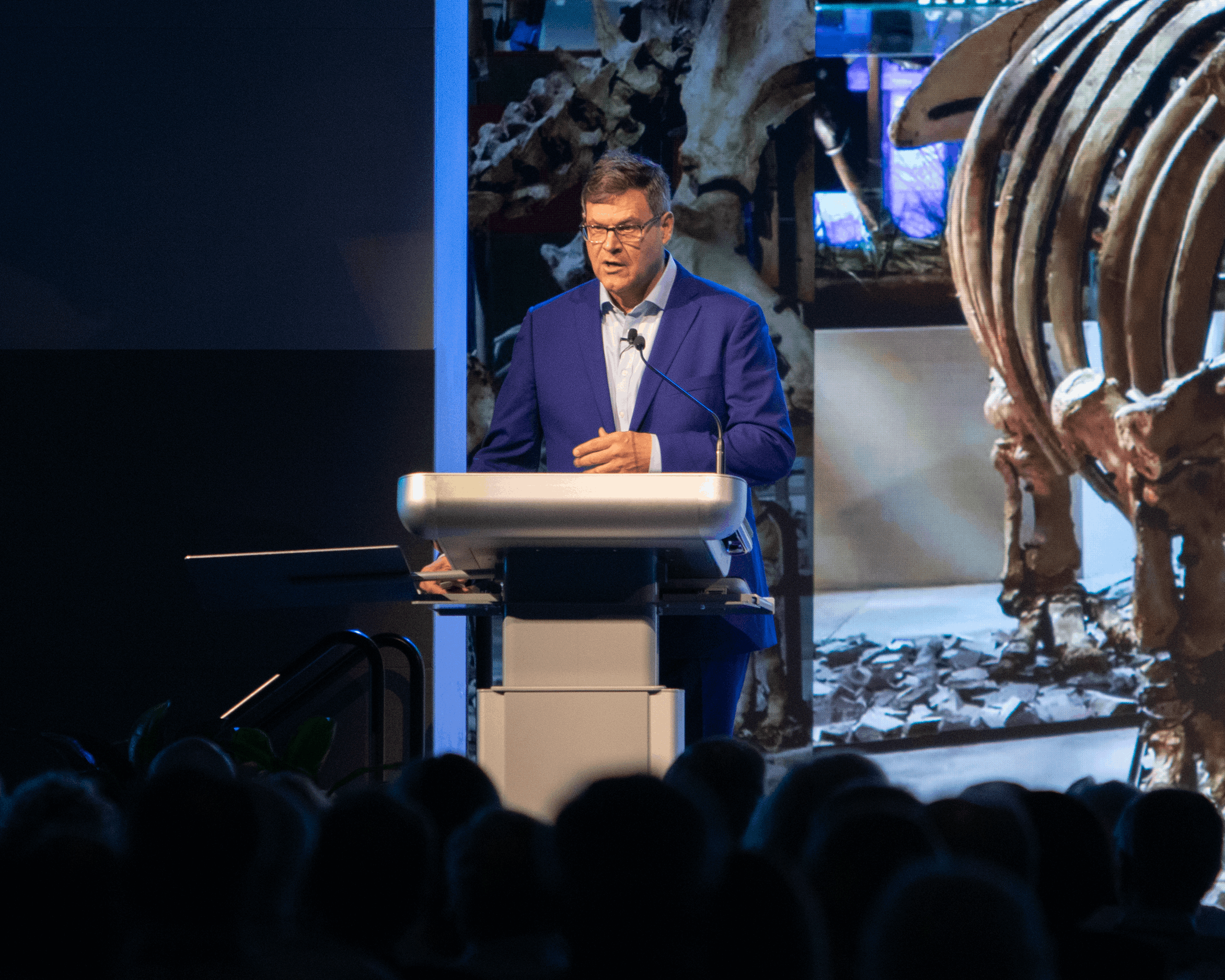
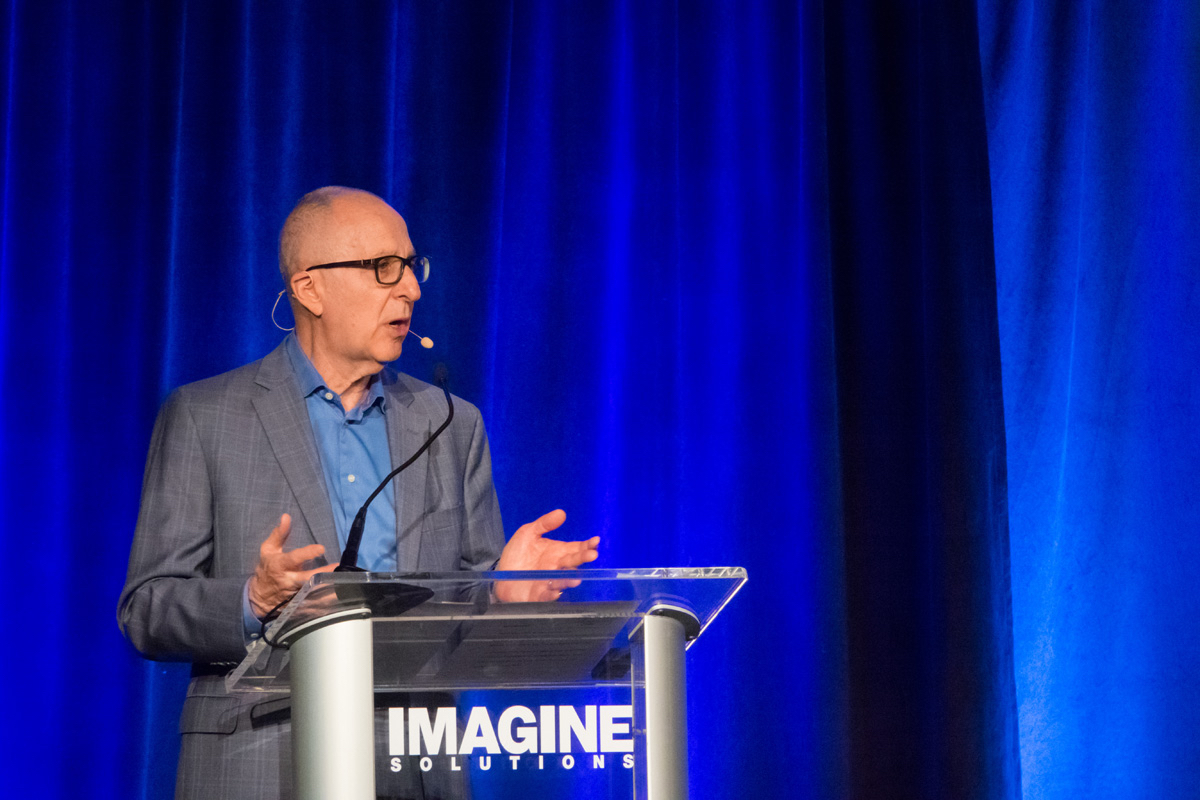
00.00 Our next speaker is the Sant director of the Smithsonian Museum of Natural History. It is the world's most visited natural history museum, hosting more than 4 million guests every year. And if that's not an impressive enough number for you, consider this. The Natural History Museum holds more than 148 million specimens, the largest collection in the world. Kirk Johnson is a Yale trained paleobotonist who's led expeditions in some 19 states, 11 countries. In 2011, he led the snowmastadon expedition in Colorado, recovering more than 50 mastadon skeletons. He has them on display in his house. I'm just kidding. uh to tell us why understanding Earth's past is essential for navigating its future and more. Please welcome Kirk Johnson. Kirk,
01.03 good morning. Uh this talk is about museums, science, nature, and the future. And as I posit it to you, I would argue that museum-based science is critical for the future of nature. I'm going to start with this guy, Bert Pierce, born in 1879 in uh Sutton Veni, which is near Stonehedge in England. This picture was taken in 1896 when he was 17 years old, right before he left England and moved to Wyoming to become a cowboy. Eventually, he would become a rancher and a sheep herder. And here's a shot of him 65 years later, age of 82, 1961. The little dude in his lap is me, which is kind of amazing because between Bert and I, we've watched the last 147 years of history. Think about that for a second. We tend to think of like, oh, the past is long
02.00 gone. I knew this guy. He was born 1879. The last 147 years have been without question the greatest rate in global change in Earth history since the asteroid struck the planet 66.04 million years ago. I'm going to make three different arguments why that's the case. I'll start with mammals. All of us are mammals. Remember that fact to start with. If you think about the world is divided into four parts. The red part are the domesticated mammals of humanity, the cows and the sheep, etc. The yellow, that's the humans. The green, those are wild land mammals. And the blue are wild marine mammals, the whales. The chart shows you what happened between 1860 and now. You can see that 1860 they're about the same amount by weight of humans and their domesticated animals as there were whales and wild mammals. about 200
03.01 million tons each. Run the clock forward. It's been a good 147 million year 147 years for humans and their animals and a bad 147 years for nature. And right now 95% of the biomass of mammals in the planet are humans and the domesticated animals. And wild animals, including the marine mammals, are only 5% of the biomass. That's a remarkable change. It's never nothing has ever happened like that in planet Earth except when dinosaurs went extinct and we lost dinosaurs and got mammals. Second example, human population. It's a remarkable thing to look at the human population curve. This shows you the last 20,000 years. It wasn't until 1804 that the planet saw its first 1 billion people. We acquired 1 billion people in the last 12 years. So the first 20,000 years give you one billion. The last 12 years get you another billion. And right now there's 8.35 billion people on the planet. What's even more amazing, if you
04.00 plot your family on that curve, and here's my family on that curve, you can see that Bert and I have witnessed almost the entirety of the flexed upward part of the curve. It's remarkable. My mom was born in 1929. There were two billion people. There's 8.3 now. The world's population has quadrupled since my mom was born. If you think things are getting more crazy and busy and crowded, you are right. There's a reason for it. Third example, carbon dioxide, a greenhouse gas. There's been a project to measure carbon at the atmosphere for the last uh 66 years. It was started by a guy named Charles Keeling at Scripps. He's been measuring the CO2 in the atmosphere. And you can note this curve. I like this curve because it starts in 1960 and it ends now. And that's me. I started in 1960 and I'm here with you now. So this curve is my life. And what you see in this curve is that the carbon dioxide in the atmosphere has grown by 35% in my
05.02 lifespan. You might say, well, is that unusual or not unusual? What it'll give you now is the carbon dioxide curve for the last 10,000 years. That's this curve. You can see it's pretty unusual. How about the carbon dioxide occurred for the last 800,000 years? It's unusual. We live in a remarkably unusual times. So, wouldn't it have been nice if the United States government said, "Wow, we're about to enter this amazing time of change. Why don't we do something to record it while it's happening so we'll know how to understand the future by using the past?" It turns out our government did that. The Smithsonian Institution. The Smithsonian Institution is the nation's first investment in science. Founded in 1846, it was set up so our nation could take advantage of the burging new knowledge of the Enlightenment and plot its path forward. Almost all the science agencies in the federal government are the offspring of the Smithsonian institution. In 1886,
06.01 Smithsonian sent people out to catch a few of the very last bison on the planes. Put on a diarama here. These bison were seen by millions of people in Washington DC. It led to bison conservation and survival of the species. And on March 18th, a few short weeks from now, I'll be implanting bronze sculptures of these very bison on the front steps of the museum in Washington DC as a celebration of the nation's 250th. Today, the Smithsonian is a remarkable institution. 21 museums, nine research centers, National Zoo, and it's an amazing thing that our government wraps itself in museums. Here's the museum I run, the National Museum of Natural History, opened in 1910. My mom visited from the ranch in Wyoming in 1939. This place has, of course, the Hope Diamond, but it also has amazing things. This is an exhibit we just opened in 2019 called Deep Time. It's about the history of life on Earth from the beginning of the planet all the way to the future. We go several hundred years into the future in this exhibit because humans are so much part of the story of
07.00 Earth right now that telling the exhibit about the history of the earth can't be complete without projecting the effects of humanity into the future. You'll see amazing things if you come to the museum. The nation's Tyrannosaurus Rex. Henry, the world's largest elephant shot in Angola in 1955. Teddy Roosevelt's black rhinoceros, the world's only example of the scientifically accurate megalodon, a 52 foot long shark that lived uh right here 3 million years ago. Giant amazing crystals from Arkansas. And what the museum is is frosting on top of a cake. The cake really is the collection made by Smithsonian scientists and other government scientists over the last 170 years. If you look at the U scientists, they're out even now in the badlands, in the deserts, in the tropical rainforests, scuba diving in the bottom of the ocean,
08.00 and collecting in the polar areas. And the result is a remarkable collection of the natural world, the minerals, the fossils, the animals, the plants, the whole thing. And in fact, in Washington DC, we have an analog twin of the natural world in the form of the collections. And the collections come in a variety of forms. There's dried things like skins and skeletons. There's frozen tissue, really good for genomic work. We call these things popsicles. There's pickled specimens, which we use for study of animals because all the parts and all the guts and all the parasites are preserved. We call these pickles. Have you ever seen a pickled gorilla for instance? We have 19.2 2 miles of shelves of pickled organisms. Think about that. Here's the National Herbarium. 5 million plant specimens around the world. National Shell Collection. The National Butterfly Collection.
09.02 The National Bird Collection, the National Whale Collection, the National Mineral Collection. We actually have 442 different named collections because 148 is a really big number and it takes a lot of collections to get to that number. The National Fossil Collection, my particular specialtity, fossilized plants, the National Fossil Plant Collection, the National Dinosaur Collection. And you might say, why does any of this stuff matter? It's just old stuff in a building in Washington DC. But think about this. We have the National Mosquito Collection. Mosquitoes kill a million people a year. It's the number one animal killer on the planet. More than hippopotamuses or lions or sharks or anything. It's mosquitoes. And guess what? There's 3,700 different species of mosquitoes. If you want to stop people from getting killed by mosquitoes, you have to understand what a mosquito is, where it lives, how they transmit disease. And
10.00 one of our scientists just published a book entitled The Mosquitoes of the World. It's giant two volume tome. And much of the work that the United States does to protect people from malaria and other insect born diseases is based on the collection of the mosquitoes in the national museum. We're in the process of making our collections digitally accessible. Here's a map that shows 10 million of our objects that we've georreerenced and mapped on the planet. You can see very well this is just 10 uh 115th of the entire collection. We get a sense of how cosmopolitan our collection is. It's not a US collection. It's a global collection. We also monitor all 1,500 volcanoes that are active on the planet and report weekly on all activity in all volcanoes. And we've just completed a complete comprehensive assessment of glo earth's history of its climate over the last 485 million years. So we can start to lay claim to a little bit of the everything always everywhere kind of statement. We're in the process now of making that
11.01 collection accessible and readable. We've just finished digitizing the National Herbarium. 5 million individual herbarium sheets available now to you on your iPhone if you wish. We're working on pollinating insects right now in a um conveyor belt that is digitizing about 1500 a day. It's a problem for us because we have 40 million. So we have to figure out a way to go faster. And we just digitized Henry. We're receiving a visit from the U ambassador from Angola next week. I'll present him with a um take-home copy of the world's largest elephant. So, think about a single specimen in the collection like this fish in a jar. It's not just a specimen. It's the knowledge that occurs to that specimen. Knowledge tied to a specimen gives you this idea of an extended specimen. If you think about it, all the kinds of information tied back to one specimen is how we understand what's going on with every aspect of that organism, its species, its impact on the globe. And we've been greatly advanced by this arrival of this
12.01 incredible thing known as environmental DNA. There's DNA in this room right now in the air. And I could grab some of that air and sample the DNA. And the DNA would belong to you. And we can ascertain who's in the room by taking the air samples from the room because you're all shedding tiny particles of your own DNA into the air. We can take environmental DNA from the water. And so if you take a jar of water from the uh the Gulf right outside the door here, it will have probably a thousand different kinds of DNA. And what we doing is using the museum's collections to calibrate those DNA so we can take a jar of water and tell you exactly which fish are swimming in the ocean. It's a really incredible tool because we've accelerated our ability to do biologic surveys by simply taking a glass of water, running it through the DNA machine, and here's all the fish that are in the water. works on land, it works in the air. It's remarkable. Now, one museum is great, but all the museums is better. In fact, all the collections
13.00 in all the museums in the world represent what humanity has collected over the last 200 years to understand the planet. So, I've started an initiative to bring the big museums of the world together. This thing called the global approach to natural history museum collections. This really is the global collection. There are not many large museums of natural history in the world. There's about a hundred. They're mainly in capital cities. They're mainly in Europe and North America. There are very few in the global south. We got 73 to participate in this project to assess the first pass. And we identified that those 73 museums hold over a billion specimens. And we're now chasing the rest of that curve. Here's a map of North America. Here are all the museums in North America. Little tiny ones. Yesterday I was at the Shell Museum on Santael Island. It's a small natural history museum. It's a great museum. It talks about local natural history. And museums do two very fundamental things.
14.01 They help people understand the world and they help science understand the world. Those two things. And people, the scientists understand the world through the collections. So whenever you walk into a museum, you're just seeing the very tip of the iceberg. You're seeing what we're presenting to you. People often ask me at the um Natural History Museum, what percentage of your collections are on display? And I heard that question so many times I decided to calculate it. We have 11,945 specimens on display. We have 148.8 million specimens. So on display, we have 7 1,000th of 1% of our collections on display. What that's telling you is that the collections really don't exist for being exhibited. They exist to drive science forward. And the discovery of DNA in 1953, the sequencing of the human genome in 2004 leads us to the opportunity of the genomes of all 2 million known species on the planet.
15.00 Meanwhile, we're discovering new species. In this 13 years that I've been director of the museum, we've described in the museum over 3,500 new species, and we're still going rapidly. These breakthroughs in DNA, ancient DNA, environmental DNA are letting us move forward the pace of science at a high rate. So when you think about that, you realize that there's an untapped asset in our midst. I wager that most of you weren't aware of why museum collections existed for natural history museums or in fact that scientific research happened in natural history museums. That's one of our biggest challenges because most people say, "Oh, it's a place to take the kids see dinosaurs." The reality is that we are critical scientific infrastructure for the future in an incredibly challenging time on planet Earth. So, if you think about what we need to do now, and we're in this very critical moment in the history of natural history museums, is we have to continue being a
16.00 19th century organization that takes objects and puts them in boxes in a building. We have to also devote a portion of our time and treasure to becoming machine readable, digitally accessible, and take advantages of the upcoming changes that we'll see dramatically implanted across all of society by artificial intelligence. And I think this makes museums one of the most exciting places in science because we can continue to reinterrogate our collections time after time and continue to grow knowledge. And it's been remarkable for me to live as a museum director over my short 65 years and watch how many scientific breakthroughs have come from being able to look at the specimens that were collected by Smithsonian scientists in the past that are still accessible to everyone in the world today. And on a given year, something like 10,000 scientists visit the Smithsonian because of the collections, not the exhibits. They come to access the scientific information that's held in the collections.
17.00 It's a real pleasure to be the director of the Smithsonian. I get to do incredible things and see incredible things. I just did a um documentary on the Pacific Walrus which was on PBS in October. I urge you to go watch it. It's a a really cool thing because today in the North Atlant North Pacific Ocean, um there is a herd of 250,000 Pacific walrus. These are two-tonon animals and very few people have ever seen a living Pacific walrus because they live in the middle of the bearing sea where nobody ever goes. But in my mind, these are like the bison. These herds of wild giant animals like the herds of bison um are living in a world that's changing rapidly as well. And what happens to them in part depends on what humans decide to do with planet Earth. And it's really cool to go back and see these bison. And I was up in the Bearing Sea. I was actually issued my very own personal ice flow. They dropped me on an ice flow and I was floating on an ice flow amongst the herds of of walrus and I felt like I was in 1886 or
18.03 maybe 1850 when the herds of bison were intact. So you see a moment now where we have the choice about bison moving forward and what we do really will matter. And I'll leave you with just um three thoughts. They're very simple thoughts. The first thought is that museums are cool. You should definitely enjoy museums. They're amazing places to go with friends and family and to learn about the natural world. Science is amazing. You all know that we are in the middle of this incredible technology boom where science plus technology is giving us tremendous leaps forward in how we think and act. And nature's wonderful. I mean, we all know that you really want solace. You get in the kayak and go out into the water or you go for a walk on the beach, you walk in the woods. All those things are true. Museums are cool. Science is amazing. And nature is wonderful. And I just end with this statement. If you want to invest in the future,
19.03 invest in museums. Thank you very much. Can I ask you to stay for a second? I want to ask you a question, Kirk, because there were a couple of slides that you referenced there. One was on the uh warming of the planet. Would you bottom line us here? How much warmer globally is the planet today than pick it 50 years ago, 100 years ago? Yeah, we measure it in um average annual temperature. So, uh and that's done by integrating temperature across the entire globe, day and night, whole seasons. And the temperature has gone up over the last since Bert was around was born, it's gone up about 75 degrees. Now it's sort of like is that a lot? It's a lot when you think about this because warming temperature not doesn't mean just warmer air in the warm places. It means less cold air in the cold places. And it warms about four times faster in the polar regions than it does
20.01 at the mid latitudes. So in a way by looking at the polar regions we can see the future because it's warming faster there because the planet's asymmetrical. The sun hits more directly at the center of the earth than it does in the edges. And when you warm it warms up faster on the edges. We know from paleontology that when the dinosaurs were here, there were no polar ice ice caps at all. There were forests on Antarctica. There's forests in Greenland. I've been up to Greenland. I've been to Antarctica. I've collected the fossil forest in those places. So, I've seen the future. You've been to Greenland many times. Greenland. Oh, okay. It's a lovely place. But I think the key point here is that we are we've seen enough warming already to tell us and everyone sees it. There's warmer hotter days. There's more there's fires there more hurricanes. The weather effects the the weather effects do seem to be related to a warming uh planet. The other slide you showed was one that you said I believe you said that in your
21.00 lifetime CO2 had risen 30ome%. 36%. I don't want to drag you into a political discussion here, but is there a connection, do you believe, between the rise in CO2 and the rise in global temperatures? Well, it's not political at all. It's actually a fact because we, you know, we understand what CO2 is and how it operates in the atmosphere. And we've demonstrated looking that climate curve I've showed you on the chart of climate over the last 485 million years. It's the variation of CO2 that drives climate on planet Earth. So that measurement of CO2 is a tool we use to assess where the climate's going to be going and we control that CO2 in the atmosphere. We decide how we emit our CO2. That's a choice. Kirk, I grew up in Arlington, Virginia. I cannot tell you how many times I took school field trips to the Museum of Natural History. It's a wonderful place to go and it is free, right? Yeah. The Smithsonian, the it's one of the most amazing places, great museum of the world. And you can walk in, American citizens, anybody can walk in for free.
22.00 Kirk, thank you very much. Thank you. We appreciate it. Thank you.