
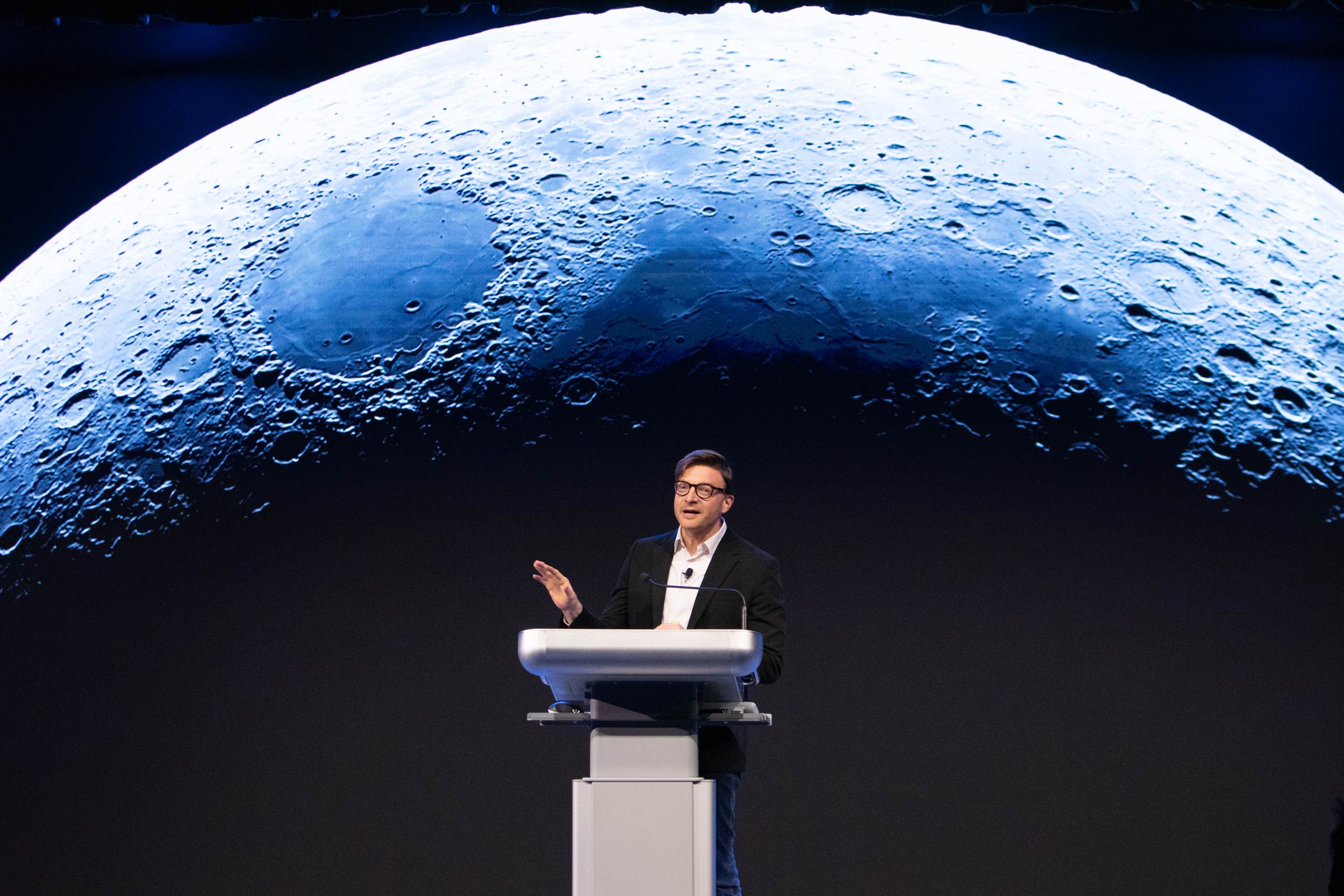

The Moonshot Maker
Office of American Possibilities
The Moonshot Maker
What does it take to turn bold ideas into real-world breakthroughs? Andrew Mangino explores how “moonshot” thinking tackles society’s biggest challenges.
00.06
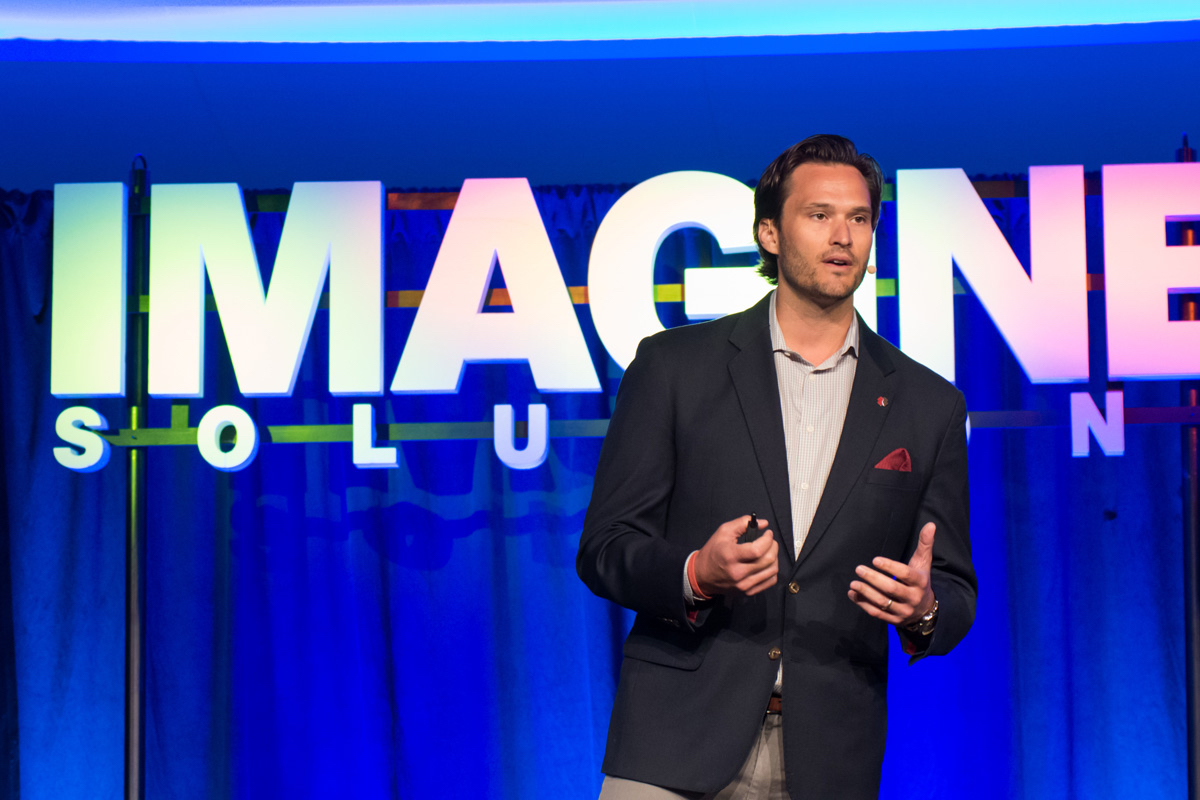
He is Andrew Manino. He's known as the moonshot maker. After serving as editor-in chief at the Yale Daily News and as a speech writer for President Obama, he dove headirst into the world of social entrepreneurship, working directly with Bill Drayton, considered the godfather in the field and then co-founding and serving as CEO of the world's first Moonshot Launchpad. In that capacity, he's helped to co-create more than 10 mega projects that have brought Americans together to tackle shared challenges from refugee resettlement and youth empowerment to democracy and civil justice reform. He also founded the Future Project, a nonprofit designed to help young people discover their passions and step into their power to change the world, in part by introducing an entirely new role in society, the dream director, which he'll tell us about in a moment. Mr. Manino gets things started. He gets things
01.00
done. He inspires collaborations among the most unlikely partners and above all has a passion for common purpose. He represents a new generation committed to unlocking human potential at scale. To tell us more about why that's important, why he is so passionate about it, please welcome Andrew Manino. Andrew. So good to be here. I'm gonna have to get that bio to my mom. Um, well, too nice. Uh, I'm honored to be the last speaker. It's first of all, it's been an amazing day so far, has it not? I will I will try not to screw it up. So, in the last moment here, um, I also just want to uh I know he'll get acknowledgement throughout, but I just want to acknowledge Randy. I know every one of us is here for some reason because of Andy's Ry's energy and I just think it's it's very cool to sort of experience it in action. So just to Randy who's put so much of his heart into this because I'm the last speaker I
02.00
think I have a special responsibility too to drive home this theme of honoring our past and creating our future. uh my view is that there's no better there's few better lenses than moonshots to really understand the power of that and not only this idea that honoring the past and creating the future are two things that we have to do but the idea that they are linked to do that I want to take us on a little bit of a journey a tour essentially through imagined solutions that have been brought to life in history are you ready to go with me on that for all right so um for that I want us to imagine going four miles north east of here 56 years into the past July 16th 1969 where one of the most vividly imagined solutions was brought to life many of you know what I'm talking about the Apollo mission what you're seeing here is the Saturn 5 we're sort of
03.00
desensitized at this point to rocket launches but just think about this there this this was the size of the Statue of Liberty and it weighed the equivalent of 400 elephants sitting there on the launch pad that somehow had to fly. There were five engines that generated more power than 85 Hoover dams. Charles Lindberg was sitting in the stands and he and he realized that the amount of power that was used in those 10 seconds could have powered him around the world 10 times. And what you're not seeing is just as impressive. There are 420,000 people who were working to create this moment. Not just the rocket uh scientists that we hear about, but also seamstresses who had to create the perfect space uh uniform or else someone could die or the cooks who invented space food. And it wasn't just NASA running all of this. People misunderstand it. It was actually 20,000 firms, 200 universities across all 50
04.02
states and the federal government spending more than 4 cents of every federal dollar. Put simply, what you just saw was not just a rocket launch. It was the impossible happening. Or as Regina said earlier, I I love this. It was a miracle. How do we get there? I think it's just as interesting to go back in time. Many of you remember this moment. Uh 2,499 days prior to that, President Kennedy stood at Rice University and he issued one of the great calls in history. Why some say the moon, he said, we choose to go to the moon. I'm trying. Sorry for the impersonation. We choose to go to the moon in this decade. Not because that'll be easy, but because it is hard. Because it that goal will serve to organize and measure the best of our energies and skills. Because that challenge is one we are willing to
05.01
accept, one we are unwilling to postpone and one we intend to win. Okay? There's nothing more fun than just doing a JFK impersonation. I recommend it to all of you. It's very fun. But I want it's actually really important to look at this this little uh section here. Notice that he says we choose. Um Angus said this perfectly earlier in his talk. Uh in the face of the impossible, he this is a reminder that doing big things is actually a choice. It's something that we get to decide even if it we don't know how we're going to get there. Two, notice of course, and this is legendary that he says because it's hard. The goal is not within reach. It's just outside of it, but he knows that we are a people that love to be challenged. And third, there was a line that was not issued in this speech, uh, sorry, that was not on this piece of paper, but he added at the
06.01
last second. Some of you may know it. He said, "We choose to go to the moon in this decade and do the other things, not because that'll be easy, but because it'll be hard." It's a little quirk of history. At the very last second, JFK added in the line, "And do the other things." Because while he realized it was very exciting to inspire everyone to go to space in the context of that moment, he realized that if he had just focused on that, it would be missing the opportunity to say we need the same spirit right here on Earth. And so this is a little bit of a talk about the other things and what it takes to do them and how we've done them and how each of you can be part of doing them going forward. And it wasn't just JFK that was this inspirational figure. He was really tapping in to a tradition that goes back many years before. So, let's keep going on our little journey. There have been moonshots of connection all throughout our history. The Erie Canal was built by laborers before the field of civil engineering was even
07.01
created. In fact, they created the field of civil engineering as they built this. There's the transcontinental railroad. They turned a six-month journey into six days and wo together two uh two oceans into one nation. You have the Bell system. This is one of my favorite. So we know Bell Labs created so many different things but over time the microprocessor satellites but it started not just with settling for the telephone. They then decided they wanted to make it possible for there to be a clear and private conversation between any two people anywhere in the world. Incredible. And this led to weaving a 100 million miles of copper wire. The interstate highway system, people don't realize that it that this is the largest earthmoving project in history. And it continues to this day. They move more soil than the pyramids and the great wall of China. The Peace Corps, a different kind of connection connecting the world. 250,000 Americans have served in 141 countries.
08.03
And then Arpanet they wanted to create a nuclear strike proof mind that became of course the internet and fundamentally changed the world. There are also moonshots of opportunity. The land grant colleges many of you know this one. 17 million land uh acres of land handed to the people creating universities that produce 2thirds of American PhDs including the University of Florida right here. the GI Bill. For every dollar we spent on the soldier, the economy got $7 back after we made we we invested in uh the veterans to become more than half of the college educated population. This created the American middle class. JobCore, incredible numbers here. 3 million atrisisk youth were served. Head Start, 37 million children. Teach for America, more than 65,000 leaders going into the front lines of the classroom. And then there
09.00
are the moonshots of peace and justice. The Marshall plan was a crazy idea. These are all crazy ideas. In this case, we said we were going to put 13% of our budget as a country to rebuild the countries of our enemies. Just think about that. Civil Rights Act, at least on paper, at least by law, dismantled the century of Jim Crow laws in a stroke of a pen. Special Olympics started as a backyard camp and now 5 million athletes are engaged across 170 countries and re have helped us all to rethink how we view people young people especially with intellectual disabilities. PEPFAR became the largest commitment to a single disease in history and has since saved 25 million lives from HIV AIDS. No kid hungry has served more than a billion meals. Many of you think of moonshots probably as moonshots of survival or of technology. The polio vaccine. I was speaking with one of you last night uh uh about how much this inspired you.
10.01
This was the original crowdfunded moonshot. Uh the March of Dimes occurred and 2.6 million dimes were sent to the White House to fund the polio vaccine. Ultimately $250 million plus were raised by the American people to create this. 911 services is one of my favorites. Uh because it's one of those things that it seems like it's just inevitable, but it's anything but inevitable. Uh this created not only a common cry for help number across the whole country, which is actually an astonishing idea if you think about it, but it also became the basis for GPS showing many of these moonshots led to many other technologies. The the actual Apollo mission actually led to more than 2,000 breakthrough technologies that are used today. And then we know this one more recently. Operation Warp Speed compressed a 10year FDA approval timeline into one year. But also, interestingly, performed a logistical feat. Never before had vaccines been traveling at negative 100° F across the country. There are the moonshots of our
11.00
planet, the National Park Service, the Civilian Conservation Corps, which planted three billion trees, the Tennessee Valley Authority, which I didn't realize this, eliminated malaria completely in the south. And the moon she moonshots of new frontiers, the Rural Electrification Act in 10 years, moved 90% of farms, think about this, 90% of farms across the country were in complete darkness. 10 years later, 90% had light. We just heard about this and the or the deeper origins of this. This is one of the most inspiring. The human genome project experts said it would take a century to map these three billion letters and we did it in 13 years. They estimated it was a $1 to $140 return for our economy. National Nanotech Initiative, $30 billion, 20 agencies to create beyond microscopic uh technologies that now power our smartphones and make and allow us to each have in our pockets uh computers more powerful than the Apollo mission.
12.02
The brain initiative is one of the wildest ones to me. uh in one brain there is a thousand pabytes they say of data which is more than the entire internet just in one of our brains. Uh nevertheless uh the brain initiative found a way to map the 86 billion neurons again the impossible. We're hearing about this as a convenient technology more and more. You've maybe traveled in a driverless car or keep or hear someone in your family or friends who have now tried one out. But it's actually a moonshot we're living. What people don't real what we don't realize is this is actually in service of ending the 1.3 million annual deaths uh from car accidents and reclaiming 30% of our urban land as from parking lots. Then of course, as we just heard, there's the ultimate moonshot in some ways because this solves for problem solving itself. The idea of compressing a 100 years of research into a 100 days. What we're seeing right now as with driverless cars is just the beginning as we know. And this is maybe my favorite moonshot of
13.00
all. Again, we're living it. The United States of America. You know, our first speaker today reminded us the United States was an idea. It was a crazy idea. And in fact, when Ben Franklin proposed the Albany plan, the idea of just uniting the colonies, exactly what we have, uh uh it was unanimously struck down. People thought it was ridiculous, but he held on to it, showing that sometimes you got to keep believing and wait for that perfect moment. So across all these different moonshots and many of you have your other have favorites of your own and you can think of more. We asked a question, what do these moonshots have most in common? Do they have anything in common? Because they come from different eras and they come from different um and address different issues. And we found that they do. And this was very exciting. First is they have a Goldilocks challenge. It's not a vague problem nor a super narrow one. It's big enough to matter. Take the GI Bill. They didn't say we want to deal with poverty among veterans. Nor did they define the problem as veterans need cash. They found a very specific defined problem around their education and housing. And
14.02
that definition of the problem is where it all begins. There's a tangible northstar. Of course, Apollo 11, let's stand a moon, a man on the moon, and bring him back safely before the decade is out. Uh, but the 911 system is another great example. A shared three-digit code that works for everyone, anywhere, at any time. This is one of my favorite ingredients, the plot twist. These are intractable challenges, but what happens is sometimes there's a breakthrough new technology, a new insight or an evidence-based solution that's been tested or piloted somewhere, or there's a new shift in culture, a new Overton window that's opened up that says something is possible. So for example, the transcontinental railroad was a dream people had for years, but it took the uh perfection of the steam shovel for it to happen or the human genome project required the technology of automated automated DNA sequencing. The distributed Avengers team always you
15.01
see this. So there's usually one or two moonshot captains at the heart. For example, for the interstate highway system, it was a guy named Lucius Clay and Dwight Eisenhower. Lucius Clay had run the Berlin Airlift. He was the best logistics mine in the world. But it was also he was coordinating to this notion of a distributed but organized network with 48 highway departments and thousands of local businesses and suppliers. In other words, great moonshots are not just the province, as we're sometimes told nowadays, of like one nonprofit changing the world. It's actually a coordinated group of organizations working together. And then you have the public private alliance. Every one of the projects I shared with you could originate in the private sector like the Bell system uh in the nonprofit sector like Special Olympics uh or in the government public sector like Operation Warp Speed. But you see in every situation that all the sectors work together, private, public and the civil nonprofit sector too. The transcendent brand identity is also to me one of the most um exciting
16.01
because it it's a reminder that these moonshots capture the imagination but also create a deeper sense of we didn't call the Peace Corps the Overseas Technical Assistance Corps or the International Volunteer Service. We called it the Peace Corps to appeal to a deeper transcendent idea. But above all, of course, these ideas, we choose them because not because they're easy, but because they're hard. In other words, these ideas all seem impossible. Well, a team of us a few years ago said, "What if choosing to do the hard thing could be a little bit easier?" I had the great uh privilege of working with amazing people. This is just a few of them, but as you see on the top, that's John Bridgeland, who is the uh head of domestic policy under George W. Bush, Melody Barnes, and Cecilia Munoz, who led it under Obama. We had public policy leaders from both parties. Tim Shrivever um a dear mentor and the head of the Special Olympics for
17.00
many years and the social emotional learning movement, uh whose uncle was John F. Kennedy. He grew up on the White House lawn. He he joined us. uh my closest friend since age two. We've always been trying to dream up crazy projects and work together on them. Right in the middle, Andy and Zach on the right, who was the one of the world's uh world champion, Magic the Gathering player. Uh we all came together with a bunch of others and we said, "How could we get this? How could we build something that makes things easier?" I was told to give a little bit about myself. All I'll say is that I had an experience in high school that actually changed my view of this. I had a high schooliz moonshot. For some reason, my friends and I decided to build the best high school newspaper in the country. We set that as our goal. And it was the nerdiest, dorkiest possible moonshot we could come up with, and we just went all in. And I spent my high school career focused on that. And we got there. But it wasn't because of one person. What I saw, it's always a team effort. And then after college, after working as a speech writer, I went to work for this guy, Bill Drayton, who coined the term social entrepreneurship. I saw what was possible, but I also saw
18.00
that it was a myth that individual change agents change things. It's always a team. So, we drew inspiration from this idea of the launch pad. As we thought about how to make things easier, this is the launchpad where that Apollo mission took off. We said, "What if there was a launchpad for the genesis of ideas?" And we got to work. Just a few days after, literally a few days after we launched, uh, the Taliban took over Kabul and Afghanistan, and there was the largest influx of refugees into the United States since the Vietnam War and only capacity to resettle 10,000 of them. We found an evidence-based solution from Canada, the idea of community sponsorship, wildly bipartisan, crossfaith. And in just three weeks, we brought together all the former presidents, uh, resettlement agencies, a council of a hundred, uh, Fortune 40 Fortune CEOs, and ultimately in, uh, over the last couple of years, more than 2 million Americans have raised their hand to help refugees. Five times the number of people who worked in the Apollo program across 12,000 zip
19.01
codes. We've welcomed since through this program more than 700,000 newcomers and have raised more than a billion dollars for refugee resettlement. We created a project called More Perfect. Knowing that democracy was facing a crisis of trust, we realized there was a coordination problem. So created the largest alliance of of organizations dedicated to improving our democracy by creating like the equivalent of sustainable development goals, the global goals, but for American democracy across issues like national learning and civic education and political reform. And it's since moved the needle tremendously and also organized what was otherwise a very fragmented group of people. Frontline justice is one of my favorites. I didn't realize how big a deal the civil um justice crisis is in our country. more than 100 million people u face these challenges and uh have no legal 92% of them have no legal help and one side is represented and they're not. We found a big idea in this notion of the community justice worker.
20.00
The justice worker is a brand new idea of someone who's not a lawyer who helps you out and it was piloted in Alaska and it proven it was proven to work and since then uh we've brought together the most bipartisan alliance in civil justice reform and it's now in 14 states. We imagine a world where one day there's as many justice workers as there are social workers to help people with their legal challenges. You heard earlier one of our projects from Colleen Shogun, our history moonshot. We have another moonshot that's forwardlooking to collect to inspire Americans to share their big ideas for our future. We're doing around the 250th called What America to Be to create the largest ever collection of creative ideas for the country's future. Um, we have a big national campaign launching uh to help us to see each other in a new way and reconnect because we've kind of uh gone to war with each other and to inspire Americans to get off the sidelines and help solve problems. We're using AI to build the ultimate personal coach for young people. Imagine the most amazing
21.00
guidance counselor or mentor in your pocket for young people who in this very confusing, fastchanging world are searching for a direction. Over the last few years as we've done this, we've realized that the pilot is working. Not in any of the cases or stories I just told you. Because of us, it's because each has an amazing team. We found in each of those stories a group of people who were already out there waiting to bring their dream to life. We co-created it with them and and found a way to get the resources for it to have escape velocity. And as we did that, we decided it's time to actually build this infrastructure. So we've now created a kind of a moonshot of our own. Inspired by this launchpad, as I said, we call it 39A because the name of the launchpad at during the Apollo mission was launchpad 39A. Uh it's not just been the home for the Apollo mission. It's now where more missions to space have ever uh have
22.00
happened all throughout the world. Uh Elon Musk technically owns or has the lease and the claim of the physical uh 39A for SpaceX, but we are creating a 39A for the moonshots here on Earth. And uh uh Regina again uh I mentioned earlier when she I loved her notion of the miracle. She said she set up my closing perfectly when she said that chasing miracles for each of you, pursuing the impossible makes you feel more alive. I agree completely. I really believe that every one of you, from what I've been told by Randy and knowing some of you from or having conversations with you in the last day, every one of you is not just a learner, but a leader at some level with ideas, with insight, with resources, with will uh to give one of these projects. You've heard or maybe you have an idea of your own. And next time you do have that idea, next time you're sitting on something where you just know there's a breakthrough, plot
23.00
twist, solution, a problem that could be solved, I want you to be inspired by how hard it is. But I also want you to believe that it is possible. I don't want you to just sit on it. Don't just dream about one day making it happen. Get in touch and let's work together to make it happen. Let's do the other things and go for launch. Thank you. Thank you.
About the Speakers

Watch more videos on this Topic


Imagine Solutions and the 501(c)(3) Searching for Solutions Institute were founded in 2008 with the mission to bring leading-edge speakers and thinkers to engaged audiences of change-makers, addressing matters of societal importance related to science, medicine and healthcare, business, social entrepreneurship, nonprofit, social sciences, the arts, conservation and the environment, exploration and discovery, and more, and the vision of generating real conversations and the space for impact, influence, and connection.