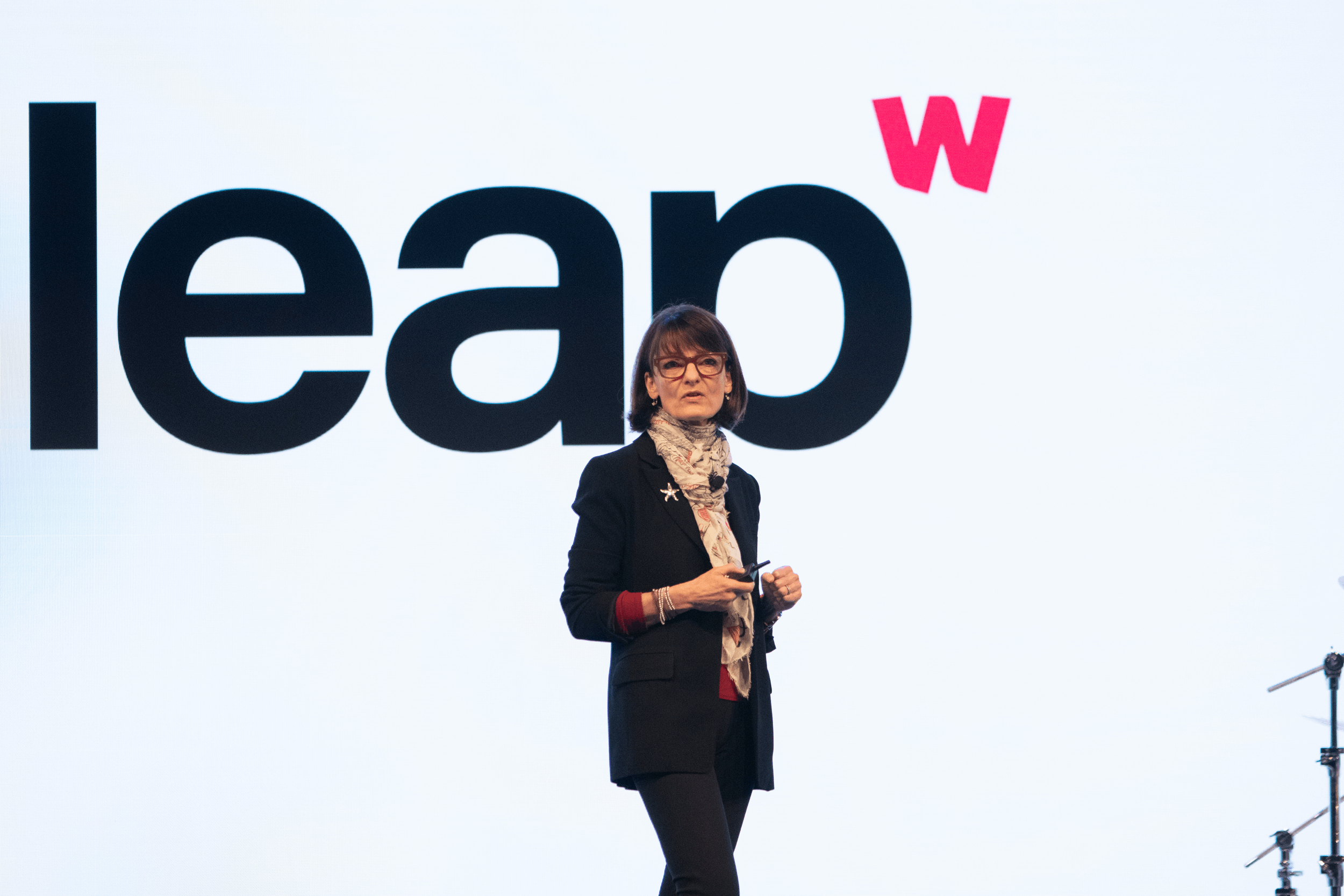
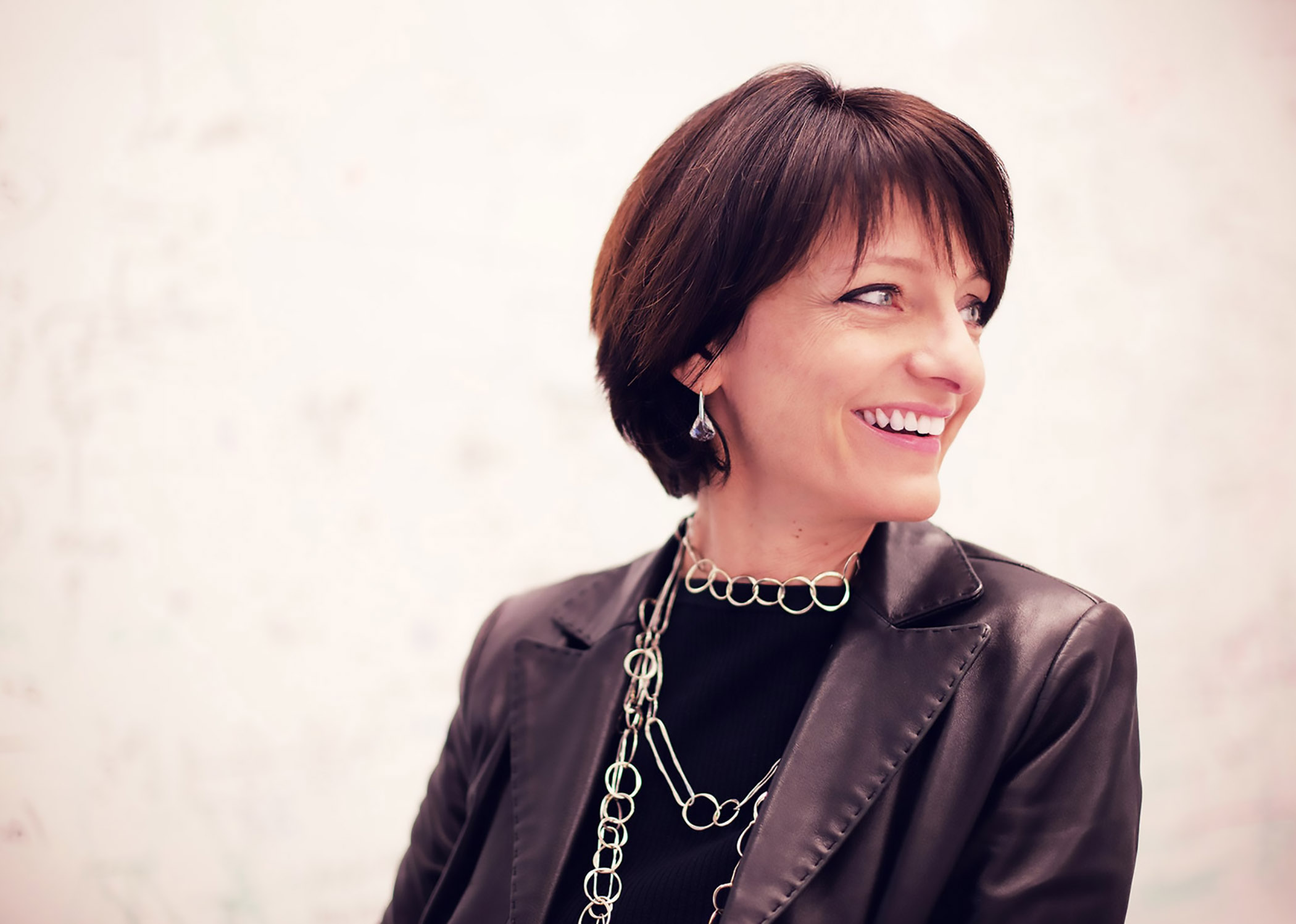
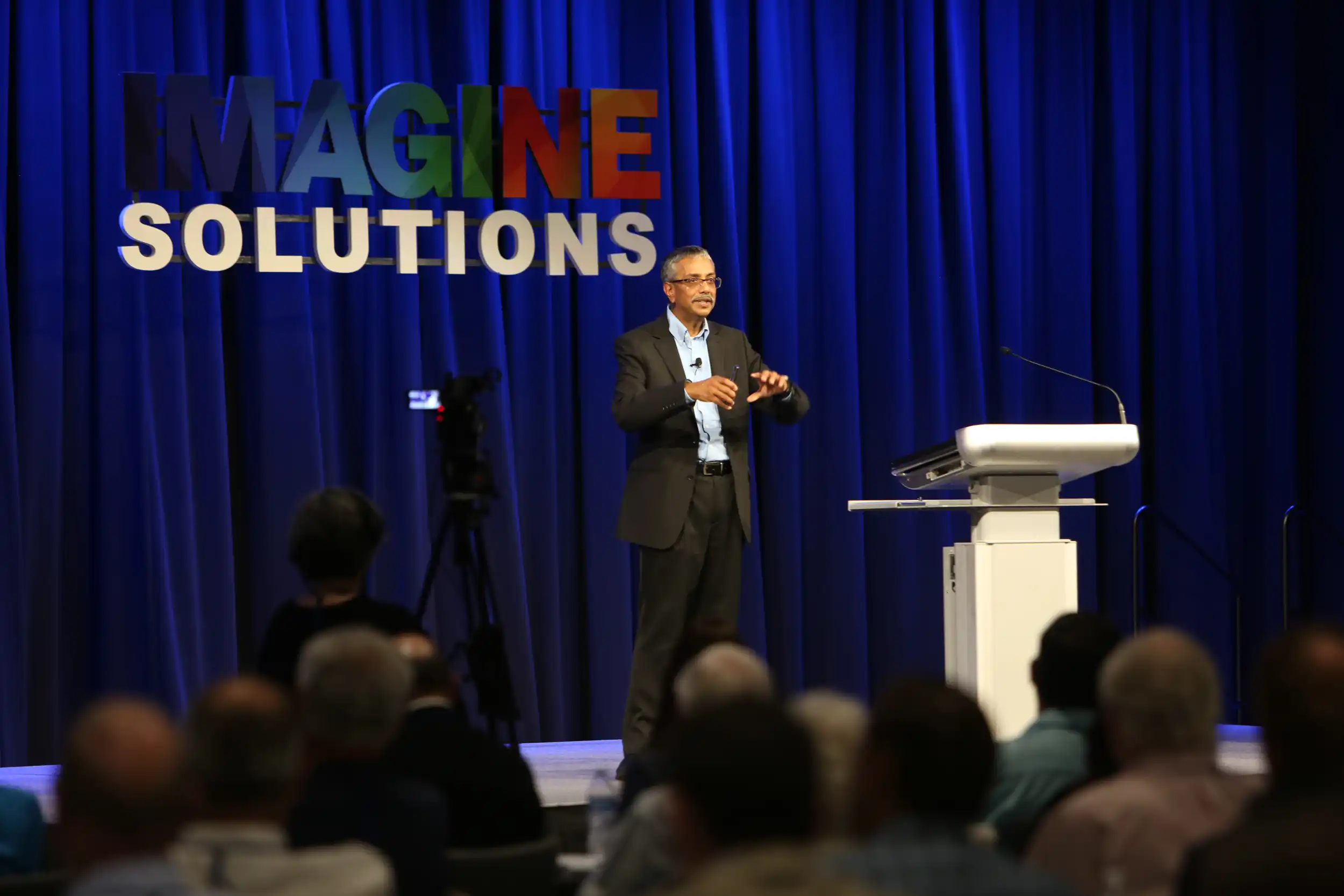
00.06 I'm really looking forward to this next uh uh speaker uh Regina Dugan. She is the CEO of Welcome Leap. She's backed by a billion dollar commitment from the Welcome Trust Plus in partnership with Melinda French Gates Pivotal. She is spearheading a $100 million initiative to improve women's health. She will tell you much much more. But women's health issues, cancers, cardiovascular, autoimmune, cognitive, mental, has been an underfunded research desert for decades. And she is changing that fast. And she's just the person to do it. At DARPA, she was the first female leader from 2009 to 2012. There she was known for collapsing breakthrough timelines from decades to years or sometimes even months. She's had top innovation jobs at Alphabet, Google, and Meta, where she created advanced technology divisions that pushed radical innovation. She's known for disruptive innovation and for
01.02 connecting the world's brightest minds to solve humanity's biggest health challenges. Today, Regina will address what happens after impossible. Please welcome to our stage a game changer like no other, Regina Dugan. Regina, I have spent my life chasing miracles. Uh, in the summer of 72, uh, the doctors told my parents that their nine-year-old daughter would not live to see Christmas. That daughter was me. I had just been diagnosed with catastrophic latestage ovarian cancer and told it would be impossible to beat. I underwent three major surgeries, two and a half years of chemo. It was the early days of chemo. So, they gave me
02.01 five different drugs and there were no anti-nausea meds. Essentially, the doctors poisoned me to the brink of death with a single hope that they'd kill the cancer before they killed me. And yet, here I am. Turns out that sometimes what we think is impossible isn't so impossible after all. My entire life has been about what happens after impossible. Literally, the sense that we can push beyond what seems impossible was formed early for me. It's what brought me to DARPA and Google and Facebook and now Welcome Leap. I have often be been asked all these years later why am I still chasing miracles
03.00 and the truth is it is not just because I am the product of one. The answer to that question is much more difficult to talk about. The answer to that question is my daughter Rachel. Rachel was 18 when I lost her to depression. 18, the age of beginnings, not endings. Rachel needed a miracle to save her from depression. She needed a breakthrough, and there wasn't one. I think all of us in one way or another know the feeling. For all our love and support, we couldn't save someone. Even those of us who are experts in related fields, men and women of science, for all our knowledge, all our power, we couldn't save someone. And so when I look back on my life, I
04.00 see that I have been chasing miracles, not only because I believe in their possibility, but because I know their absence. I know what it means when the breakthrough doesn't show up. Doesn't show up in time. That is the why that built welcome Leap because the world needs more breakthroughs faster because there are millions of people out there who need a miracle and someone to deliver it. We have piqu the interest and opened the wallets of outside funders which has allowed us to make a long overdue bold investment in women's health research. A chance to correct a historic wrong to close a gap that should have never existed. It's a lot almost impossible and yet not. So, what I'll talk about here today is the vision and the model that we use at
05.00 Welcome Leap and then we're going to nerd out a little on some science. So, let's start with what's different about this model. How is it that we generate breakthroughs in such compressed periods of time with such reliability? There are three things that we do that are different. The first is all of our programs are built with an ambitious goal that is also testable and measurable. It must be possible for us to tell whether we succeeded or failed at the end of a program. And what we seek to do is demonstrate this breakthrough at convincing scale enough to unlock further investment so that we can get it to the people who need it. And to give you a sense of what that looks like, when we began, it was originally anticipated that maybe we could launch five programs in approximately five years. And this is
06.00 what was actually possible. five year five programs in the first year, 14 programs in the five years since we have existed, a doubling of investment twice, and close to a half a billion dollars in follow-on funding to transition these breakthroughs to scale. So that's the first thing. The second is that what we do is we network diverse temporary project teams together, create a global orchestra, all serving to accomplish a goal that is bigger than any one of them can accomplish individually. And then we conduct that orchestra with a best-in-class conductor, a CEO type whose job it is to push everyone towards that goal. And here's what that looks like in practice. Here are some of the networks that are formed in collaborations within the programs. What you see here is not notional. These lines connecting researchers all over the world. These are actual
07.01 collaborations that are happening within the program so as to drive us to success. And this is only possible because we have cleared something that is decidedly not sexy. And that is contracting. contracting is usually in the way of forming this kind of team science in service to breakthrough goals. So when we began in 2020, we set a goal. We need a standard contract that everyone can sign imminently fair so that we can begin collaborations all across the world. And in 2021, we had our first 21 signitories of the agreement on six continents. And in 2026, this is what that network looks like. All of these entities have signed the same contract, all terms and conditions. What this allows us to do is accelerate progress towards the breakthrough. It took us five years to build this network
08.02 and it is arguably the largest most readily activatable research network in the world. The third thing is that we move with unprecedented speed. The kind of urgency that drives us towards these breakthroughs is motivated by so many experiences, real clarity about the need. And as I mentioned, we use contracts rather than G grants. And counterintuitively, this actually allows us to take more risk because someone can have a bold idea. We can try it for a year. If it works, then we add fuel to the fire. If it doesn't, we redeploy the resources elsewhere. And what that allows us to do is create this highly agile, iterative environment where we are using the best and the most advances, most state-of-the-art in research driving towards a common goal. Now to give you a sense of what that
09.00 speed looks like, the normal process in moving from an application in research to a selection decision is 12 months. Now I would argue in that 12-month period, the science has changed. Often the people involved have changed. We challenge that very notion and we do something quite different. We make our selection decisions 30 days after we receive proposals and immediately after we are forming the network and we begin working in the same period of time that most are waiting for an answer on their application. We are already yielding milestones and setting pace and culture to drive towards these outcomes together. What we are doing using all of these strategies is systematically stacking the odds in favor of breakthroughs. And this model is a proven model. I've used
10.01 it over my entire professional career to drive breakthroughs. So the most recent addition to our board, Suzanne Norah Johnson, the former vice chairman of Goldman Sachs, described the need for innovation in the health care space. We need to move faster and currently we are all too often moving at snail's pace. And what has inspired her you see reflected these three concepts in the inspiration for her to join us that we have bold timebound goals, global multidisciplinary teams and measurable milestones that we use to progress the programs. And what this has meant in her mind is that we have essentially formed a new model of philanthropic investment. exactly the kind of model and approach we need in healthcare innovation today. Okay. So now what we're going to do is
11.00 nerd out a little on the science. This is what it looks like in practice for us. So just as we were making our way through the pandemic and we all saw what happened with the modern development of vaccines and their delivery in record time. We also saw that access and global participation was limited and that that kind of pandemic preparedness is not economically sustainable. So we asked a question what if we could build a distributed network of biofoundaries that could produce diverse new medicines and treatments and also be ready to surge in the time of a pandemic. And when we started, most thought that this goal would be impossible. In three years, we yielded tremendous advances in our ability to produce new medicines using RNA technology. A hundfold yield,
12.03 scale independence, a quantity sufficient for a mouse experiment and all the way through to produce enough medicine for an entire continent in one day. cell-free capacity at um expert levels and sufficiently prepared to meet the 100-day challenge of response to a pandemic. And those breakthroughs then catalyzed an international effort, a $150 million global effort to build that first network of biofoundaries. And this is what that first network will look like. a few bio foundaries across the world in Europe and in Southeast Asia, a brokerage that connects those who have new ideas about medicines with production capacity and multiple products making their way through for the first time using new design and manufacturing techniques. And then what
13.02 this does is it paves the way for more biofoundaroundies, thousands of designers and engineers who are capable of producing new medicines for the future and at the same time preparing the world so that we never again have to shut down in the advent of a pandemic. What that means of course is that we have economic sustainability, a vibrant diverse ecosystem of innovation and simultaneous readiness in the advent of a pandemic. Now many may not know that much of the world is in need of basic surgical care. We have about a gap of 143 million surgeries that are needed per year. The lack of access to those surgeries results in about 1.5 million deaths per year. And over the next decade, that gap
14.03 is projected to cost approximately 10 trillion in lost global GDP. This is a problem in the US as well. About a third of the US population lacks access to trauma care within one hour of their injury. Surgeons struggle to meet demand. And a lot of the gap here is by virtue of the difficulty we have in training surgeons to perform surgeries. Now this okay click. There we go. This is how we train pilots. advanced simulation, emergency procedures that they may or may never see. In practice, this is approximately how we train surgeons. Now, it's not quite that bad. We actually use box
15.00 trainers to train surgeons. And what we know is that when we use box trainers, we see a 16% reduction in post-operative complications. Even simple advanced simulation or training is very important in surgery. What we have done in this program over the last three years is create the first ever AI generated training simulation for surgeons. What I want you to know is this is not real tissue. This is AI generated tissue and with a physics engine underneath we are providing the first ever advanced simulator for surgeons ever produced and we have the cap capability to train them better because they can also see emergency situations that they may never see in practice.
16.00 And if we turn our attention now to women's health, I want to talk about a silent tragedy. And that is one of still birth. Every 16 seconds in the world, a child is born still. That's two million babies a year. We don't count still births in the global statistics of death. If we did, still birth would be the fifth largest cause of death in the world. In fact, it is larger than HIV, malaria, and heat related deaths combined. In low and middle inome countries, still birth is the number one cause of death. And 93% of these still births are potentially preventable. Now, what's in the way of preventing still births? We haven't had advances in
17.02 maternal care in approximately a hundred years. And so, we aimed to fix that in the Inutro program. Within months, we assembled 33 research teams from all over the world who together worked on advances in maternal care that could lead to a reduction in still birth by half. And within one year, we had line of sight to a maternal blood test, the first ever maternal blood test that could with better than 80% predictive accuracy, tell us whether a pregnancy was at risk for fetal growth restriction, preeacclampsia, or gestational diabetes. These three causes are responsible for approximately 50% of still births. And this is not an experiment. This is not research that we conducted on a hundred blood tests,
18.02 blood samples. This is the result of 11,000 blood samples collected in the course of a few years across three countries. Now, we also know that placental complications are implicated in about 40% of still births. And so we have the question in front of us. Can we assert? Can we determine that the baby is receiving enough oxygen? This is a difficult task to do from a simple sonogram. And using AI strategies, we have turned what is typically a 60 to 90 minute exam to try and answer that question into a 10 to 15 minute exam and taken it such that we can move from expert synographers to novice synographers so as to gain access. And with reductions in cost of about tenfold, we're changing the
19.01 accessibility of these advances. Now, this is a quote from one of the researchers in our inutero program that it was not lost on him that they had accomplished more in two years than they typically would have been able to accomplish in five to 10 years and that they'd learned a lot about how we can change the nature of our research so as to get to more breakthroughs. And at least I think so many of us feel that this is because in the case of still birth, the urgency really matters. This silent tragedy, these babies are still remembered, they're still missed, they're still loved, they're still born, but they're still born. And so this is an example of the work that we are doing in women's health. But it is not alone.
20.00 We have now four programs launched. We have another coming. And what we have asked is how can we move women's health progress? How can we make more progress towards these issues towards these health challenges that affect women differently, disproportionately and uniquely? We talked about maternal care. That is an example of uniquely. But we have many other challenges in women's health that are experienced differently and disproportionately. Women experience cardiovascular disease differently than men. It is the number one killer of women globally and disproportionately 80% of all autoimmune disease is experienced by women. For far too long we have treated research for women's health as if women are small men. Women are not small men.
21.03 99% of the studies on the biology of aging do not include a transition for menopause. Women are 50% of the population. That is not okay. And the list goes on. So we are changing that. Together with Melinda French Gates, last September we announced a hundred million dollar investment in women's health. That brings our total investment at Welcome Leap to 250 million. Because these are not medical mysteries. These are problems to be solved. The gap in our understanding of women's health is not small. It is a chasm. And it is time. Women have waited long enough. So I want to conclude by talking about the very urgency that
22.01 so many of us feel when our loved ones, our community face health challenges in the world. 800,000 suicides a year. More than 2,000 a day. Two million babies lost to still birth every year, one every 16 seconds. 18,000 new cases of Alzheimer's every day globally. 12,000 of them, two out of every three, to women. What if we had better solutions faster, sooner? At leap, we are running toward all these hard problems, the hardest problems, the seemingly impossible problems, the my child needs a miracle problems because those are the problems worthy of our whole selves.
23.01 My wish for everyone here today, every scientist, leader, person here or hearing this message is that you chase a few miracles. Because if your experience is anything like mine, you will sense that you are more alive, more present, more full of wonder and curiosity, of passion and hope than you were before. And because if we do then together we can turn a disillusioned world toward possibility and a doubting world toward hope. That is the urgency and the purpose the world needs from us today. That is what happens after impossible. Thank you.
24.01 Regina, thank you very much. Of course. Thank you for your work. Thank you for your persistence. And thank you most of all for your impatience. Yes. Exactly. Good.