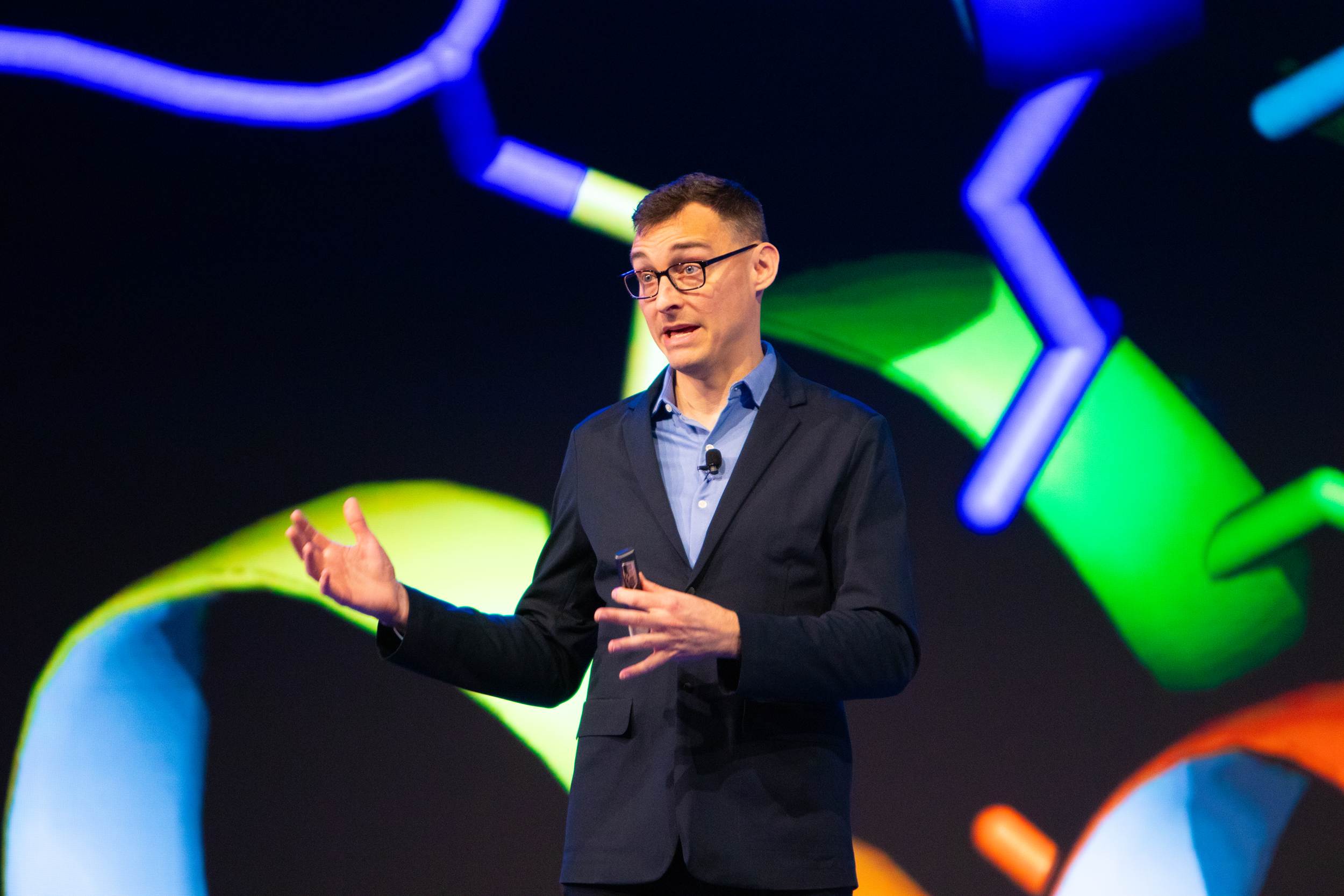
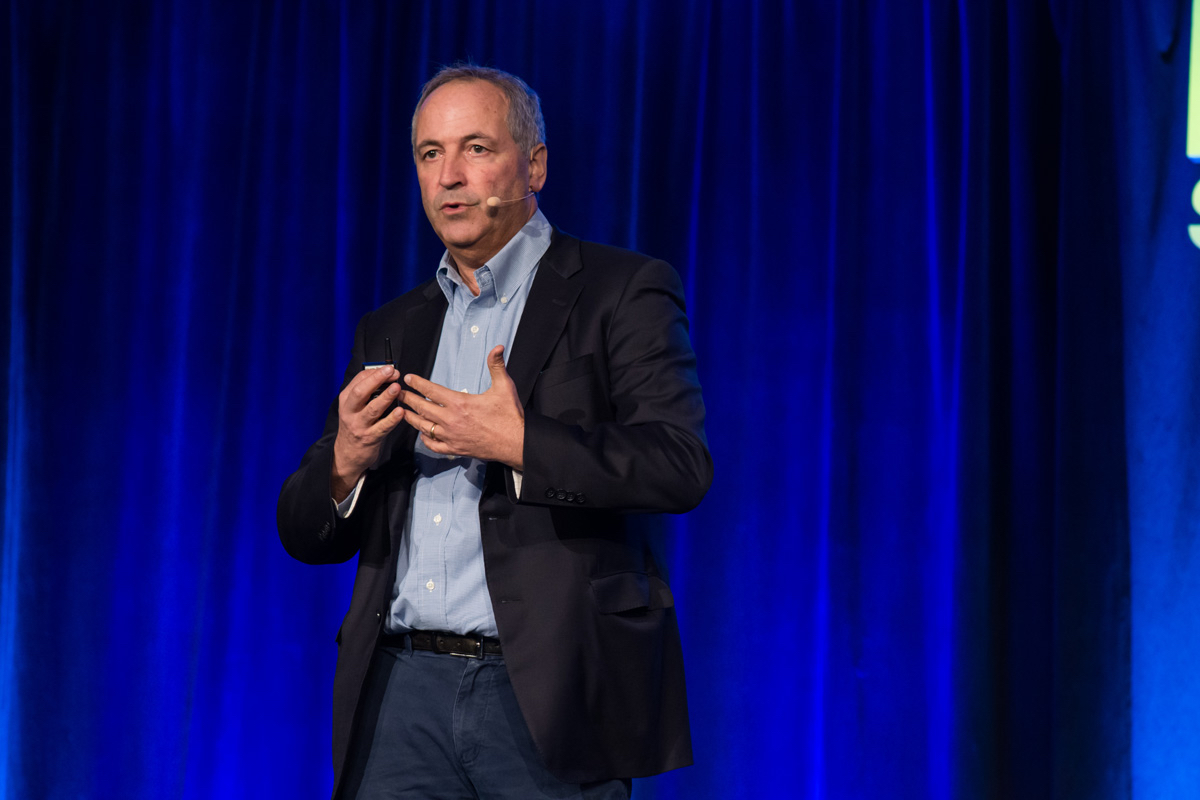
00.00 Our next guest cracks the code of life. Chris Ball is a worldclass biologist. He's the founder and CEO of AI proteins. AI proteins cracked the code to design entirely new proteins from scratch, molecules that could transform medicine literally forever. Their breakthrough is staggering and represents the birth of programmable biology. In effect, scientists using generative AI, robotics, and synthetic biology can design proteins like engineers design bridges. These proteins in some cases are 20 times smaller than antibodies, meaning they can penetrate tissues that antibodies cannot reach. The therapeutic possibilities here are almost beyond imaginating imagining, potentially transforming the treatment of cancer, neurodeenerative diseases, and infectious killers the world over. Here
01.02 to tell us about the brave new world at the intersection of artificial intelligence and medicine is Chris Ball. Chris, welcome. I'm excited to share with you today a little bit about the future of medicine. So obviously modern medicine is pretty incredible and the origin of most of our of our medicines actually came from the environment from nature and I'm here to make the case that the next generation of medicines that are going to be very exciting won't be found somewhere but will instead be designed on purpose to be medicine and to do remarkable things. But before we get into the science I would love to just take a moment to acknowledge my team. So the company that we that uh that we founded about four years ago uh prior to this I was a professor at Harvard Medical School and
02.00 the Institute for Protein Innovation and we were making some really exciting progress in the lab and we wanted to accelerate our efforts and so I quit my job in academia canceled all of my grants and took the plunge joined full-time this company that we founded. I'm really fortunate that my team followed me to the company and we've just about tripled in size since we launched and the story that I'll share today is really the story of this incredible team of people. So, we've had some awesome talks about history to start the day. So, I thought it would be fun to maybe begin with a historical analogy to emphasize the magnitude of this technology change here. So, we're based in Boston. This is the James Blake House constructed in 1661. It's the oldest house in Boston and it's a pretty remarkable structure. It's definitely stood the test of time, provided shelter for generations. Um, and it's largely constructed out of things that we just found in the environment. Here's a
03.00 photograph of the forest in New England. You can see the rocks and the trees and the woods. They're shaped a little bit and they're fit together to form the foundation and the bones of this house. Another thing that we found in nature is this remarkable medication. It's called Adalimmaab or Humira by the brand name. Some folks in this room may be actually taking this medication. It's a great way to treat many different inflammatory diseases like rheumatoid arthritis, different psoriasis conditions or um inflammatory bowel disease. It was also identified from nature but not the woods but us right we are natural and this medicine was identified from the human body it's a antibbody now looking forward here's the credential center this is the tallest building now in Boston and as you can see very clearly it's not made of rocks and trees you need more sophisticated control over the materials that you're using right we have concrete and steel now and if you were to show this
04.02 structure to someone from 1661, it would blow their minds. This is so much more sophisticated than the James Blake house. It can do a lot of things that the James Blake house cannot. And I would argue that the next generation of medicines that are going to be a similarly sized leap forward are on our doorstep. And it's going to be quite amazing. But we're not finding them in nature. We're going to need more advanced tools like synthetic biology, artificial intelligence, robotics. All of these advanced technologies need to work together in harmony to be able to manipulate these molecules to be the next gen of medicine. Now, humira or adelimmaab is a biologic medicine. It's made of protein. We focus also on engineering protein to be medicines. And so I thought it would be helpful maybe just take a moment and review what is protein. I think for most people when you hear the word protein
05.00 your first association is food. Food obviously uh protein is a very important component of food. It's essential but it's so much more than just food. Uh I think genetics and DNA have done a very good job of explaining themselves to the world. Everyone is aware that DNA is your genetic material and you you pass it on. Your DNA is what makes you you. But what does DNA really do? How does it do that? DNA encodes information. It stores blueprints for building proteins. And proteins are actually the biomolelecules that mediate the chemistry of life. They actually do the stuff that makes you alive. And they're built out of these components called amino acids. And they're attached together and to form long chains. Here's the most standard amino acids that we see. You can see their chemical structures. We don't need to worry too much about the exact chemistry here, but instead think about them in two broad buckets. You've got some oily amino acids and you've got
06.01 some salty amino acids. You know that if you pour oil into water, they separate. They don't like to go together. And if you put salt in water, totally fine. It dissolves in solution. So what happens now when you can take them and you attach them together and you've got your oily bits and your salty bits and now you have one chain. The really exciting part happens when you put this in water. So our bodies are mostly water. So our proteins are in water all the time. So the oily bits don't like to be in water. And so this molecule rearranges itself and tucks all of the oily parts to the inside and puts the salty bits on the outside. And so this, you know, flat 2D representation helps to understand what's happening. But here is a three-dimensional structure of what a protein looks like. But even this is a cartoon that we structural biologists use to try and wrap our brains around the fantastic complexity of these macroolelecular structures. Um, so let's zoom in and
07.03 remove these helpful cartoons so you can get a sense of what proteins really look like. These uh molecules are exceptionally complex. Um this is actually the structure of a protein that I determined myself a naturally deter u a protein of natural origin as a graduate student about two decades ago. Now there are many different types of atoms uh many different types of bonds. So you've got some coalent bonds, some ionic bonds, some hydrogen bonds. There's also key water molecules that are coordinated in these structures. And it is dizzingly sophisticated and intricate. The human mind has kind of a hard time comprehending all of this. So now can you imagine trying to design something like this from scratch? It's really hard. Uh there's a in field of protein design that I've been in for quite some time now where we actually do this where we don't just observe in nature, we build it from scratch. And it's pretty hard. It's taken us a long time to get
08.01 good at this. And it's really just in the last few years that things have gotten really exciting. And this, as you may not be surprised to hear, has been the introduction of artificial intelligence. So, I'd like to go through a little bit about how we do this, but um and really just focus on the one major algorithmic breakthrough that's enabled this recent acceleration, and it's something called a diffusion model. Whether or not you know how these work, you probably have encountered diffusion models if you've seen all of these AI generated images. Diffusion models are how this works. So let's just step through really quick. Right on the right side we've got our nice picture of a cat. We could recognize this. So how we make these algorithms these neural networks is you train them first to add little bits of random noise to the picture. So you do this in steps. So as you can see we're stepping towards the left. The um cat gets fuzzier and fuzzier. at the end you've added so much noise that it's just indistinguishable from
09.00 pure random static. Now this is not super helpful to make things noisy. What where becomes really exciting is now when you take this neural network and you run it backwards and each step you train your algorithm to take some of the noise out and eventually it goes back to a cat. Now your brain is also a neural network and it can do this right if you look at the picture maybe just adjacent to the full static you can still sort of recognize a cat in there and you can imagine in your mind's eye a sharp photograph of a cat. This is effectively what these algorithms are doing. So you can start now with random noise and generate full pictures. We do the exact same thing with three-dimensional protein structures. So we begin with noise and we have these specialized algorithms that are trained on all of the known protein structures and then slowly we can turn that random noise step by step into a full three-dimensional model with all its dizzying complexity. Now there's many other computational methods that we use
10.00 to refine these structures to imbue them with function and the properties that we want. Um but this is sort of the the main highle breakthrough. but know that there's kind of a lot more complexity underneath. So now that we have the ability to design basically whatever we want, the question then becomes, well, what do we want to design? So we specialize in this one particular class of proteins called mini proteins. As the name suggests, they're small proteins and being small has a lot of advantages. And because we're designing them from scratch, which we often call denovo from the beginning, we can imbue them with the exact properties that we want. We don't have to try and shape something that evolved for hundreds of millions of years to do something whatever it is that isn't medicine. So we designed them to be incredibly stable, which is a big advantage. If you've ever taken a antibbody drug like adelimmaab, you know that you have to store it in the refrigerator because the medicine itself isn't that stable and it
11.00 will go bad. Our mini proteins are so stable we in fact we can boil them. Their small size allows them to get around the body in all the little nooks and crannies that you you want to access like maybe an inflamed joint or a solid tumor that's just like a dense mass of tissue and doesn't really have a lot of blood vessels going through it. Another important thing, especially with biologic medicines, is your immune system will start to learn this foreign substance, react to it, and neutralize it. We don't want that to happen. We'd like the medicine to keep working. And so, we also can predict how this will occur and engineer our medicines to avoid this unfortunate phenomenon. We can control where these medicines go in the body and how long they stay there, how long it circulates through the blood and which types of tissues it likes to reside in. And perhaps most excitingly, we also can take all of these super cool features and package it up into an individual module that we can
12.00 click together like Legos. And so this is where the big leaps forward start to become truly possible. Almost every medicine that humanity has today works by interacting with one target in the body, doing one thing. Obviously, biology is very, very complicated. And so, you'd ideally like to be able to do a bunch of different things. That's where this modularity comes in. You have now the ability to do multiple actions inside the body, provide messages that direct the proteins to go to certain places, um, and to carry out all of these like more sophisticated functions. So let's talk about one example of this. Um we're doing many things with this medicine but um I think maybe one of the ones that's I I think it's most exciting is in this concept of immune cell engagers. So these are medicines used to treat cancer and instead of being toxic like chemotherapy and just poisonous and bad instead these medicines work collaboratively with your immune system.
13.00 So they find immune cells, engage with them, bring them to tumors, and then direct them to kill those tumor cells. Your immune cells are already actually quite good at attacking cancer. And so all we're trying to do here is supercharge your natural immunity to cancer. So here we're showing an immune cell in blue and a tumor cell in yellow. And uh cells decorate their surface with many different proteins. And those proteins can have lots of different functions. So the blue one, you've got these little proteins on the surface. These are activating receptors. Those immune cells use those proteins to make decisions. They're going around your body interacting with all sorts of different tissues and cells and making a decision. Is this a normal healthy cell that I should leave alone or is this a bad tumor cell that I need to attack and get rid of? Now, on the tumor side, tumors are weird, right? These are not normal cells. They're not doing what they're
14.00 supposed to. And so, they've they've changed. They're different than normal healthy cells. And often times, they have different proteins on their cell surface than you would normally expect a cell to have. And we can identify these and use them as an Achilles heel to pick out the bad cells. And now the engager has multiple components. It binds to each of these, brings them together and triggers that immune cell to attack. So we didn't invent this concept. There are about a dozen drugs approved by the FDA now that do this. And we thought this would be a nice foundation. Let's start here and then build complexity on top of this. So we wanted to first recapitulate this action using our mini protein modality. So on the far right of the slide, you can see the schematic of the drugs that we made. Um, we already went beyond two components and added three. Some experiments that we're not showing here, we found that having two copies of the part that binds to the immune cell actually made these drugs way more effective. So right out of the gate, we're stepping the game up a bit.
15.02 Um, we also have a nice a nice ability to make control molecules. So in gray here, we've taken the same mini protein structure that does something and we've taken those amino acid components and swap them out so that it no longer has its action, but the overall shape and structure of the molecule is preserved. And so this allows us to really precisely break different components of our drug and make sure that the whole thing is functioning as we expect and all the parts are doing what they're supposed to. So in this experiment, we take human immune cells, we take human cancer cells, and we mix them together in a dish, and then we count the number of tumor cells that get killed. This is what we're showing on the Y ais. And then we want to see how potent our medicine is. And so as we go from the left to the right, all the way on the left, we don't add any drug. We just add in a little bit of salt water. And then as we step towards the right, we're adding more and more and more of our drug. And this allows us to see how potent they are. The red line is where
16.02 we have our fully intact drug. And so on the the two the graph on the left in the middle, you can see the curve increase. This means that we're getting more anti-tumor activity as we add drug. And these are exceptionally potent medicines. The far graph on the right is a control. So in this case we have a tumor cell line that is different and does not have the target that we've engineered our drug to pursue and so that we don't want to see activity here because this means that what we're doing is very specific very selective. So now together these data the conclusion are that our medicine directs immune cells to attack tumors with extreme precision. So this is a dish we want to see how this works in something that's alive. So here we're testing these molecules in mice. Uh so these mice we've implanted with a human tumor. First we have to actually remove the mouse's natural immune system for this um so that
17.00 they'll graft a human tumor. And we've engineered these human tumors with a gene from fireflies. And this allows those tumors to glow like a firefly will glow. I mean we administer a chemical to these mice. And this is a really helpful tool because it allows us to keep track of those human immune cell, those human tumor cells that we implanted into the mice. We can see how many there are uh the burden of disease in these animals. And so, you know, we tested 10 animals in each of these conditions and we followed them over time. And so, as you go from the top to the bottom here is is time is is passing. So, when we don't give them any treatment, they just get a little bit of salt water. You can see the tumor grows quite a lot. And in day 17, that intense red color means that there's really quite a lot of this human tumor growing in these animals. When we give them just the engager that we engineered, we don't see any impact, right? These molecules aren't toxic. They need immune cells to collaborate with to be functional. When we give them some immune cells, they have a little
18.00 bit of activity, but we're not doing very well. Um, it's when we add them together and they synergize that things get really exciting. And now we can see really robust control of disease. And this is effectively reproducing the state-of-the-art, but you can still see a little bit of glowing in those animals at day 17. We haven't cured them. We've just controlled the disease. And we really want to make cures. So this is the James Blake house. Let's talk about building the credential center. So this molecule is so much more advanced than anything that has existed today. This is in fact a prototype molecule from our lab. This is the world debut that this exists and we've never talked about this in public before. This has 11 components way beyond anything before. And now it's so much more sophisticated. We can target multiple things on the tumor at the same time. We have so much ability to interact with immune cells. It's almost like we're having a conversation with those immune cells. We can trigger
19.00 multiple different activating receptors. Tumors often have mechanisms to try and protect themselves to block the activity of those immune cells and protect them from being killed. We can intercept that signal now and and stop it from happening. And we can also extend the time that this molecule persists in the body so that it has more time to do what it needs to. And so again, you can see our our uh graph where we're red line is going up. We're killing the tumor cells. And we're also showing here an experiment where we looked at the immune cells and their response. And you can see them turning on, getting riled up, ready to attack. These molecules are in animals as we speak right now. And we're very hopeful that they will actually provide cures. And at some point, the goal is to put these into into patients. So hopefully today I've been able to give you a little bit of a glimpse of what the future of medicine looks like and why they're going to be so effective because they can do so much more. It's
20.00 when you use denovo protein design that unlocks this. And I'd like to leave you with just a couple of parting thoughts. We talked about AI a lot. In this case, AI is nowhere close to replacing humans. We really need humans in the mix to do this. Um, and so biochemists, biologists, drug discovery, AI is not going to make your job obsolete for a very long time. And our mission obviously is to make these transformative leaps. And we know that patients need these medicines urgently, but we don't want to hurt people. And so we're being very cautious, very meticulous. We're going to make sure that these medicines are as safe as possible, and we've shown that before we administer them to a human. Our our first clinical trial is planned for 2028. Everything I've talked to you today about has been medicine. But these molecules can do so much more than just medicine. diagnostics, um, agricultural applications, biod
21.00 defense, human enhancement, all of these things are possible. We're starting to dip our toes in there, but we don't want to be distracted from delivering transformative therapies for for cancer patients. And finally, a modality like this is a once in a generation opportunity to make a huge difference. Um we're a startup and we've devised a business model that will allow us to generate maximum returns for our investors by helping the largest number of people. So we've adopted this hub and spoke business structure and if folks are curious to talk about the business of science uh would be delighted to to have a conversation during the breaks. And with that u thank you so much. [applause] Quick question before you leave Chris. Um, I think you may have just answered it in your last in your last slide, but how far away are you are we from the deployment of that last mighty engager
22.01 protein with 11 different sort of thrusts involved? How far away are we from seeing that in the marketplace? And how many millions or maybe hundreds of millions of dollars is it going to take to bring it across the finish line? So, uh, the first medicines that we're we're starting in 2028 are not that molecule. Uh, those are smaller, simpler things that still solve really important challenges. The ones you're working on are smaller, simpler. The the ones that we'll put into the clinic first, right? Um, you need to make sure you're building methodically. So, while we have this prototype molecule in the lab that does amazing stuff for laboratory animals, uh, that's not going to go into a human anytime soon. So probably another 10 years before a molecule like that is on the market and and you obviously you have investors. How many millions of dollars is it going to take to bring this across? So the finish line it it many hundreds of millions. Um but it doesn't we don't have to do it alone. So part of our business model actually
23.00 is partnering with big pharma with other biotech companies. Our mission is to have the greatest impact. If we have to do that by ourselves our impact is very limited. By working and collaborating with the entire biotechnology industry we can do so much more. Chris, thank you so much. Appreciate it. Chris Ball, ladies and gentlemen,