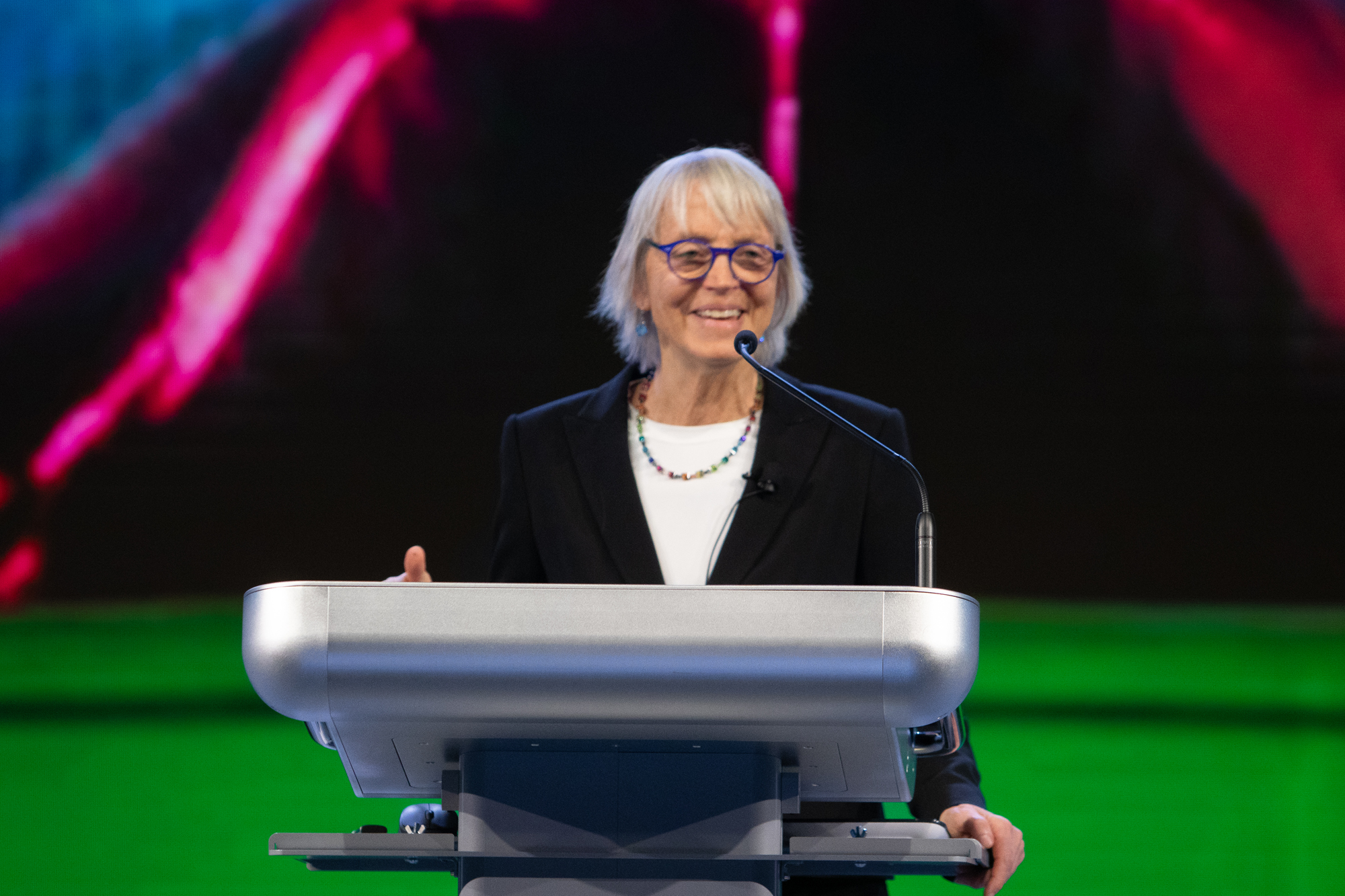
00.06 Dr. Gun stands as a pivotal bridge between the complex world of bioscience and the public understanding essential for its adv advancement. She's the originator and host of Biotech Nation, an influential and hugely popular audio platform that translates complex bioscience information into understandable narratives. She's conducted more than a thousand interviews with scientists, biotech CEOs, and investors, making an often opaque world eminently clear and understandable. Here to talk about translating scientific discovery into real world health solutions is Dr. Moira Gun. Dr. Gunn, welcome. Uh yeah, technology is the silent partner of history. I mean, if you look back, I mean, we talk the wheel, control
01.01 of fire, you know, but then, you know, like medieval times, you built your castle, you're good. you know, they they can come up as much as they want, but then over the hill you're like, what's that? Oh, darn. It's a catapult, you know, it's like, who saw that before? So, technology keeps changing. We keep changing, adapting, and that's that's where we're uh we're headed here. So, every shift in technology uh is a pivot for those who are affected. And in today's fast-paced world, uh every major pivot is global. And every major fi pivot affects humanity now. We no longer make a change and it's just us. It's everybody. So the major pivot I'm talking about today is biotech. Now uh Randy asked me to said you need to get in there and tell you few things about yourself. And I said well okay and I have a BS and MS in computer science. Then I became the
02.01 first woman from Purdue to get a PhD in mechanical engineering. worked at NASA in largecale computation and satellite image processing and in the private sector in robotic engineering systems and even with the US Department of Agriculture. I have a patent in human nutrition research. And frankly, I just I'm just interested in things. That's why I kept like, well, this is interesting. Let's do this. Well, that's interesting. Let's do that. And then in 1993, I started TechNation uh which is a public radio show um at KQED in San Francisco. you may have heard of. It's the largest public radio station and we're uh distributed on NPR affiliates and global distribution and uh if you uh I think everybody in this room knows about Car Talk. Well, the Car Talk boys, they started theirs at uh WBUR and and Boston and we're all under contract to NPR, but you'll never hear NPR's con, you know, car talk or NPR's technation. We're all independents and so they like
03.02 us and we like them but that we still have all the control in the world and that let me decide in 2004 here I'm sitting in San Francisco which is we all know about Silicon Valley and all the technology and I just kind of didn't look right down in South San Francisco here's one of the world's largest bioclusters and it's where biotech began and I said oh well let's uh let's add biotech nation let's do that so I was able to do that and we just got instant distribution and then now academics and media for me started to run in parallel and in 2006 I joined the faculty of the University of San Francisco and by 2009 I started adding bio entrepreneurship to the graduate uh curriculum that's everything from the lab bench to a registered product that's where all the risk is that's where all the excitement is sort of from my days at NASA and it's like ah I don't really care about manufacturing or sales or any of that. I
04.01 want to say what are they building now? What's next? You know, what do we what do they have in the hopper? And so we served MBAs, JDMBAs, uh, masters in information systems. And then by 2012, overcame the college of arts and sciences and the bio department. They said, "We want to do a masters in biotechnology and we want to add your courses to our masters in biotech." And I said, I'm going to throw the scientists in with the MBAs. This is going to be fun with the lawyers. Oh, it was really it was really fun. But uh it really helped me. It was I was not just influenced by the biotech nation segment. I als it also the teaching and and interacting with the challenges of everyone talking together also came along and uh influenced how I would do things on the radio. Uh so today, professor and director of bio entrepreneurship at USF and host of TechNation and its segment biotechnation uh on NPR affiliates. And
05.02 now of course we've got a complement of podcast venues or as we like to say anyone anywhere can listen to us. Times have really changed over the 30 years we've been producing the show. And then Randy put this in the program. $1.55 trillion world dollar world of biosciences. And I had to laugh, you know, because uh people kept coming up to me last night and the night before going, "What is this 1.55 trillion? Is there really that many?" I go, "Well, the silly thing is is it comes up in two ways." Here's the first one. Um and that is uh in all sectors. If we take all of biotech, which isn't just the um um you know biioharmaceuticals and diagnostics and all those things that are going on, but in the United States, we have genetically modified food. All of our soy is genetically modified. Many of our
06.00 vegetables are ah but our potatoes, don't don't spend a dollar more a pound over at the organic potatoes. Gut news, none of them are genetically modified. just buy the cheaper one. That would be the way to go. But all over the uh uh the the uh earth actually all of us remember there was a time when all suddenly it was so terrible to put our uh liquid into our uh our washing machines because it was being bad for the water supply and all of that. Well, biotech solved that with enzymes that would clean your laundry and then dissolve into natur back into natural ingredients. So, that was no longer a problem as it had been for years. So, we see it again and again. This is one uh people's uh representation of the market and they separated out biioinformatics for some reason. We don't know why but basically 60 65% of the world's uh
07.00 revenue of biotech sector is $1.6 trillion just over the 1.55 and then biofarmaceuticals which is just a part of that um is part of the global biotechnology industry um and that as as a the global biioharmaceutical technology industry is 1 need six trillion dollars also. So it's like pick any number you want. Ry's right. We got the right number here. Now the thing that's interesting is that biofarma today is um about 27 about a quarter of the big pharma industry. And as it turns out, our biggest and one of the first uh biioharmaceutical in uh companies was Janentech. And Janentech today is still Janentech, but it's wholly owned by RO, one of the top one, two or three pharmaceutical firms in the world depending on the year because they sell
08.00 and they buy things and revenues change a bit. Um and so they're use bio the global bio uh pharmaceutical industry is using the biofarmaceuticals as sort of their R&D. You can't pick up the paper or look online or look at any of the investment and not say oh so and so bought this company for this amount of money. It's their R&D and they invest in and they give small amounts of money to small by their standards and that's what they're looking. So that relationship between biioarma and pharma is very important to understand because why develop a manufacturing facility? Why develop uh sales and marketing? Not really necessary. So what are biofarmaceuticals? Really important to understand. This is the simplest explanation. It is not complete but it is accurate as far as it goes. Um and that is traditional pharma we think of as pills. Now, yeah, you go
09.00 in and you get a you have to get a shot or something, but mostly we're getting pills, and these are called small molecules. In biioarma, we usually have to get infusions or injections, and these are large molecules. Now, you can bet if you can figure out something that a large molecule can do, is small enough you can make it a pill, that's a really good business move. But mostly biioarma is large molecules infusions or injections. And I'll show you what it's like. If you look up this is the chemical structure of two drugs that you know aspirin for one off the shelf and the other is ompic. Now aspirin is so small. It's a small molecule that we don't even get the biological version of it. They chemically syn synthesize this. So we get the chemical version of it. They can stamp it out one right after the other. We can take aspirin. Very clean, very simple. But ompic is so big, our
10.00 medicinal chemistry can't make it into a chemical. I mean, they can make it into a pill, but you your stomach acid, it'll never get to your system. And that's why people on OPIC once a week or however often it is, they take a little jab. The amazing thing is is they've been doing a lot of uh uh injections in Europe for many years. It's not a problem. And the United States from a marketing standpoint has not been popular. Seems to me we're getting a little change in attitude now that with all the GLP-1 drugs. So that's different. Bioarma versus pharma. We're still looking to biology to change our our state of what we're doing. So how does this fit in honoring our past creating our future and uh this is from the pharmaceutical research and manufacturing association and it's telling us 74% of medicines in clinical development are potentially first in class a new nobody ever tried
11.02 it with this kind of technology possibly a possible new pharmarmacological class. What is that class? biofarmaceuticals. Here they are. We look right down the line. The percentage that are with that are looking at in bio 79% for cancer, 73 for cardiovascular go right down the line. In the 70s or Alzheimer's, 86% looking for solutions in this larger molecule area. Now that we understand DNA, we understand a whole lot more about the body. Here's a visual representation. Phase one, phase two, phase three. You need all of those to finally get approved by the FDA. Look at phase one, you know, 82%. There it is in the green biioharmaceuticals. Then you get to phase two, that's longer and stronger, if you will, got to figure out more things. Then it's 72%. Then you get to phase three and it's oh gee, you
12.00 know, half it's like, but then finally at the end it's only 44%. And that is because that orange is the traditional pharmaceutical that we know so much about. A lot of those are me too or me slightly different. We have a lot more background in it. The odds are you're going to get that through. But it won't do what the pharmaceutical is. Now we all remember the pandemic and we had three vaccines. We had two which were called M&R uh which was Madna and Fizer Biioentech and the other was Johnson and Johnson the same old trusty vaccine. Now the what they did with the M&R vaccine is they took a little bit of that spike protein decoded it and said okay how do we make this? Now remember you you everybody here knows they got DNA. Well, to execute that DNA, you had to take a little bit of that and whatever your DNA is, you've got all it really is a series of programs like on your on on your uh
13.03 uh on your phone and it just picks out that converts it to M&R. M&R executes, creates a a protein. So instead of worrying about your M your your DNA, it gave you a the MRA that created that little portion of the spike protein, a decoy. So that when COVID showed up, it said, "We've already seen you. We've already got antibodies against you." So what did it do? Was basically 100% coverage. But then with the standard vaccine uh from Johnson and Johnson, 66% coverage. What happens then is the spike protein it um uh mutates and it's like uh oh now what do we do you know it's like it doesn't work anymore you have to make a new MRA vaccine scene but Johnson and Johnson still 66% effective so feeling lucky it's all about what you
14.00 want to do here so these are the differences between these kinds of drugs so we're talking about building biioarma today. But it's not easy. Uh it's got innate risk. Success is not predicted from the outside set. There's a lot of things that can happen. You need a creative entrepreneurial um uh uh organization and you have to deal in with unprecedented things. More importantly, today to get to the FDA from that lab bench, it takes 12 to 15 years to get through all those phases. Only 12% of the compounds make it. One to2 billion dollars of investment. One billion dollars if you have it, two billion dollars if you need somebody to give it to you, and 3.2 billion to average all attempts. Only one out of nine drugs make it. This is not a great place to go and just make money. If you want to do that, we got a lot of other places. Call the business school. They really know how to make money there. Why
15.00 do people do it? because they can alleviate human suffering because they can they can delay or avert mortality because they can change people's lives. That's why why they're in it and this is the way we can get those drugs. So now let's get to biotech nation um as we have it today. Um I believe that every everybody would want to know about this biotech uh interviews. We can make them compelling and understandable to the mainstream or audience. But the hard part biotech CEOs and chief scientific officers caused now I think many of you may remember CP Snow. Um he was a scientist, a novelist and and much more. Um and in 1959 he gave the University of Cambridge famous read lecture about the two cultures. It went on to become an essay and then it
16.00 became a book. You can even get it today. He talked about the gulf of mutual incomprehension between the sciences and humanities. So I was sitting there going we got science and we got the mainstream audience. Holy moly, what was I thinking? you know, and uh and it didn't take too many interviews for I recognized that gulf. I'd seen it before at NASA because I had degrees in science and engineering. So, I had a little tiff with an engineer here. She said, "Oh, she's a scientist." Little tiff with the scientist. She's an engineer. Two different ways of thinking and looking at the world. How do you bring them together? So, what's everybody's favorite topic? Come on, know this. Know it for the rest of your life. themselves, you know. So, I had to find a way to talk about biotech that had to do with everybody. And that's what we did. Why? And then why would they want to listen? Because
17.00 biotech can bring hope to them, to those they care about. I don't care who you are. It happens to me. It's like, well, the medicine hasn't quite gotten there for you. Like, oh no, is it coming down the pike? And how is it? How do we help it come down the pike? How do we do this? When can we expect it? Can we participate? What was it that Steve said earlier? It goes, "Well, I wanted to join this this study, but they couldn't get enough people to do it, you know, changing our attitudes there and understanding it." So, now again on Biotech Nation, there's a pre-in a story development zoom. And I'll tell you, you know, when Chris B was up here, he said, "Humor." We're like, "Oh, we all know Humera." And then he goes, "I do with a bum mob." And then then later on I thought okay well he's done with the adalam and he says humumeira again but he couldn't help himself. Chris couldn't help himself. He says that's you know and it's like can you imagine if this the talk was on hum you know it would be again and again and I saw this all the
18.01 time. These people come in and they want to talk about these names and finally one French firm says well yeah and I want to talk about the name of my drug and blah blah blah blah blah. You know I'm like okay what's the name of your drug? And they say Mona Lisa mob. I went Mona Lisa mob. You could say that name anytime you want. That's that's a great name. And that mob that mab monoconal antibbody. So it means something scientifically. But to your ear monisa mob is just the Mona Lisa makes it really good. Then sometimes we do a second zoom. Then we do the recording and I go through what I think the questions and answers are. And finally we get to the recording which is then edited. a lot of work and hats off to the guests who participate, but we have to get it. So everything is you don't stop. If you hear words you don't know, you don't know. You you will stop and and kind of miss things and then the second time, forget it. And I got to run through slides here. Why is this
19.00 worthwhile? Well, we're looking at speedy interventions for heart attacks. right here in Florida, they're doing a study uh in in um ambulances in the early the first hour or so of the heart attack and injection or actually they just put it in your uh IV line if they come with you for an ambulance of just glucose, insulin and a potassium and this is an amazing amazing first act into that's all that is but it changes the outcome of heart attacks. euphoria suppressing opioids. Uh it turns out that part of the reason we're getting people addicted is they are both they get a euphoria. That's only about a quarter of the people and another quarter and and if when that overlaps with an addictive personality we're getting the addiction. How did they figure out what was euphoria generating? Because we don't know. There's a set of people who are not addictive to it but they get the euphoria and they have these euphoria parties on weekends. So
20.00 they gave them all these combinations. They're like, "Ah, that's terrible. Oh, that's great." You know, like, so you never know how science is going to go. Insulin cells without amunosuppressants. Right now, you've got to do it. We're in the final stages in California with son biotechnology on that investment advestments. Oh, I'm going to go over time with co quadriplegics now called tedroplegics that they in fact if a friend of mine he was in Vietnam he flew helicopters and uh then a v he was sleeping on the top bunk of of a a group place Vietkong came in set off a bomb he found himself halfway across the room on the floor he has no hearing right now the US Air Force is using a compound from Canada which is restoring ing hearing 50% in some of their pilots and they think the longer it is out the better it's going to be. Early detection of bed sores bed sores kill 15,000 people a year. They can do it early before anything happens and getting a
21.02 single baby uh protein to to pre-term babies that first month first week they can avoid intubation but because they just got to get it in there. Very exciting. And of course AI, AI, AI, which all I'm going to tell you is the good news about biotech. AI generates something. They can take it in the lab. Um, biotech is also worthwhile as an exercise in humanity helping humanity. And here's the global uh bioclusters that work on it. I was very pleased that that uh with LEAP uh they showed you the the map of their contracts. If you look at if you follow all the lines, it's the same places. It happens to also be where when we split out Biotech Nation on podcasts, that's where they go. And of course, here in the United States, here's our bioclusters here. And for the biotech industry to be able to speak science in plain English has other benefits. This happens to be the the the innovation expertise that you need in a
22.01 biotech company from science and science tech, intellectual property, venture capital, all the way around law, finance, all of these. They need all of these at the same time. We never know when we need what? Regulatory, ethics, multinational expertise. We're only talking about every human on the planet here. A USF, our biotech students learn to speak English, Spanish rather, in plain English. And so I've changed the uh the model for them. Right in the middle is communication. The bottleneck here is the science people. They're like, "You learn French." No, you learn. It's a different language. Come over to our side. We can do it. You can do it. Right now, I'm coaching guests one at a time and and classes one at a time uh to go through this so that they know whose fin is everybody can talk to each other. You know, you need that on a team and it's been really really terrific. So, I'm into getting everybody to speak
23.00 science and uh because science is the oxygen of biotech. Thank you very much.