
The World’s Largest Citizen Science Movement
Executive Director, iNaturalist
The World’s Largest Citizen Science Movement
Millions of people are helping map life on Earth. Scott Loarie shows how everyday observations are transforming conservation and scientific discovery.
00.00
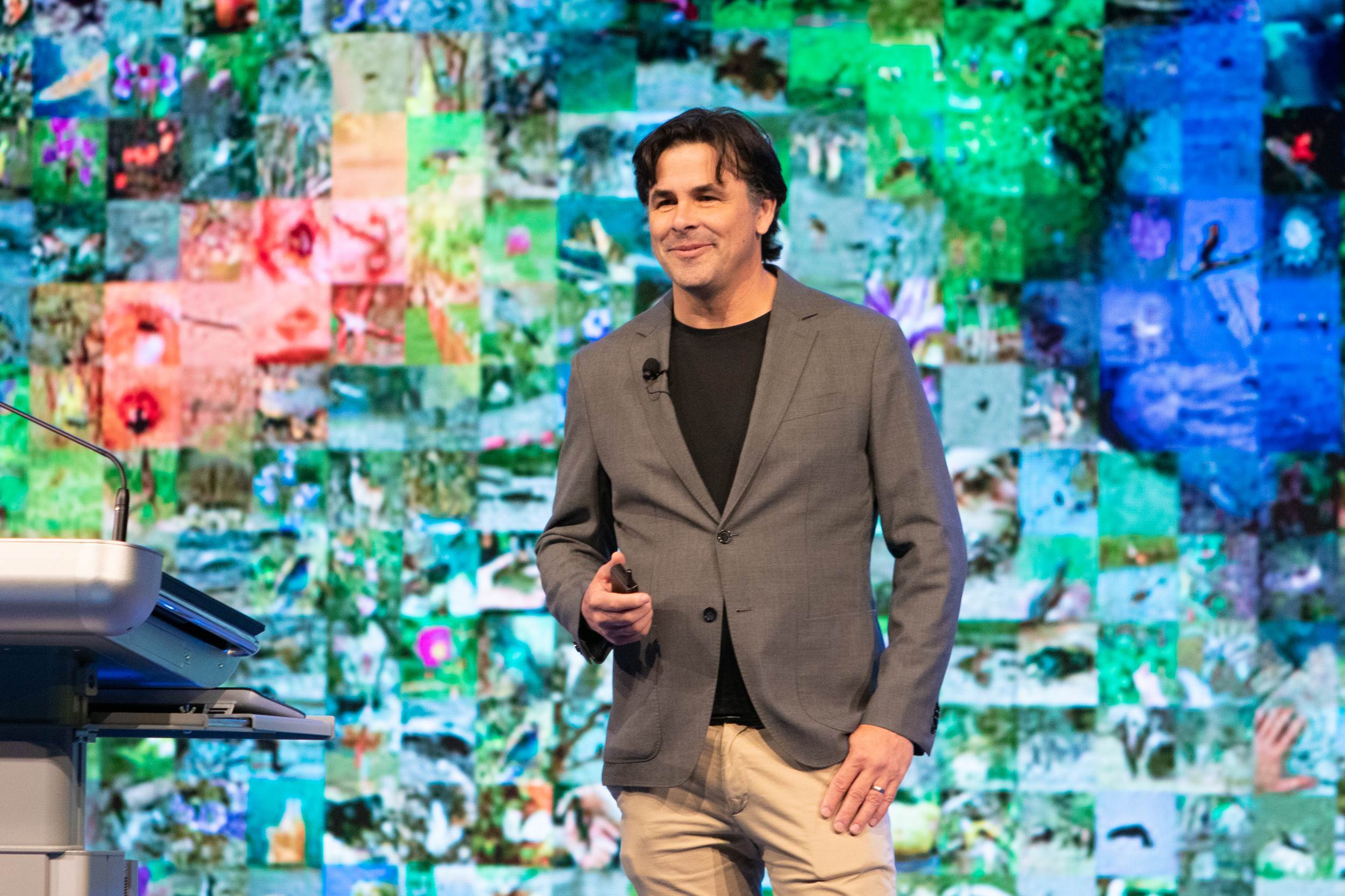
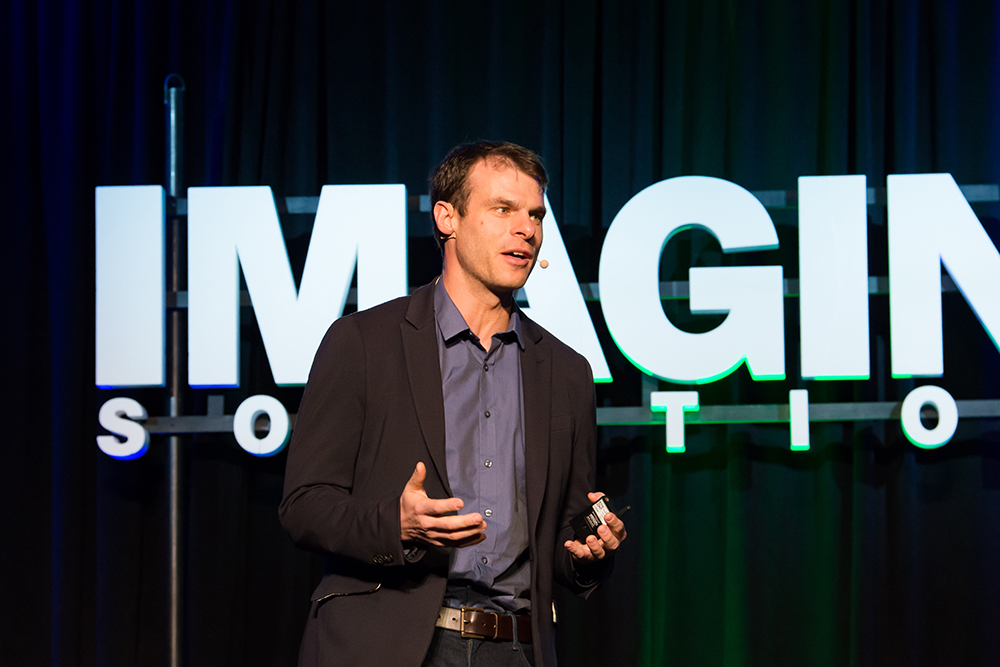
Our next guest is going to tell us the amazing story of six million so-called citizen scientists doing important field work. I Naturalist is an American nonprofit social network of naturalists, citizen scientists, and biologists built on the concept of mapping and sharing observations of biodiversity across the globe. It's also a crowdsourced species identification system and an organism occurrence recording tool, whatever the hell that means. As of August 2025, I Naturalist had nearly 300 million observations in the books and millions of active users. Please welcome to our stage Scott Lori. He is the executive director of naturalist.org. Scott, welcome.
01.02
Everyone, my team built for the first time a real time global system capable of tracking hundreds of thousands of species across the planet. But the amazing thing is we did this just by getting millions of regular everyday people outside, noticing nature and sharing what they were seeing with us. just getting outside, exploring, and experiencing nature. So, I can trace my own passion for this back to growing up along the Russian River in rural Northern California. So, I spent my childhood flipping over rocks, you know, looking for frogs, catching turtles, and there these fishermen that would come down to the river with these big long fly fishing rods, and they'd talk about a time when the Russian River had one of the best steel head runs in all of America. They talk about the the river being lined by eagles, but by the time of my childhood, those steel head were long gone. They were fishing out of
02.00
habit. I never saw any of those fishermen pull a steel head out of that river. Um, the eagles were gone, too. I hadn't seen any of those. I never seen a steel head there. Even these little yellow-legged frogs that they say were so abundant that you had to be careful not to step on them. I couldn't find those either. They were completely gone. Why? Why had all these things disappeared? How big was this problem? Was this just a problem in the river or was it a problem everywhere else? What was happening here? Could we bring these species back? When I went to college, I became obsessed with these kind of questions. And I learned that we are living through what scientists are calling the sixth great extinction where we could be losing species about a thousand times faster than the natural background rate. These are species that we depend on, but the evidence is sparse and patchy. So on Stanford campus where I was a student, they have this biological field station called Jasper Ridge. And it's one of the best studied field stations in the world. And on places like Jasperidge, we do have hard evidence
03.00
that kind of helps us understand what's going on. So what happened at Jasper Ridge? Well, we lost all the big mammals, most of the big mammals, but that, you know, that happened a long time ago and that that's happened in many places. But they also have evidence of losing some of the smaller things more recently, some of the things that tend to go unnoticed. So like these reptiles amphibians all disappeared from the preserve. Jasper Ridge has lost dozens and dozens of different plants including all these. And it even has some data on insects which is the most diverse branch of the tree of life. But it's also where we know the the least including this is the bay checker spot butterfly which was one of just a handful of wellstudied insects in the world and it disappeared from the preserve in 1998. So, we had a pretty good idea of what was happening on reserves like Jasper Ridge, but what happens when we step off of reserves? We're there, we know very little. Maybe a smattering of museum data from here and there, but pretty much we're completely blind. So, I set
04.01
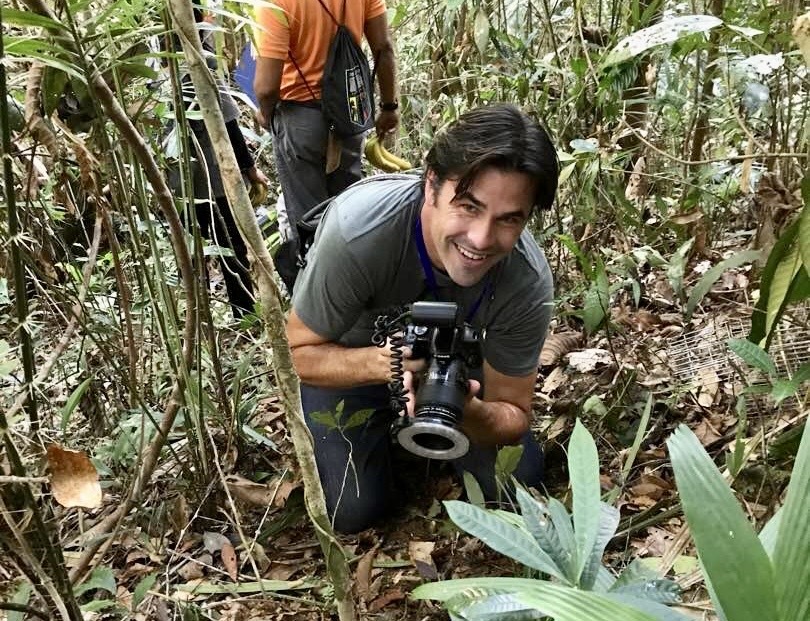
off on a career as a wildlife biologist trying to fill some of these gaps by studying species around the world through the traditional way. So, I used an electro fishing unit to study fish and streams. Um, down in the Caribbean, I studied lizards. In Panama and Costa Rica, I banded birds. And then in Africa, I put GPS collars on lions and elephants and buffalo. And all this work was really important. We learned a ton about these species. Um, but it's slow and it all faces the same brutal constraint, which is just there are not enough scientists. There's not enough funding. There's not enough uh time to understand what we need to know about species using these means alone. And what's important about that is it means that we're protecting a planet that we couldn't even see. So here we are making billion-dollar decisions about your land and your water on records that are often hundred years out of date. It's like we're operating this
05.00
conservation infrastructure with a blindfold on. And that is a really dangerous way to operate a changing planet. So around this time I met a university student at Berkeley UC Berkeley named Kenichi Waya and he had just launched a social network called I naturalist a website and it was is a simple idea you take wildlife photographers post their photos and then they talk to each other and identify each other's photographs through a social network but when I saw that I thought you know these aren't just photographs this is data every one of those photographs it had a it was a point on a map and it had a time stamp Right. So, this is the same kind of data that scientists like me were flying around the world trying to collect. But here it was. It's right here just generated by normal people. And I started thinking why, you know, why are we just sending hundreds of scientists out into the field when we could invite millions of everyday regular people to join us as the eyes and ears of the planet. So, we set out to launch I Naturalist on a smartphone so that anybody anywhere
06.02
can contribute to science and conservation. So this is how it works. You go out and you take a picture of any living thing and first we have an AI that will identify it and tell you what it is. But then you post it, you share it. You share it with a global community of naturalists and scientists will help tell you what it means, vet it, and turn it into scientific research quality data for science. So we've had millions of people do this now. We've generated hundreds of millions of records representing about one in four of all species on the planet. And this data has contributed to 7,000 scientific publications. In fact, most data in the in the world right now for most species is generated by people using this app. It's not from institutions. It's not from governments. It's just from people. But the surprising thing for me was that, you know, I was so focused on building a tool to detect species loss. But I also realized that we had built this tool for discovery. I mean, we right off the bat, we're seeing species
07.00
turn up in all these amazing places that you wouldn't expect. So, just to give you a sense for what I mean, these are just a handful of stories just from this last month. So, how about this moth? This little green moth. So, this was thought to be extinct. It hadn't been seen for 150 years and it just turned up in South Africa. So, species rediscovery just from someone noticing this moth. This plant from Peru turns out it's completely unknown to science. It's completely new species and scientists just gave it a name. And even here in Florida, this little crab, scientists have just published this paper using this data to show that it's moving up the coast, tracking warmer waters with climate change. And right now in New Zealand, the government is using this tool to invite people to track the spread of this invasive plant before it's too late. So I naturalist has become critical global infrastructure for science and conservation. You know, it's used by governments around the world to try to detect and eradicate invasive species before they cost billions. It's used by
08.02
scientists to understand the impacts of climate change. And it's used by land owners, sorry, land managers to prot priorit prioritize their protection. But remember where all this comes from. It's just a global community of regular everyday people supported by volunteer experts getting outside and noticing nature. Anybody can do this. Right? It's not just collecting data too. We're actually changing the relationship that millions of people have with the natural world. And by leveraging technology, we punch far above our weight, right? We can serve this mill global community of millions with a staff of about 15 people. And by operating as a nonprofit, we can ensure that we're using this technology for impact and not for profit. And that means while most social networks they're designed to optimize and maximize polarization and addiction and uh argumentation, we can optimize our social network for curiosity, for
09.00
connection, for collaboration, for contribution. In fact, the the New York Times called us the nicest place online, maybe. And the same goes for for AI. You know, with the wrong incentives, AI is disrupting, destabilizing communities. It's flooding the zone with noise and misinformation. But with the right incentives, AI is a really powerful tool. It can help us get collaboration on even greater scales to try to get even greater scientific impact in the pursuit of truth. I mean, technology is a really powerful tool, but mission matters. So, what's next? So, what I'm really excited about is now that we're getting hundreds of millions of records coming in, we can start figuring out not just where species are, but where they aren't. and also not where species were but where they are right now. And this I think is a game changer for conservation. You know, for example, going back to that little frog that from the river. So this is a map of a hundred years of museum specimens. And if you looked at this, you'd say, okay, this frog lives pretty much everywhere in
10.01
California. But most of these records are at least 50 to 100 years old, right? There's almost no recent museum collecting of this frog. So these data they can't be used to tell you where the frog has disappeared. Um so let's contrast this with a map of recent naturalist data. So instead of um so now we can see clearly where this frog has disappeared but also where it's still persisting. And this is important because it means instead of spreading our conservation resources thinly across large areas we can pinpoint and target exact wersheds where we can have the most impact. you know, we're going from guesswork to aiming, right? And we can now do this for over 100,000 different species. We're really moving from a a conservation system built on guesswork to a conservation system built on evidence. Another reason why this is a game changer is it's not so top down, right? It's bottom up. Because remember, this is all powered by individual communities that are spread out across the world. And these communities,
11.01
they're not just monitoring data, but they're also protecting it, improving it. Like this I naturalist user, he wanted to see more species in his yard. So he ripped out half of his lawn and started planting native plants. And in less than a year, he was able to bring back hundreds of species of birds, butterflies, and plants. I mean, imagine multiplying this by a thousand or multiplying it by a million. Habitat restoration on big scales. It doesn't just happen to happen by governments. Now anybody can participate in this. And also I think that this bottom up conservation is much more palatable to communities than top down conservation. Like in the Russian River where I grew up, local farmers have been persuaded to just make small changes to some of their management practices, how they irrigate their vineyards, how they dispose of their pesticides. And the river is really coming back to life. These species are coming back. So that frog that disappeared from half the state that I mentioned just in the last few years I started finding them again in
12.00
the river. Couldn't believe it. You know, this is this frog that I spent so much time as a kid trying to find and now they're back. It's pretty amazing. And just last month, my brother, who still lives in this river, right, he sent me this photo. He caught a wild steel head in the Russian River. This never happened when we were kids. Pretty cool. You know, for so long, flying blind meant that we had to choose between sort of hopeless inaction or uninformed action. But now, for the first time, we have a new path forward. We can see nature for the first time. We have a real understanding of where it persists and where it's slipping away. And we have a global connected community of people that care. We can draw a line from data to action into results. So we have a choice. We can either sort of passively look the other way and differently or we can notice nature. And
13.00
when we notice it slipping away, we can either be passive or we can participate. And this act of noticing, this simple act of going outside and noticing, learning the name of a butterfly or a plant or a bee, it changes you from a bystander. the first step to becoming a scientist or a steward. And when millions of us do this together, you know, we're not just having impact locally. We can have a global impact. But there's still so much work to be done for us to build this new kind of global movement for nature. And we need your help. So join us. An easy way to get involved, just go outside, take a picture of any living thing posted to naturalists. If we work together, we can do this. We can solve this. Thank you guys so much.
About the Speakers
Watch more videos on this Topic
Imagine Solutions and the 501(c)(3) Searching for Solutions Institute were founded in 2008 with the mission to bring leading-edge speakers and thinkers to engaged audiences of change-makers, addressing matters of societal importance related to science, medicine and healthcare, business, social entrepreneurship, nonprofit, social sciences, the arts, conservation and the environment, exploration and discovery, and more, and the vision of generating real conversations and the space for impact, influence, and connection.