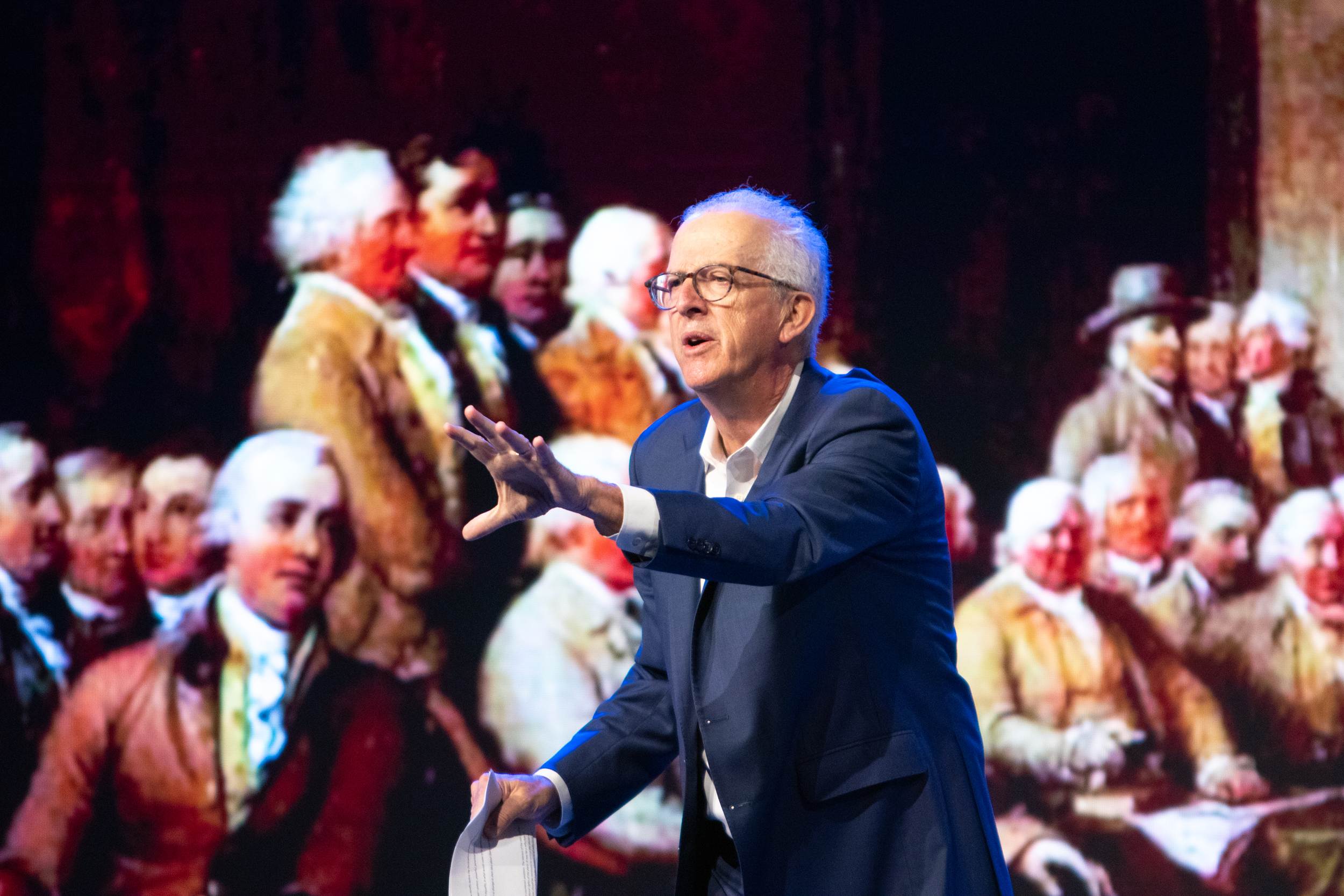
00.07 So, let's get started. Our first speaker is the quote history professor everyone wishes they had. Lewis P. Major is the board of governor's distinguished professor of American history and American studies and history at Ruters University in my home state of New Jersey. He focuses on discreet moments when our nation's history and narrative in our nation's history and narrative and seeks to unpack their significance. So where better to start than with the discreet moment that tops all discreet moments in American history, the Declaration of Independence. The title of his talk today is the idea of independence. Professor Lewis Majer, welcome to our stage. I'm absolutely thrilled to be opening up
01.03 today's conference because this is a conference of thought leaders who have ideas at the edge. You know who else were thought leaders who had ideas at the edge? The founding fathers. What they accomplished was simply remarkable. They were of course well read. They were well educated. And this year particularly as we celebrate the semiquincentennial, it's a mouthful, but we'll get used to saying it, of independence. Uh it's it's a great moment to sort of look back and think about what they accomplished because the United States, if anything, is an idea. But they were also men, humans, everyday people who suffered the way all of us do. Jefferson had terrible migraines. He would often have to hold up inside his
02.02 office for hours at a time. Madison Madison suffered, we don't even know as historians what it was. Some people think it was epilepsy. He would have these seizures and billious fevers. Adams. Oh my goodness. Adams was very very sensitive about his reputation. He he never forgave Jefferson for getting all the credit for writing a Declaration of Independence. Franklin said about Adams that he means well, but sometimes he's totally out of his mind. It deteriorates a little bit from there. Hamilton. Hamilton. Many of you have seen the play. He's been recovered and restored to us as one of the seminal founders. But he had a libido that knew no quit. John Adams once said, and this is an absolute quote, that Alexander Hamilton has more secretions than an abundance of horrors can possibly take away from him.
03.00 That's And you think the tone of politics is is problematic today? And then there's George Washington. Oh, how I love George Washington. By the time he was 26 years old, he suffered from puricy, malaria, smallpox. He was as president suffering with difficulty hearing. He was down to one natural tooth. When someone went to have lunch with him, they wrote in their diary, "Today I had lunch with the president of the United States." uh being with him was as grave as being at a funeral. And then of course there's this. We hold these truths to be self-evident. That all men are created equal and are endowed by their creator with certain unalienable rights. Among these, life, liberty, the pursuit of happiness. It's
04.01 a drop the mic moment. It's perhaps the most felicitous sentence ever written in American history. Uh it didn't come off of Jefferson's pen that way, by the way. In the original draft of the Declaration, instead of self-evident, he wrote sacred and undeniable. And Ben Franklin read it and suggested self-evident. There's a better word. Fantastic editing, right? One word as opposed to two. That sentence encaptures what the revolution was about. It was about ideas very much what we are here to think about and study today. John Adams famous quote 1819 the revolution was in the minds and hearts of the people. This radical change in the principles, opinions, sentiments and affections of the people that was the real American revolution. It was a revolution against authority
05.02 and patriarchy. But it did not start with Jefferson. Ideas don't just come automatically out of someone's head. They rise up from the culture at large. And to think about the origins of the idea of independence. We have to go back to think about the idea of free will. There's perhaps no important concept in the history of western thought than that. Before an idea can matter, we have to believe that we have the power to make those ideas matter. And the critical text for this was John Lockach essay concerning human understanding. It was published in 1690. And Lach of course is an influential figure. His two treatises on government shaped Jefferson's thinking on the decoration. But this book was significant because what Lach posits is a theory of environmentalism. Before lock in Puritan America, you did
06.02 not believe you had choice in the matter of your own salvation. No, no, no. If you were a strict Calvinist, God had determined the outcome of all of history before you were born. Predestination. All you could do is hope for the best. You had no idea whether you were going to be saved or damned. It's fantastic. If you read diaries of of Puritans, a guy named Michael Wigglesworth, the psychological uncertainty is painful. The there there's a door flapping in the breeze and he writes in his diary, "Is this a test from God? And should I get up and close it? And if I do close it, will he be angry with me or should I keep it open?" It's this constant state of uncertainty. Lock single-handedly taking what was in the air got rid of that. What he posited was what was called the tabular rasa, the blank slate. We are all born blank slates and ultimately we are the products of our
07.00 environment, of our upbringing, of how we're being raised. Now I'm going to show you in a minute how that's going to play into the American Revolution. Let's illustrate using art because art is fantastic as a cultural source that captures and embodies the changes that are taking place in the culture. So take a look at this painting famous painting by Robert Fei from the early 18th century a depiction of a family. Now if we were to read this painting as we should as I encourage you what do you notice? You notice, of course, that it reproduces patriarchal relationships. Uh, the man is at the side. He literally stands heads and shoulders above the women. The women sit and take a look at what we want to call a child, but certainly doesn't look like one because childhood is an invention of the 18th century. The Puritans thought of children as little adults, right? If you
08.00 don't have a belief in nurture, in environmentalism, then you don't have this concept that children are something that have to be raised. Watch what happens when we look at this painting from 1776. My goodness, what a transformation. The men and the women are interacting together. Indeed, the woman is the one who stands heads and shoulders above of the men. And look at the children. There is now playfulness. They look like what we understand children to look like. This is going to play into the revolt against kings. Kings are doineering and authoritarian and strong. Republics by comparison are affectionate, caring, loving. That is what we are seeking in a form of government. You all one way or another know the story. George Washington and the Cherry Tree popularized by Mason Williams in an
09.02 early biography of Washington. The story as it gets told down through the ages is that Washington chops down the tree and his father asks him, "Did he do it or not?" To which Washington replies, "I cannot tell a lie. I chopped down the tree." That's not what the story is about. If you keep reading, it's what Washington's father does after Washington tells the truth. And you know what he does? He hugs him. He embraces him. He shows affection. He shows love. This becomes absolutely critical to the idea of creating a republic, of rebelling against a mother country. Right? These are the sons of liberty. A a king who is stern and patriarchal and couldn't care less about nurturing the colonists.
10.00 Well, you can have the idea of doing this, but someone still has to make the case. Someone has to make the case against the king. Now, this is an important point that we don't have time to go into, but is a moment in the revolution, right? If you go back to 1765, the Stamp Act crisis, there's a buildup, right? There's a period. Colonist original grievance was against Parliament. They kind of liked the king. They thought the king was on their side. They were sort of anglophile in the sense of that we cannot have a revolution until we rebel against the king. This is the pamphlet that did it. It is by my estimation one of the five or six most important writings in American history. Thomas Payne recently had come to the United States 1774 and he begins to write down again what's in the air. He doesn't invent the idea
11.00 that there's something wrong with the divine right of kings. He doesn't invent the idea as he famously says in America the law is king. But he picks up what's in the air and he writes it down. He originally titled it plain truth. And Benjamin Rush, signer of the decoration, physician in Philadelphia, suggested common sense. Common sense. It's okay. It's okay to rebel against the king. Everything calls for it. He talked about revolution and he tried to make people feel less afraid of the idea of revolution. Revolution was scientific. It was natural. Planets revolve on their orbits. He talked about nature, one of the most important words in the 18th century vocabulary. Of course, Jefferson referred to the laws of nature and of nature's god. Here, Payne also invoked nature as the
12.01 necessity of rebelling against the king and reason. his repugnant to reason, to logic, to all sense of thinking, to remain loyal to the king. The cause of America, he thundered, is the great cause of mankind. And so, common sense, is circulated five months before the Declaration of Independence. So if we're honoring the 250th anniversary, this too must be part of that honor. Well, we have a revolution, but then of course the founding fathers famously disagree over what is the best form of government in order to enact this republican small R republican revolution against monarchy. The Federalist Papers was the articulation of course of the um of the
13.01 group of supporters of the ratification of the constitution written by Hamilton, Madison and Jay. They argued for the necessity of a stronger centralized government. Recall we have a revolution and the first form of government is the articles of confederation. Well, if you go back and look at that, guess what? There's no executive branch. Of course not. We just had a rebellion against the king. The anxiety of having an executive branch was paramount. So there's no executive branch. And Congress doesn't have the power to tax. Why not? Because parliament had taxed the colonies almost into into revolution. So the constitution is attempt to remedy that. It creates a more centralized government. It creates an executive branch. Madison famously in Federalist 51
14.01 is going to write about this. He's going to talk about how we must use ambition to counteract ambition. There's enormous anxiety among the colonists of unleashing ambition. The idea for the colonists was that Americans had to exhibit virtuous behavior. Virtue, Madison said, was the health of the soul. And it's especially necessary to be virtuous in a government that's fragile because it decentralizes power. Right? That's what a republic does. It distributes power. And so he's thinking really hard about government. What kind of government should we have? What kind of government can we have? He says, "What government itself? What is government itself?" But the greatest reflection of human nature, if men were angels, no government would be necessary.
15.00 If angels were to govern men, neither external nor internal controls of government would be necessary. In framing a government, which is to be administered by men over men, the great difficulty lies in this. You must first enable the government to control the governed and then the next place oblige it to control itself. Well, Jefferson's in France. He's reading about this. In fact, if you take a look at this copy of the Federalist Papers, I have to talk to you about this because I I just love this. Can you see that at the very bottom it says Mr. Jefferson's copy? Can you guys see that? And then take a look at the top. It says to Mrs. Church from her sister Elizabeth Hamilton. Wait a minute. How did this copy of the Federalist Papers, which Hamilton, let's say, came
16.02 home, you know, honey, I just wrote this. Here you go. And Eliza is so happy she sends it to her sister who's living in England, right? Angelica uh Barker Church. and it ends up in Thomas Jefferson's hands. It does so because Jefferson was having a flirtatious relationship with a married woman named Maria Cosway who's friends with Mrs. Church. She brings it over to France. Jefferson doesn't return it. It ends up in the Library of Congress when he donates his books. I love this, right? Because it tells us something real about these people, about the ways in which books ideas circulated. uh the ways in which they took seriously what was going on and it humanizes them. I I think there's a Netflix special in this and I'm going to pitch it. I think it would be fantastic. Well, Jefferson is in France. He reads this and he writes back
17.01 to Madison and famously he writes back, "A bill of rights is what the people are entitled to against every government on earth, general or particular, and what no just government should interfere with or refuse or rest on influences." And so it's this it's this ying and this yang. There's government, but there's also rights. There's the centralization of authority, but there's also the need for liberties. And it's going to lead, of course, to the first political party system. But it's going to lead to an experiment in American Republican life, in American democracy, though that word itself does not become normalized until the early 19th century. that's going to carry on for a very long time.
18.01 But the other thing about ideas is they at times have to be renewed. They have to be rededicated to sometimes they need to adjust and transform to the moment. That's what Abraham Lincoln did. This is a picture of him, the only known picture of him at Gettysburg on November 19th, 1863, in which he delivered a speech that was only 272 words, but redefined the meaning of the war and nothing less than the meaning of America itself. Four scoring seven years ago, our fathers came forth upon this nation, a new land conceived in liberty and dedicated to the proposition that all men are created equal. Doesn't matter whether Jefferson intended it to apply as broadly as Lincoln would now make it apply. The
19.00 declaration was American scripture. The declaration was the meaning of America. As our situation is new, Lincoln said, "So, we must learn to think a new. It's all about thinking. It's all about the ideas we carry in our head." Now, I'm a student of of Lincoln among other topics. I've spent a long time reading him and thinking about him. And I've often talked about and thought about what's the secret? How did he do it? And I think the answer is as simple and yet as complicated as this education, a love of learning, a love of reading. What were his chances? He was born to an illiterate father on a dirtfloor cabin. He had very little chance to rise in the world, which of course was his
20.00 articulation of the American dream. The American dream we all understand intuitively. when he was interviewed for a congressional dictionary in 1858, he was given a questionnaire. And in the questionnaire, this is what he answered. It said, "Birth, February 12th, 1809, Harden County, Kentucky. Education defective." His entire life he spent trying to remedy what he saw as the defectiveness of his education. He got lucky. When his mother died, his stepmother brought books. And we know some of the books that he read. He read Asop's Fables. He read Uklid. He read Bunyan's Pilgrim's Progress. He loved Shakespeare throughout the war. He would quote long passages from McBth, which was his favorite play. It's that commitment to learning, that same commitment that we
21.00 are all here engaged in today. And so Lincoln would take those ideas formulated in 1776, renew them in 1863, and they'd be renewed time and time again. So today, in this year of the 250th anniversary of American independence, perhaps the greatest idea ever to be birthed today. Who knows as you hear this slate of thought leaders presenting ideas at the edge, who knows what new idea will lead to our next revolutionary transformation. Thank you very much.