00.06 Dr. Colleen Shogun served as the 11th archavist of the United States. The archives are a national treasure home to more than, get this, 13 billion documents. She's currently the CEO of In Pursuit, which is a national initiative timed to illuminate the upcoming 250th anniversary of the founding of the United States. The project has recruited 74 historians, journalists, academics, former presidents to write essays about every president in American history. In Pursuit is addressing a genuine crisis. Only about one in five of our nation's eighth graders are proficient in civics education. And less than one in three Americans, American adults, would be able to answer the basic questions on a civics or history test, let alone the test that qualifies an individual to become an American citizen. In pursuit, hopes to reach 10 million Americans,
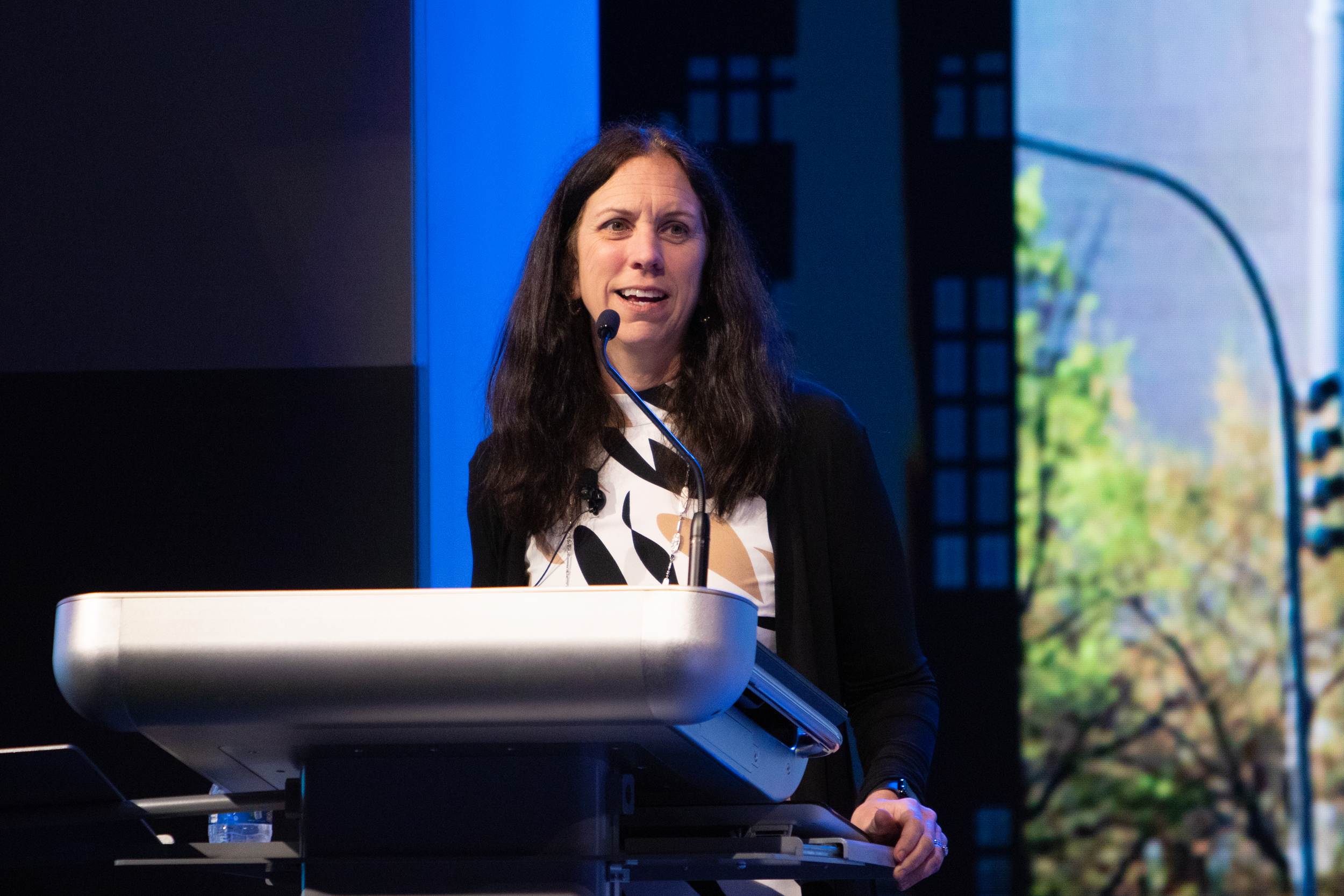
01.00 including five million students. Please welcome to our stage Colleen Shogun. Colleen, my name is Dr. Colleen Shogun and I served as the 11th archavist of the United States. I was the first woman in American history to do so. So, not only do I study history, I actually made history and was part of it. So, as the archavist of the United States, I ran the National Archives and Records Administration, which is the institution that houses our nation's records. I host I I ran the National Archives and Records Administration, as I said, the institution that houses 13 and a half billion records that document our nation's shared history, including
02.02 some of the documents you're very familiar with, we've already heard about this morning. The Declaration of Independence, the Constitution, and the Bill of Rights. Unfortunately, last February, I made history in another way. uh when the president of the United States fired me, it was the first time that a national archavist has been removed by a sitting president of the United States. And you can imagine why this was unusual because the archavist of the United States serves in a nonpartisan capacity. This was indeed, of course, a surprise and a shock. Um I've never been fired before in my life, and I can tell you, you don't want to start by being fired by the president of the United States. Uh but today I'm not here to talk about that. I'm not here to talk about those events and really even to talk about my tenure as the archavist of the United States. I'm here to talk to you about what I've been doing for the past year.
03.00 And I think it's one of the most uh positive and remarkable stories we have in 2026 as we learn about our nation's history. So the name of my project is in pursuit and I do believe it is the most ambitious history national history project we have in our nation's 250th anniversary and I'll tell you a little bit about it. We think about the United States as an experiment. It's a phrase that we use often. It can be almost decorative, almost poetic. But experiments aren't metaphors. their processes and any experiment only works if you pause, you look honestly at the results and ask what have we learned? And that's what in pursuit is all about. Not celebrating the past, not prose pro prosecuting the past, but doing
04.00 something surprisingly rare in American life, taking our history seriously enough that we can all learn from it. The question as we face our nation's 250th anniversary, which comes up on July 4th, isn't whether we will talk about American history. We certainly will, and we already are. The question is how will we talk about it and whether we will use it to divide ourselves further or reorient ourselves to what comes next. Robert Penn Warren wrote that history can't give us a program for the future, but it can give us a fuller understanding of ourselves and our common humanity. This is an important distinction. History is not a set of instructions. It's a mirror. Self-government depends upon citizens who are willing to look into that mirror honestly without flinching and also
05.01 without despair. When I served as archavist of the United States, I was very excited about the 250th anniversary of the United States in 2026 and the opportunity that it gave our country. But I was also concerned that we weren't planning projects or initiatives that took our nation's history seriously. So once again, we call it the American experiment, but we don't act like it. We study history constantly. We teach it. We argue about it. We invoke it in political debates, in cable news segments, and on social media threads. But what we do, we what we never do is step back together and think about it critically, collectively in a spirit of reflective patriotism. We don't ask as a nation what worked, what didn't work, what surprised us, and what are the relevant lessons that the founders would have never imagined.
06.02 Now, there's a good reason why we don't do this, and there wasn't something planned for 2026 in this vein. It's certainly not easy. For many Americans today, history acts as a third rail of American politics. It's become another component, another front of our culture wars, something to wield rather than something to learn from. Lessons are scattered across different classrooms allowing academic journals and books and op-eds with no shared format, no common language, and no trusted national hub. At the same time, we are a culture that is obsessed with novelty. Everything is new, everything is urgent, and everything is unprecedented. And yet, paradoxically, times of rapid change are exactly when societies most need its grounding historical principles. When everything feels uncertain, it's time to look at
07.02 our anchors. And that's why our nation's 250th anniversary matters so much. As this year progresses, I think our nation will be in part in a reflective mode, asking where we've been and where we're going. Educators are looking for ways to connect with students beyond things like trivia or celebrations and fireworks. Communities will be planning commemorations and celebrations large and small. And yet when in 2025 we were facing the prospect that there was no nonpartisan national initiative anchored in history that asks Americans the single question. What have we learned? It wasn't just an oversight. It was a missed opportunity and one we wouldn't get for another 50 years. So after I left the National Archives, I was presented with an extraordinary
08.00 opportunity to solve this problem. And if I could credit for one thing in all of this, it was the fact that I didn't sit on my couch and I didn't take off for the beach and sip margaritas. Although I will say having senior beaches yesterday, I kind of am a little bit sorry that I didn't do that at least for a few weeks. Um, instead I got back into the game and I worked with the organization called more perfect who brought this challenge to me. The idea be uh behind in pursuit is quite simple. We are learning about the past 250 years of the American experiment to uncover the insight and the courage we'll need for the next chapter. It's not nostalgia. It's not moral scoring. who's good, who's bad, who's in, or who's out. It's about learning from history in formats that people actually use and that's relevant to their lives.
09.00 So, I'll tell you a little bit about the project. The heart of In Pursuit is a single innovation. It's called, we call it the lesson. Each lesson is only one sentence, deliberately short, deliberately sticky, and paired with a brief essay of 1,250 words about a president or first lady in American history. Every lesson comes from a real story, a character trait, or a crisis in our past. But the lessons have to meet a higher bar. They have to be timeless. They have to be universal and relevant beyond the moment. So, think of Ben Franklin apherisms for the modern age that can frame an essay, catch attention on social media, or frame a short educational video for kids. The goal is not to tell people what to think. It's to give them something worth thinking about. You can see this in a slide from
10.00 our first lesson that we released on President's Day, which came from President George W. Bush about George Washington. That's what he wrote the essay on and his one-s sentence lesson about the importance of humility in democratic life. The lessons from In Pursuit solve the very problems that have made studying history difficult for us as a nation. They cut through polarization by grounding insight in evidence, not ideology. They're written by Americans of diverse backgrounds, diverse perspectives. They're accessible. They're sophisticated and insightful, but they're they're not academic. And they're brief enough to be remembered and shared. In short, lessons are designed for citizens, not for specialists or historians, although we we love historians. These lessons aren't just meant to be read either. They're meant to be used for public servants that are navigating
11.01 hard decisions for educators who are trying to connect students from the past into the present and for citizens who want a shared reference point about civic conversations. So lessons become touchstones. They're a common language Americans can use even when they disagree. They are conversation starters hopefully leading to more productive and civil dialogues. And we've been in this project now for we're entering the third week this week and I can say I've been monitoring it on social media and our various websites where where the essays and the videos live and I can say that people are disagreeing but they are disagreeing in a respectful manner and even that is is a miracle in itself. So in phase one, the essays and the accompanying one sentence lessons have been developed by people who have already earned the public's trust as
12.02 students of the American experiment. We have Pulitzer Prizewinning historians. We have journalists. We have former public servants. We have our nation's cultural leaders. Not because they're famous per se, but because credibility matters. when you're asking a divided nation to think about these difficult ideas together. So what matters isn't one any one single name. I would say it's the broader picture. This is cross ideological. It's bipartisan. It's cross-disciplinary and its delivery is crossgenerational. And that's the breadth that enables in pursuit to be trusted. And really trust is the currency that this time demands. That being said, you know, we do have some pretty cool contributors that I I'd like to talk about. you know, former presidents uh that are participating, former first ladies, Chief Justice
13.01 Roberts, Secretary Condisa Rice, General Stanley Mcristel, Admiral McRaven, and a total of seven Pulitzer Prize winners. In 2026, in pursuit is starting with one focused lens, which is presidents and first ladies. So all of our essays and lessons will be based upon the lives of presidents and select first ladies. You might ask, why do we focus on them? Because they are the elected leaders that truly have represented a whole nation. They have stories that necessarily scale about leadership, about crisis, about restraint, about ambition, and about character. and Americans already care about them or know something about them which makes the lessons accessible from day one. So just to be clear on the organization of the project, each of our contributors is writing one short essay and lesson about
14.01 a president and first lady in American history. And once again, President Bush kicked us off with the project on President's Day earlier in February with his essay on George Washington and the relevant lesson that you saw in the previous slide. So each week, another essay and lesson will appear all the way through American history. So, if you're like me, you're waiting to find out what President Barack Obama says about Abraham Lincoln or President Bill Clinton about Theodore Roosevelt. Or if you like the first ladies, we also have you covered Laura Bush on Ladybird Johnson, Michelle Obama on Jackie Kennedy, and Hillary Clinton on her own personal hero, Eleanor Roosevelt. So, if you'd like to receive these essays, they're absolutely This project is 100% free for all Americans. We are not charging anything to read these essays. We are not firewalling these essays. You
15.02 can go to our website is inpursuit.org and you can sign up. We'll make sure you receive the essays in your inbox every week and we're going to distribute them on Tuesdays and Thursdays every week. And if you're on Substack, you can also read our essays on Substack. They're our primary distribution partner. And this is just to show you what it looks like uh from our website. Here's a screenshot from our first two essays from inpursuit.org. And you can see by looking at the website, each essay can be read and it can also be listened to. So we have our authors narrating the essays. So feel free to listen to them when you're driving in the car or you're walking on the beach. We also have terrific video essays created by our our partner C-SPAN that combine the audio narration with rich historical images that tell the
16.01 story of the essay. And this is our Substack page and you can see what that looks like as well. Um, and as I said, Substack is our partner for distribution and also enables a really rich conversation to take place about the essays. So although we love history, in pursuit isn't just a history project. We're trying to turn it into a cultural initiative. Turning history into something that is shared, discussed, and sustained. And we have three phases of the project. The first phase of the project is already complete. This is what we did which was curation. Uh it's what I did for the most part of the year was recruiting all these amazing authors to write these essays and set up the structure for what the project would actually be. Phase two is what we're in right now.
17.00 It's about engagement. It's about bringing Americans into the conversation. This involves reading or listening to the essays, responding to them, and also creating partnerships to disseminate the lessons in as many media outlets as possible. And then at the end of 2026, when we've shared all the essays and lessons about presidents and first ladies, the next phase is expansion, building this living archive of American wisdom that will grow over time. we'll move to other influential Americans to study. And we'll do that by engaging everybody that participated in In Pursuit and everybody that followed along and asking them, who do you want to learn more about in 2027 and beyond. So, we had a very aggressive goal for in pursuit to touch 10 million Americans with this project. And I admit when I joined the project uh back in March of 2025, I thought this was like more of a
18.00 rhetorical goal than an actual goal. But I can tell you that just two weeks into this project, it's not a rhetorical goal. It's real. We are going to reach 10 million Americans. We've already touched more than 1 million Americans since the beginning of the project, and we're only a couple weeks into it. We're just getting started. We haven't even expanded into some of the media that we're going to be doing such as as podcasts, television, uh, and humanities councils. So, it's no longer wishful thinking that we will reach 50,000 teachers and eventually five million students. You might ask, how do you do all this in less than a year? How do you put this all together? And I can tell you the way you do it is through partnerships. That's how you build a project. So I mentioned earlier Substack is our partner and our primary distributor of
19.00 the essays themselves, but we're also relying upon entities such as C-SPAN to deliver our video content. PRX who's distributing our podcast to get this information out to a multitude of platforms. And we've great got great nonpartisan partners such as the Bill of Rights Institute, I Civics, Retro Report, and the Jack Miller Center who will be distri uh distributing our educational content. The way that we were able to also do this, of course, is through an amazing and remarkable team. And I'm so thankful uh to be leading this project in conjunction and under the sponsorship of More Perfect, led by John Bridgeland, previously worked in the White House for President Bush, Anita McBride, who was the chief of staff for Laura Bush, Mark Upgrove who is the CEO of the LBJ
20.00 Foundation in Austin, Texas, and then Andrew Manino, who is our vice chair, who you're going to be actually hearing from later on today. So I have to leave you with this question that anchors in pursuit. What lesson do you think matters most as we prepare for America's next chapter? Because this is the moment to ask that question. And we're counting on millions of Americans asking it, too. So my last thing ask for you is to join us as we learn about our shared history together. Thank you.