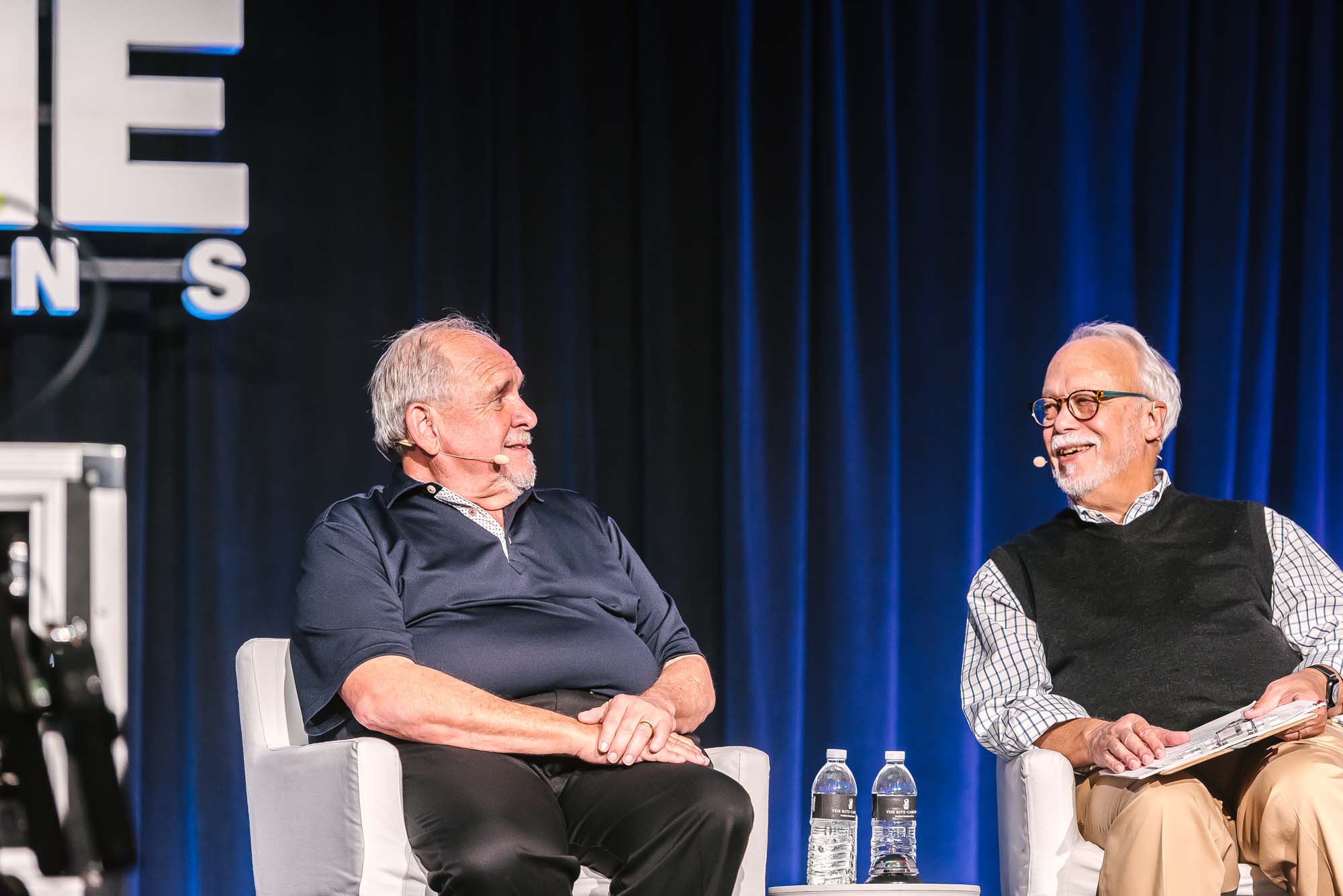
00.00 Our next guest is driving the concept of lifelong learning and career re-imagination at one of the nation's great universities, the University of Chicago. His name is Seth Green and he's the dean of Chicago's Graham School. That is the home of the university's center for lifelong learning. Through a variety of innovative programs, including the leadership and society initiative, the Graham School is creating new pathways for people at mid-career or even later to indulge their intellectual interests and reset their career and life trajectories. Randy told you earlier about a project that Imagine Solutions is working on with the University of Chicago and the Graham School, and I invite you to delve into it if you're interested. Perhaps if uh the students in the Graham School are lucky, Seth students and fellows there will get to hear from one of the university's most respected voices and graduates, David Brooks. Well, today you
01.02 are lucky because David Brooks is with us and will join Seth shortly from Washington. Simply put, as a columnist, commentator, and author, David Brooks talks sense. He walks a fine political line. He is, I think, a philosophical conservative, but never a partisan one. and sometimes he leans towards what he calls the quote right-ward edge of the leftward tendency. What is so interesting about Brooks is that he is not merely or even predominantly now a political commentator. He writes deeply and movingly about society, loneliness, social division, and how we can live better together. They say, by the way, that the University of Chicago is where fun goes to die. Well, here to disprove that notion is Seth Green, who I can tell you is actually a pretty fun guy, and he will soon be joined by the profoundly thought-provoking and fun David Brooks. Seth Green, welcome.
02.06 Well, I am so honored to be here with all of you and I want to say a special thank you to Randy and the board. Uh I have admired so many incredible leaders in Chicago growing up as a professional in that city and then a few of them I didn't know where they went until I came here and last night I literally saw all of them had now come to Naples and were part of this conference and so I'm looking out at so many people that I deeply admire and am so excited to be part of this world with all of you. So, I want to talk about what has been beautifully introduced by Tyler, this increasing longevity and what it means for a new structure of adulthood. And as you've heard, the real treat is that I'll ultimately be talking with one of our faculty members, David Brooks, who has been an incredible leader on this topic at the university and beyond. So what I want to talk about first is the
03.00 longevity revolution and then we're going to jump into what that means for a new structure of adulthood, how it's led to new principles at the University of Chicago for generativity and then how we're actually approaching that in our courses and David will talk about the course that he's led at the university on this subject. So how many of you are over 32 in this audience? Okay. So all of you have surpassed the longevity that was expected in 1900 globally. How many of you are over 73 in this audience? Okay, you're on borrowed time according to this graph. So the main point of this graph, we have had a revolution right in just over a century. Mind you, the University of Chicago came into existence in 1890. So we don't take sole credit for this change, but there are correlations between the two. uh but in a century we had a more than doubling of global life expectancy in the US we had exactly a doubling because it went uh
04.01 from around 45 uh to around where it is today. So there's longer life today but there's also and you've heard about this all day from people much more brilliant than me. There is a massive change now in health span because what's happening across science with AI now infused is we're building GLP1s and biotech and it is not just allowing people to live longer but actually retain their mind and their bodies at the fullest levels through the end of their lives. And so if you are today 60 years old, you have a certain level of education and wealth and you haven't had a major like a significant stage four type cancer that could put a threat, then you have a more than 75% chance of going to 90. So we are in a totally different world where people are looking out potentially when they retire from their long-standing career at 30 more years where they can
05.02 be highly generative. And of course all of this is changing the economy. Look at this 20 years here from 2005 to where we are today. The segment of the economy that was the smallest 65 years and older in the US it's now the biggest. And people know that it's been the biggest in wealth for a long time. This is consumer spending. This is actual dollars being spent in the economy going from the smallest segment 65 and older to now being the biggest segment in a single generation. So we are seeing a massive change in our world. And all of this demographic change is taking place at one of the most dynamic times, which we've talked about a lot today, where AI is massively changing the broader economy and skill sets you need over just a period of years, let alone a 90-year horizon. Okay, so that's the revolution. The next question becomes, what does that mean for adulthood? And I'll say that going back to Greek
06.00 mythology which we love at the Graham school there was a certain way of thinking about how people lived right and here was uh the riddle given to the sphinx and it was what walks on four legs in the morning two legs in the afternoon three legs in the evening and no legs at night. shout it out humans, right? And of course, that's how we thought about the world that you learned crawling when you were young, then you worked with your two feet. You might have a cane. I know that's an old image and we'll talk about that of retirement. And then you were laid flat. Very simple three stage life. And then starting in 2010, there was a author Mary Katherine Bateson who wrote a brilliant book. And basically the big idea is we shouldn't see longevity as just extending old age. If people are living longer and better, it changes every chapter of life. And basically there have been a lot of academics, but
07.00 this boils it down really well. Instead of a three-stage model, we now have a multi-stage model. How many of you may have finished your primary career but may still be engaged in boards, in investments, or other activities? Raise your hand. Okay, so all of you have engaged this multi-stage life and you're not alone. What we see in the data is that there are more than 25 million Americans who are interested in this multi-stage life. Not everyone has the same access to it. And in the workforce itself, in especially in part-time roles, we now have 11 million people that are over 65. some by pressure of the economy, but many by choice because they want to continue to be generative in that way far into their 60s and 70s. We also had more businesses started by people between 55 to 64 than ever before by a multiple of two compared to it was a generation ago. So there are two shifts happening, right? we have a
08.00 change in how people are living their lives and then a change accordingly in how people are learning because if people are going to be generative across their lives and the world's changing faster, you need to keep coming back to learn throughout life. So it was that context that we saw longevity and demographic change. We knew that as a learning institution, the University of Chicago needed to think about how do we use our intellectual assets to engage this changing life cycle. And so in 2022, we brought together 250 of the world's leading experts as well as individuals in our target population for a summit at the university to look at this question of how do we engage as a university as a learning institution in helping to empower this movement of individuals who want to have productive and generative multi-stage lives. And ultimately out of that convening we launched a major initiative in 2023
09.00 called the leadership and society initiative. And the idea is we wanted to be in partnership with individuals who may have been finishing their long-standing careers but instead of traditional retirement were thinking about how they could be generative and impact society positively using their talents in this next stage beyond their primary careers. And we ultimately designed with David Brooks and a number of other faculty members a three-part journey where part one is getting to know yourself at this stage because as people finish their career sometimes they feel like they have a change in their identity, their purpose and their community all at once. And so who am I if I'm not in this particular position? And how do I think about what I want to achieve in this next chapter? What are the big issues in the world? How do I think about the overlap between who I am and the issues that matter around me? And then how would I actually chart a course? And in many ways, we see the university playing a semi-similar role
10.02 to the role we play in 18-year-olds. We now get these high school seniors coming into our university who are brilliant, who have already built their AI systems, who are already entrepreneurs, but they're still asking some pretty fundamental questions about who am I outside this house I've grown up in and what do I want to be? And it turns out in a longer life world, we have 50 and 60 year olds who are sometimes asking those questions beyond their careers. and the curation is very different. But the same idea of a university being a home where people can explore our big questions and actually discover who they want to be in this next chapter has a lot of similarity. Alongside that flagship offering, we've also built a whole menu of opportunities for people to really engage in midlife in these questions of how do you age well, how do you stay generative, and how do you navigate life's turning points. across all these programs. We recently came out with what we see as five principles of
11.01 generativity and I want to share those and then we're going to have a conversation with David Brooks especially about his approach to curating this generativity in his classroom. So let me start that one big idea comes from Harry Davis. I don't know if any of you had Harry Davis because I know some of you are Booth alums and he's been there for 64 years. So talk about generative and Harry was actually his first 30 years he was a marketing professor and then he went into the dean's office at Booth and it turns out that he realized I'm really interested in leadership because he was engaged in leadership and he was really curious about it and so he gets all these leadership books. He decides to start teaching it because that's how a lot of faculty learn is teaching others. And by the time he finishes in the dean's office, he's really passionate about leadership, a transition he makes in his 50s. And so it turns out that he then leaves the dean's office. And one of the existential crises you have in academia is if your office gets smaller,
12.01 what books do you take with you? So it turns out his office was half the size. And he realized as he went to his new office, even though he was one of the most eminent professors in marketing, he didn't want to take his marketing books. He wanted to embrace leadership. So he only brought his leadership books. 30 years later, there is now a Harry Davis Center for Leadership at Booth. He turned out to be incredibly eminent in this new area. But what he talks about is he actually had to let go of his identity and achievement in order to start this new chapter. And he relates it to taking a trip somewhere where if you go to a new destination, there may be pieces of what you've built over your life in your wardrobe you want to take because you don't want to go naked. But if you take everything you own, you're going to be worn down by that baggage. And so the number one principle of generativity for people making transitions, especially between a long-standing career and their next chapter, is travel lightly. Think
13.00 about what you've built that relates to where you want to go and take those things. But if you no longer want to hold a big title, let go of it and embrace this new chance to be a beginner again. If you no longer want to be an expert and you want to be a learner again, let that occur as well. For some people, they want to go in a similar direction. Others don't. You need to travel based on where you want to head, not based on what you've accomplished to date. Second big principle, don't live in other people's minds. And what that means is that some people because of their accomplishment or experiences can feel narrowed by it. And I'll give you an example. This is a woman Betty Vandenbos who is one of our wonderful lifelong learners. She had held some really big positions. Chancellor of Purdue Global, chief strategy officer of Corsera, but at 70 she realized I really love cooking and in this next chapter I want to embrace it. goes to Lord on blue, comes back to Chicago, tells a friend, you know, I remember a retail job when I was younger, and I want to
14.01 experience just helping people think about cooking. And the friend says, oh, no, you you can't work at the Spice House because you're, you know, someone who's been a major executive. What will people think if they walk into the Spice House on the Magnificent Mile and they see you there advising people? Well, she's the type of person where when someone says you can't do something, that's like the very thing that motivates her. And guess what? A few years in, she's been working just 10 hours a week at the Spice House. Absolutely loves it. She also sits on some boards and does some other things, but she decided she wasn't going to live in other people's heads of who she was. Right? People may have a static impression of you based on who you may have been at one stage in your life, but we have many actors in us and we play on many different stages. And one of the things that you want to free yourself of to keep that fluid intelligence alongside what may be the benefit of crystallized as you get older is staying open to all the possibilities and thinking about what's in your head and not in other people's. Third thing is
15.00 nurture something that animates you. People have purpose and that's what keeps them alive. There's a ton of research on the neuroscience of when people believe they have some greater meaning. That could be grandkids. could be a major cause. It could be being in a social community where you feel like you're building relationships that matter to the people around you. for Janet Faudy who was a part of LSI. She had just finished as CEO of Deote and she went through a process saying I want to really impact women's health and she would have loved the earlier presentation today because now she's building a fund specifically devoted to trying to deal with the fact that women live five years longer in the US but actually have similar health spans in terms of numbers. So they have about twice as many years with life and not health. and there's been an underinvestment and she wants to address that and she's someone who is motivated by that purpose. So she wakes up every day even though she's no longer in the same role but in a new ability to
16.01 embrace life and see the contributions she's making. Uh the fourth is contribute to the lives of others. Uh it turns out that contributing to others being philanthropic is one of the most selfish things we can do especially on the upper end. you get very diminished returns uh on what you might do for yourself. There's actually a lot of research that when people feel like they're contributing to a cause that they believe in in part of a greater good, they get huge psychic benefits. So, I always tell people it's the most awkward idea on earth, but the most altruistic people are really the most selfish because they're the ones who ultimately benefit from that generosity because they feel the impact that they're having on so many others. And this is Matt Brooks, another LSI fellow. Served in our military uh for more than 20 years. Came back, built a very successful business. I sold the business to private equity and then realized, wait a minute, I want to make a difference. And that was what really motivated me in service in
17.00 entrepreneurship. He's built now a fund to be the early investor in veteranowned businesses and is helping veterans across the country to launch theirs as his way of thinking about how he engages this next chapter. The final suggestion which I love comes from Melody Hobson. Uh Melody was in a conversation actually at the university as part of a series we call enduring excellence with Tyler about how you sustain purpose across your life. And I think she had one of the best quotes. She said, "When I walk into a meeting, my goal is not to be the smartest in the room. My goal is not to be the expert in the room. I want to learn more than anyone else in that room." And so I'm always thinking to myself, what's the question I can ask everyone else so that I can learn from them? And I literally want to leave every meeting having everyone say, "Melody, she's the learn it all, not the know-it-all, the learn it all." And she has described that as one of the things that keeps her quote unquote young because she feels like she is a kid at
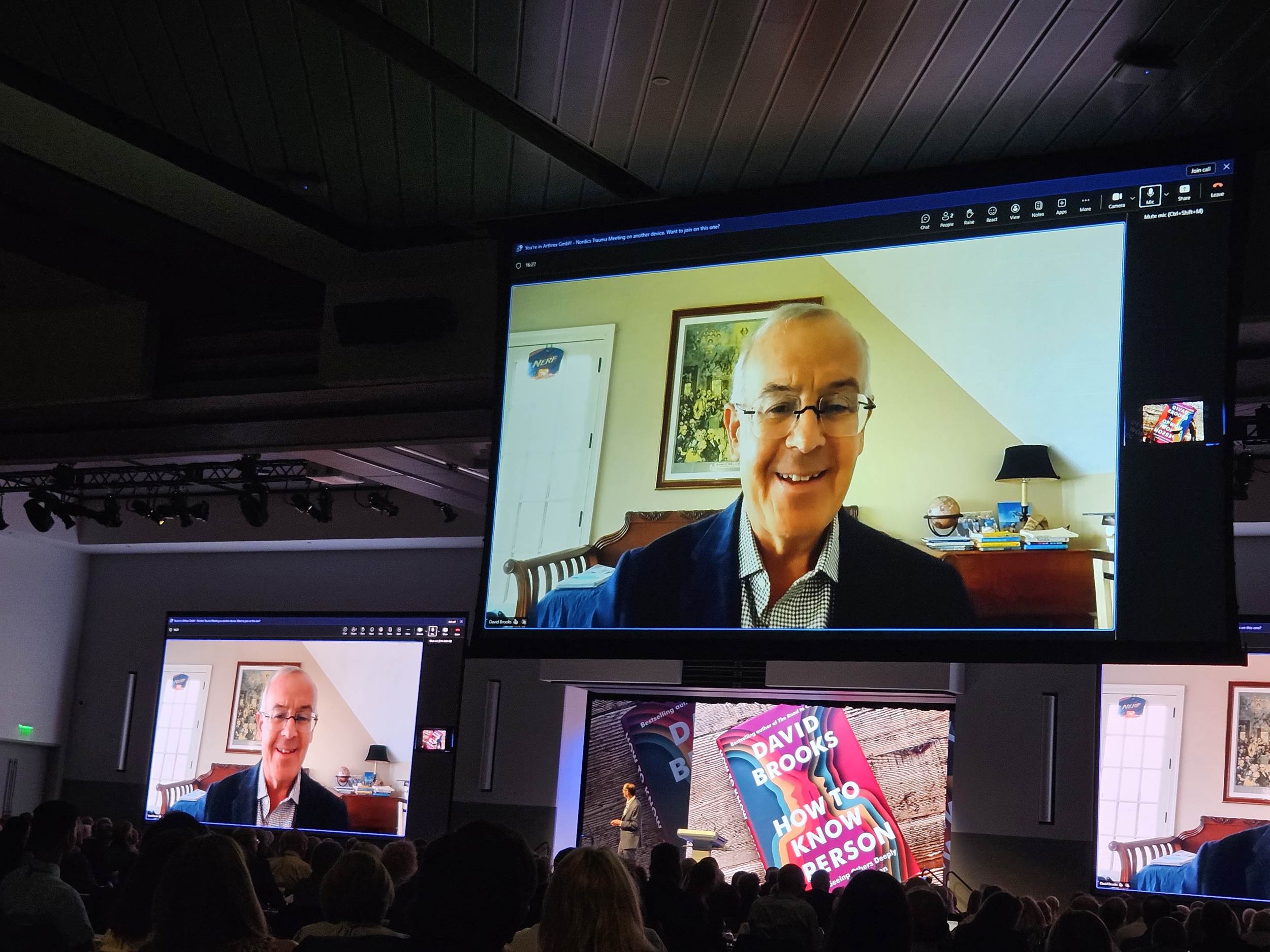
18.01 the candy store learning every time she makes an investment and every time she's in a room with others. And I have to say after hearing her just describe that idea now every meeting I walk into where maybe I had that idea I wanted to be the expert. I now really think in my own mind I want to be the learn it all. What questions? What can I learn from all of the incredible people around me? Well, speaking of one person we can learn from, David Brooks is one of the most significant figures in our efforts and he's also one of the most incredible human beings on this earth. And so I believe he should be coming up on the screen any second. There we go. Hello, David. You are larger than life here. Welcome. Let me try to unmute myself. Hello, Zach. Well, we are grateful to see you. Yes, we hear you. There is actually an echo, but we'll see if that um goes away in time. And it just means that everything you're saying will echo here twice, so people will really get the message.
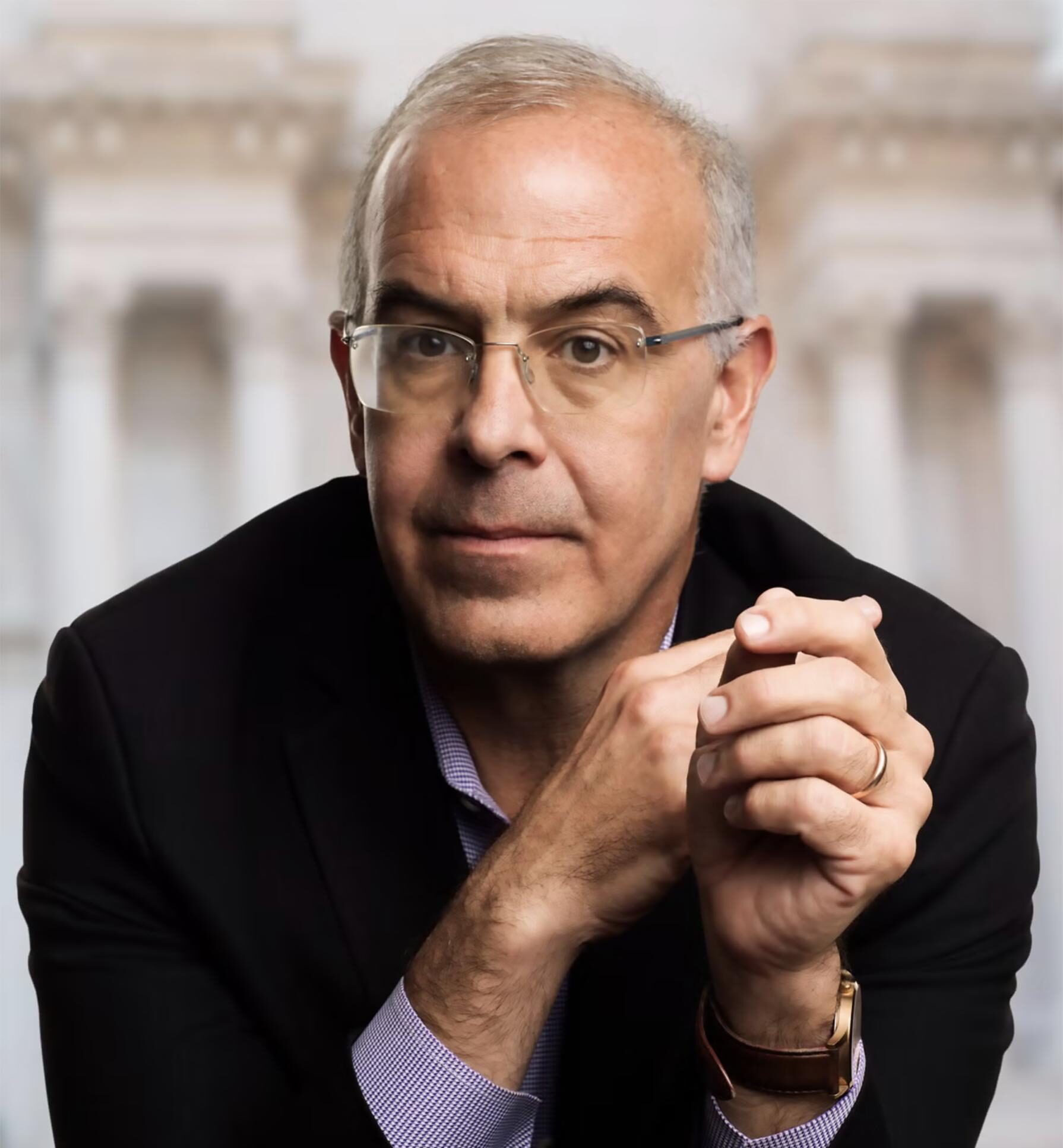
19.01 Well, so David, is in the building. So, uh you wrote an incredible book. uh well you've written many and they all are bestsellers but in 2019 I should say you wrote the book a second mountain and that was about your own journey in midlife and how you wanted to go beyond professional accomplishment the first mountain and into the second mountain of purpose and I'm curious if you could talk a little bit about your own experience at that time and what led you to write the book and then we'll kind of go a little bit broader and think about the meaning for society. Yeah, the general idea behind that book was that most of us get out of school and we have a first mountain to climb which is a career mountain, some attempt to achieve some sort of success, some sort of significance, some impact on the world and one of three things tends to happen. The first is you achieve the success you dreamed of and maybe surpassed it and it's vaguely dissatisfied and that was more less my
20.01 story. I achieved more career success than I ever thought I would. I remember the first day I had a book on the bestseller list and my agent called me and it just felt like nothing. This is a something all writers dream of and it was just something out there. It didn't really touch me. So success strangely doesn't make you happy. It cures you from the pain you might feel if you felt you were unsuccessful but it produces less positive good than you might imagine. I think everybody would agree with that. The second thing that might happen is you fail. Uh you get fired, your company fails, whatever. uh and you're in the valley. And the third thing that tends to happen is something happens to you that wasn't part of the original plan. Uh you may have a cancer diagnosis, you may lose a child, something bad. But in each of those three cases, either severe or shallow. You're in a valley. And in my case, the valley was not a career failure or anything, but I was in a tough period in life where uh my marriage was ending. My kids were leaving uh home to go to school and I
21.02 realized that I'd sort of been misleading my life. I I had had a lot of uh career friendships. I had people I called week weekday friends, but especially after my kids sports teams went out of my life, I didn't have a lot of weekend friends. Uh and those are the people you can call at three in the morning. And so I did what any male idiot would try to do in those circumstances. I tried to work my way through it. And work callolism is a very seductive form of of of therapy and when you're in an emotional crisis, right? And so if you'd gone to my kitchen uh at my apartment, I wasn't having anybody over and you pulled over the drawer where there should have been silverware, there were post-it notes. And the drawer where there should have been plates, there was stationary. So I was just working my way through it. And I was experienced a fair bit of pain which came in the form of loneliness and sort of pain in my stomach. Uh, and I read a book by Paul Tillik, a theologian, who said that moments of suffering interrupt your life and remind you you're not the person you thought you were. They carve
22.00 through the floor of the basement of your soul and they reveal a cavity below. And then they carve through that floor and they reveal a cavity below. So in moments of hardship, you see deeper into yourself than you did ever before. And then I read a book by a guy named Henry Nan as a Catholic theologian who said when you're in pain you have to stay in the pain to see what it has to teach you. And I was like screw that. I want to get rid of the pain. But he wasn't wrong. And then the third thing I read was by a short story writer named Frederick Bner, a novelist who said in those moments of suffering you can either be broken or broken open. When you're broken you callous yourself over. You make yourself impermeable. When you get broken open you make yourself even more vulnerable. And I decided that's what I wanted to do. And so I think we proceed individually and also nationally as a society through a process of rupture and repair. And the hard part about moving to the second mountain is none of the old formula work. The first mountain is all about acquisition. Uh your ego is in charge. You're doing what
23.00 your ego wants. The second mountain is about contribution. It's about generosity. It's about generativity. And so Einstein has described a quotation that he didn't really say, but it's not wrong, which is that you're not going to solve your problems at the level of consciousness at which you created it. And so you have to move to an entire new shift in consciousness. And when you have a change, you might change where you live, you might change your job, but when you have a transition, you change your entire consciousness. Yeah. And so what I went through and I think what people go through in retirement is a transition. And just finally, the hard part about the transition, it has three phases. There's the abandoning of your old self, the time in the neutral zone when you have no clue what you're doing, and then the adoption of your new self. And that time in the neutral zone is super hard because you really are lost. But you got to stay in the neutral zone because shifting your consciousness is not something that happens overnight.
24.00 Well, David, that is your experience. And I know that you wrote this book and then realized actually it's a sheer experience. And in 2023, four years later, you wrote an extensive piece for the Atlantic about what you call the new old age. And you basically talked about how this was a whole new structure of adulthood. And so I'm curious, having experienced this yourself, if you could then describe how you see this giving rise to a new way that we should conceptualize adulthood as a whole. Well, I started thinking talking to people who were either approaching or in retirement. And I had one guy say, um, you know, um, I fear death, but I fear retirement worse because he didn't want to lose his identity as the head of a a company. Uh, and I ran into another person, 70 years old. She said, uh, I realized I'm really bad at predicting what will make me happy. That all the things I thought in retirement that would make me happy, um, they don't make me happy. It turns out I'm kind of bored. Uh, and so it's this process of
25.01 losing your identity, losing your resume that's just super hard on people. Uh, I had one executive in retirement said, "You know what I miss weirdly, is the work emails. I like being in the flow and now I'm out of the flow." And so one of the things this one of my favorite stories from that piece which dubtales with what you were talking about 10 minutes ago is I interviewed a woman named Anne Kenner who was a prosecutor big- time prosecutor in her career and she uh joined the Stanford version of LSI uh and she realized that that at during that moment during that course that year long she decided she thought she was going to do something adjacent to what she had been doing but during that years she decided I want to do something completely different. Uh I want to do something I know nothing about. Yeah. Uh and so what she did was she uh decided I've always loved Anne Bolin. And if when you look at people going through this process very often they go back to childhood. Some love they left
26.01 behind. They have to reexamine their childhood. So she had always loved Anne Bolin the wife of Henry VIII. And she decided to write a play about Anne Balin. She knew nothing about playwriting, but she thought she said to me, you know, who gives a [ __ ] I'm 65. I can fail. Who cares? And I love that attitude cuz you've earned the right to like do that. Uh, and so when I talked to her a little while later, a theater company in San Francisco was was uh putting on her play and she was having the time of her life, sitting in on the readings in the in the daytime, fixing the script in the evening, and it was all it was uh just tremendously rewarding. And I love that that attitude of widening your horizon of risk. I'll tell one final story on this. What one of the things I found is that entering your retirement is not dissimilar from leaving school. It's a similar leaving behind the old life and walking out into an ocean that seems to have no markers. And one of the first rules that I've
27.00 learned about both those moments of rediscovery is you've got to widen your horizon of risk. Uh, I had a a friend who um she got out of college, she applied for Teach for America, she didn't get in, so she Googled teach abroad. Uh, and some guy in Korea said, "We need an English teacher in our little fishing village in Korea." So, she told her parents it was a big supervised program, lots of structure, but it was just a guy in Korea. And so, she flies to Seoul, transfers to little airport. She lands at about 11 at night and there's nobody there to greet her. It's just she's sitting on a bench. She has no money. She speaks no Korean and the airport closes. Uh and then there's only one person next to her and it's a monk and he leaves. And then at about 1:00 in the morning, uh a van pulls up and there are five Korean guys in. And they said to her, "Are you our teacher?" And if my daughter did this, I would kill her. But they said, "Get in the van." and
28.01 then she got in a van and had a wonderful experience in Korea for the next 18 months and forever after her horizon of risk was wide and she says once you widen your horizon of risk in retirement or in adulthood you it never goes back you figured well I handle that I can't handle this and that process of widening your horizon of risk is the first step in whatever the you're going to do next well so David you have counseledled now 100 plus fellows uh through this moment in their lives at the university and you've talked with them about how do you embrace this next stage. Can you talk about some of the practical advice you've shared about how to approach really leaning in as you've described? First, you have to have a realistic conversation with yourself about how hard you want to work. Uh some people just don't want to they want to work 10 hours a week. That's totally fine. Other people want to work 40 or 50 hours a week. So you got to have an accurate
29.01 assessment of how much effort you really want to put in. Uh second, you have to shift from the paradigmatic mode to the narrative mode. Most of us in our work life, we're in paradigmatic mode. Paradigmatic mode is like making a case, making an argument, making a PowerPoint presentation. Narrative mode is telling a story about your life. And you have to tell an accurate story of your life starting today and where is it going to go? And that's just takes a shift and it takes a lot of self-reflection. And so you have to get over the panic that many people seem to have um doing true understanding yourself, true self-standing. The third thing is um you have to develop a capacity to be seized. Finding the next thing you're going to do is less like choosing to buy a car and more like falling in love. That you have to something has to something outside yourself has to touch something inside yourself and set off a nuclear reactor. And you can't really control that process any more than you can control
30.00 whether you fall in love with somebody. And so how do you find how do you put yourself in a position that you're likely to fall in love with some activity, some mission, some some thing? Uh the phrase I've used is three adventures a decade. When my oldest son hit 30, he felt he was behind his colleagues because they had gone into one profession and they were advancing up their profession. My son, by contrast, spent four years in the military, was a kindergarten teacher in Nairobi, Kenya, and started a or help worked at a sports camp and worked in business. And so, he had tried three or four different things in his 20s, and he felt he'd miss missed that decade. He was falling behind. I said, "No, you did exactly what you should be doing with your 20s, three adventures a decade, especially when you're trying to figure out what to do next." And if that's true in your 20s, and it gets true every decade of our lives, we should have three three adventures a decade and certainly should be true in in in your 70s because you've earned the right. So
31.00 you're never going to find out what you want to do until you try it and figure it out. Then once you're in the midst of trying things, it's a process of discernment, not decision. And so you're not reading what the what what is admirable about the world out there or the job out there or the cause of the mission. That's not the thing. The thing is, how does it affect you? Does it stir a fire in you? It could be that feeding the world's poor is a wonderfully noble thing to do. It just doesn't happen to arouse your passion. And if it doesn't seem fun, it doesn't matter how noble it's going to be, people aren't going to do it. And so, I say look for enthusiasm. What's the thing that I'm really enthusiastic about doing? I I I'm not doing this because I want ought to do it. I'm doing it just because I genuinely want to do it. Second, look for indignation. I had a friend who was a sports reporter and she happened to see video of the TN men square massacre and she uh first her first reaction was indignation. She was fury at what the Chinese regime was doing to those
32.00 students and then with self-examination like why am I a sports reporter writing about volleyball when all this is happening and she then went on to write a book about genocide and became a US ambassador to the UN and so she listened to that sense of indignation they give her a sentence and then finally looked for admiration where do you find a group of people who seem to be doing something extremely worthwhile uh when Warren Buffett was a little kid He uh his dad took him to Wall Street and he walked through a Wall Street brokerage show and he looked at them and said, "Wow, those people are doing something extremely worthwhile. That's my magic circle. That's those are the people I want to join." So if you're listening to those emotions of of enthusiasm, indignation, and admiration, they'll be the markers that people find it useful as they try to figure out what to do. So David, one unique approach of your class in addition to the practical wisdom is that you read humanistic texts and you go deeply into these questions
33.01 that people have asked across time and space around why am I here? What's my purpose? Why do you use humanism and humanistic texts as part of this discovery process? Uh partly be because uh uh humanism tells you about yourself. uh when you read a novel, when you read history, you read a poem, uh you uh you learn how other people operate, which is just very handy to know. Second, you learn how you operate. Tony Morrison once said, "When I read about Simone de Bovoir or James Baldwin, I'm they're giving me access to part of myself. I'm comparing myself to their self and I'm I'm getting self-nowledge through that." Third, a poem doesn't give you doesn't give you new information, but it gives you new experience. Um, David, we've temporarily having an emotional experience. Launched your volume. Oh, there we go. We have you back, but you have us in suspense from the words a poem and then
34.00 we lost from there. Okay. A poem and a painting uh doesn't give you new information, but it gives you new emotional experience. And so, for example, uh I was in St. Petersburg a couple years ago and I got to see Rembrandt's poem of the about the prodigal son and I've seen many paintings of that parable but in this one and Rembrandt painted it at the end of his life when he was broke fashion had passed him by his wife was dead four out of his five children were dead and I've never seen a painting where the son who comes back the prodigal son is so ashamed hairless broken almost destroyed and I've never seen a painting where the father's love for the weward son is so intense. He's just embracing him. And when you look closely at the father's hands, you see one hand is a masculine hand and one hand is a feminine hand. And so you can imagine Rembrandt after losing his son, his children. He's trying to imagine his eternal love
35.00 express it in a painting. And so when that's happened, you've had an emotional experience. And that's nice to have and it's very moving. But it also widens your repertoire of emotions. If you're really going to discern who you are, what you want, you have to have what they call emotional granularity. That's the ability. Some people have low emotional granularity. That things are either up or down. They're bad or good. And some patients of therapists, they can't tell that they're between anxiety, which is an up state, and depression, which is a down state. they they just can't read themselves very well. But people with high emotional granularity can tell the difference between adjacent emotions like frustration, anger, indignation, impatience, uh anxiety, and they can finally read themselves. And that turns out to be a great skill because your emotions are evaluation mechanisms. They're telling you what you want, what is worth wanting. And one of the key things that is put before us in all of our lives,
36.00 but especially in these transitions is what do I really want? Deep down in my soul, what do I really want? And that's a surprisingly hard question to ask answer because the it comes from your desires come from down here. But I had a professor at Chicago when I was in undergrad who said what distinguishes people is not their beliefs, not their ethnicity, not even their skin color. What truly distinguishes people is the ruling passion of their soul. That some people are lovers of understanding, some people are lovers of action, some people are lovers of justice, some people are lovers of beauty. And one of the nice things about this final stage uh of your life, the vibrant stage of your life is you can shed some of the shallower motivations, some of the shallower loves like you know when you're younger you have to make it a living. You have to you have to do certain necessities to please the system and to please your boss. But when you're older, you can shed some of those and you can adopt the moral motivations.
37.02 My passion for beauty, my passion for justice, my passion for compassion. Uh and so, but understanding what your true desires are, I think that takes an advanced degree in humanistic inquiry. And then the final thing I'll say is we just live in a cruer and sadder society these days where people are lonelier, people are more depressed, people are more pessimistic, people are meaner, and we've lost the humanistic core of our culture. And so just the capacity to treat each other with kindness and consideration, respect in the complex circumstance of life. That's what the humanities help us do. And and fewer people are are majoring in the humanities. Fewer people are reading fiction. uh fewer people that go in our museums and so getting back in touch with all that soft and squishy stuff turns out to be hard and practical. Well, so David, you are not just a teacher. Uh I now consider you in part a student because after going through this journey with more than 100 fellows, you just recently announced your own next
38.02 chapter. And so I'm curious if we could close there, maybe talk a little bit about what motivated you and then give us a snapshot of what's next for David Brooks. Yeah, when I was um well, when I was a kid, I was raised by my grandfather importantly, and he was a guy who was a lawyer, but he didn't try cases. He mostly sat in his law office writing letters to the editor of the New York Times. And when I got hired uh to be a columnist there, um it was like a fulfillment not only of a personal dream, but of a family dream. And so working at the Times was really a wonderful experience I had for 22 years. Sure. But I'm 64 and I thought, well, I I'm not yet retiring, but I'm going through this chapter. Really, as a writer, you don't have to retire. I'm not a CEO or something. Um, and if I I'm doing the same thing in 2036 that I was doing in 2003, I think I'll be disappointed in myself. And I a wanted to get back to my
39.02 true loves, which were writing long essays and not short newspaper columns. Second, as I said, I thought the country is going through this process of dehumanization and I had a great humanistic education that was the making of my life at the University of Chicago when I was in undergrad and it changed the whole trajectory of my life and I wanted to get back in touch with that and hopefully offer it to other people, not just college kids, but people up and down the age scale. And so I decided after much talking and deliberation uh to leave the times and I I really think you do have to leave change your circumstance. One of the things we've learned from social science is you can't will yourself into better behavior. You have to change your situation and your situation will change your behavior. Um and so I decided to leave the times. I'm going to do long magazine writing for the Atlantic. I'm going to sorry uh Yale University uh to uh both create a
40.02 culture of intellectual diversity there but also to start a podcast where I'm going to get to talk to the greatest teachers in America about the biggest issues of life. And so for example, I haven't asked him yet but one of the guys at the LSI program is a guy named David Ray. He's a classist and a philosopher I guess. And when I talked to the students I hadn't met David Ray for two years but the students were like that guy is amazing. how what Aristotle can teach you about retiring. Uh here's what it says and then in Aramaic and here's what a word means in Greek and here's what it means in Latin and this guy's got it all in his head. And so when you meet a guy like him, you see someone who I remember this when I was in undergrad and it's the same today. I knew I never could match the learning of those people. But I found them so impressive and I wanted to be with all my soul as much like them as possible. And so they became my magic circle. the people I wanted to be around and other people will have different magic circles, but the the need to cut
41.01 out your old lives and just to leap into some new set of situations and circumstances, that's part of this transition. Well, David, this has been a wonderful conversation. We are thrilled you will be continuing with the University of Chicago even as you also are now involved in that university in New Haven. And truly uh you are a a gift to all of us who have loved reading your columns and will enjoy now your longer form and your podcasts. Uh I told him I'm thrilled I can now take him on a run with me uh when I when I go out with my my earphones. So David, thank you again. We're really grateful to have you here in Naples. Grace with you. I'm sorry I can't physically be there in Naples, but thank you for making my book so big behind you. Maybe you could make it slightly larger. the cover of my book. Yeah, it is pretty big here. It's larger than life, just as you are actually in the screen. Uh, and I will just close before I turn it back to Tyler to say that thanks to a wonderful partnership
42.01 with Imagine Solutions, we are able to invite you to be part of our community. We will be offering a learning course around civic virtue, looking at many of these great texts all the way to today. Uh, and it will be exclusively for people that are attending this conference. so you'd be in class with one another virtually uh with one of our great faculty members at the university. Thank you for having us and I hope you enjoy the rest of the day. Before you go, I Okay, so I like doing Imagine Solutions. Yes. And I love doing enduring excellence, which is a series of lectures and interviews that Seth and I uh sort of spearhead at at University of Chicago. But for the longest time, I have wanted to be a man a men's clothing salesman at Nordstrom. All right. Should I try it? Should I do it? You should be because you can tell everyone. I literally was at CNBC. I know how to dress and impress better than anyone. That's right. And everyone will just take your
43.01 recommendations. And if you don't like someone, you give them bad recommendations, they'll take it anyway, and then they'll show up, you know. So, it's a lot of fun. So, I'm I'm taking that as a yes, you should try Definitely. I should definitely try it. That was a conversation that I want to go watch again. And it was just really wonderful. Seth, it's great to be with you as always. Thank you. Seth Green, one more time. Thank you.